

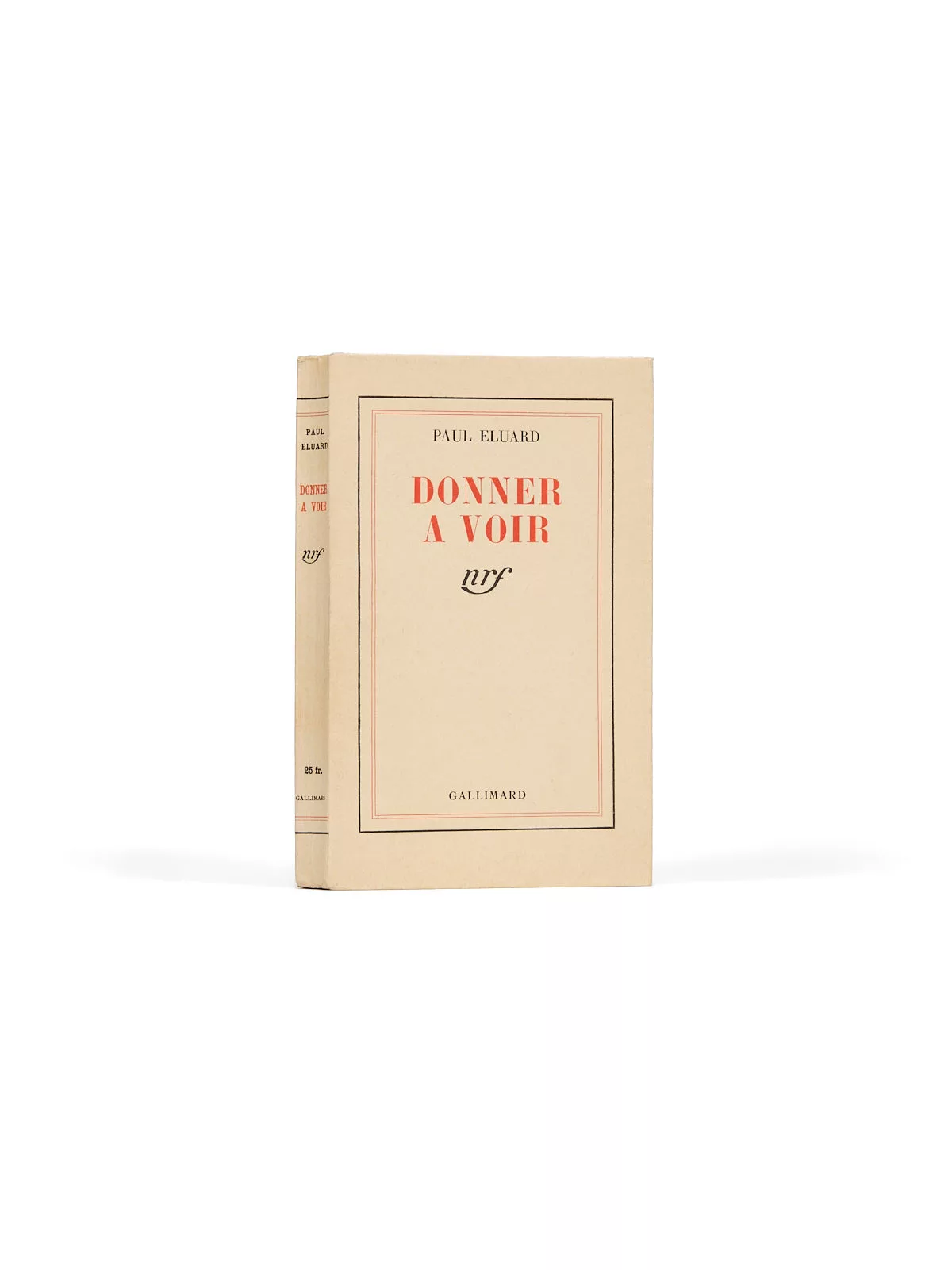
Donner à voir
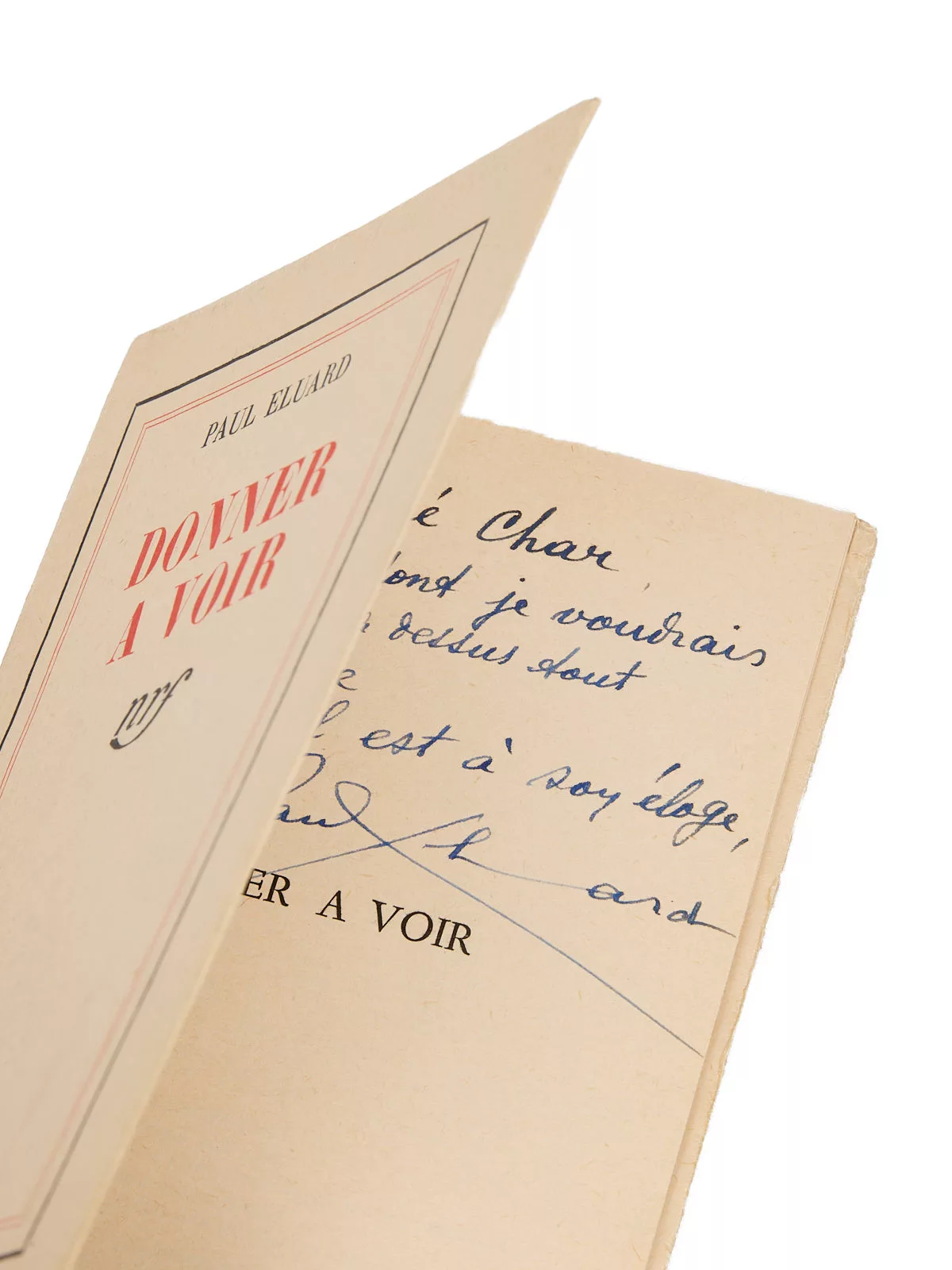
Presentation copy inscribed by Éluard to René Char: “à René Char, ce livre dont je voudrais par dessus tout qu'on dise qu'il est à son éloge, Paul Éluard.”
The last collection published before the outbreak of war, Donner à voir — another magnetically titled book — survives here in a copy deeply charged with meaning and literary history: it is inscribed by Paul Éluard to his friend René Char. It is the last collection Éluard would give him before five years without direct contact between the two men, who did not yet know that, at the end of the conflict, they would be the two great surviving poet-résistants — one through arms, the other through words.
Published in the spring of 1939 by Gallimard, Donner à voir is far more than a collection of poems. According to Lucien Scheler, it is “more than a poetic art, a truly revolutionary treatise on aesthetics” (Pléiade, p. XLIII). It gathers essential texts, some previously unpublished, others already in print but reorganized here according to a new inner logic. It contains the first publication of the poem “À Pablo Picasso,” which includes for the first time the line: “Tu as remis la tête sur le corps.” A direct tribute to his friend and fellow artist, written in the shadow of Guernica, it belongs to a particular moment for Éluard: a period of tension with André Breton, with whom he had just completed the Dictionnaire abrégé du surréalisme. Éluard was gradually distancing himself from Breton, deepening his friendship with Picasso instead. The previous summer, at Mougins, the two men had shared a sunlit interlude with Roland Penrose, Man Ray and their companions. By autumn, the rift with Breton widened further: on his return from Mexico, where he had met Trotsky, Breton demanded a total ideological break and urged the Surrealists to “sabotage Éluard’s poetry.” Some complied; others — Picasso, Ernst, Penrose — withdrew, refusing to follow this authoritarian line. Donner à voir appeared in the midst of this turmoil. Two months later, in September 1939, Éluard was mobilized.
The bond between Paul Éluard and René Char, for its part, was old, deep and never altered. Their friendship dated back to the late 1920s, when Char joined the Surrealist movement, and was cemented in 1930 by their collaboration on Ralentir travaux, co-written with Breton: “a fairly long book of thirty very fine poems, which Char’s printer is making for us for nothing, in 200 copies,” Éluard told Gala in April 1930.
Despite ideological fault lines — between Surrealism, Communism and aesthetic commitment — their friendship and mutual admiration endured through the dark years. During the war, the two poets maintained a silent dialogue, sustained by “the ideal of a united Resistance.” René Char, deliberately silent during the conflict, chose L’Éternelle revue, founded by Éluard in 1944, as the outlet for his first new poems.
It was at the Liberation that the two men finally met again. They once more exchanged their latest collections: Éluard gave Char Poésie intentionnelle; Char answered with a copy of Seuls demeurent, inscribed:
“à Paul Éluard, obstiné, exemplaire et pur,
comme l’homme que tout menace,
comme l’homme que rien n’atteint.”
Five years earlier, this copy of Donner à voir had already affirmed to René Char the bond of friendship between these two brothers-in-arms and in letters.
A good copy.
Fictitious second-edition statement, but with the correct first-edition printer’s imprint (achevé d’imprimer).