



Discours sur l’histoire universelle. Défense de la Tradition et des Saints Pères [Manuscrit]
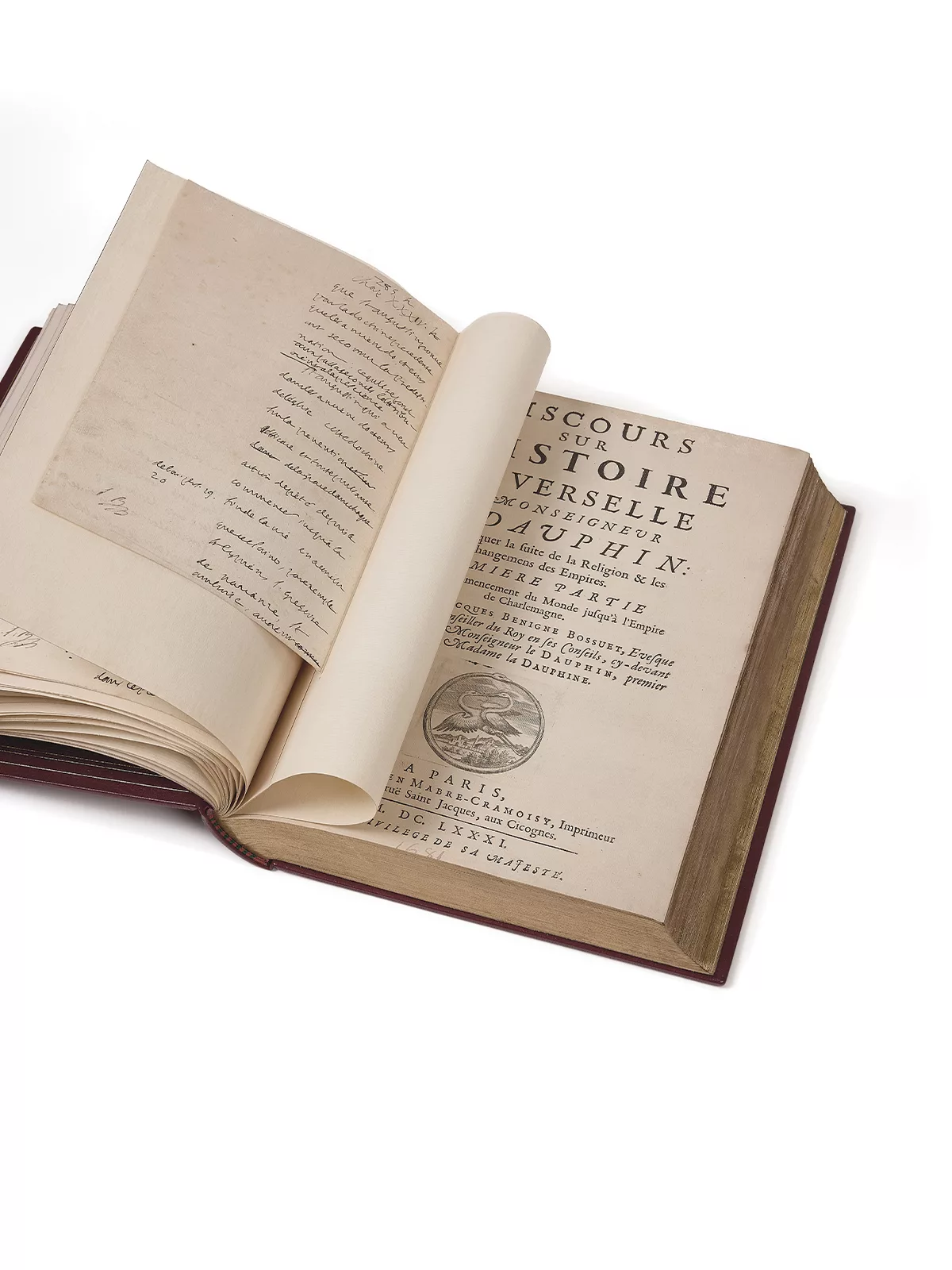
An exceptional copy, to which has been added a fragment of the manuscript of the Défense de la Tradition et des Saints Pères.
A coherent pairing: in these two texts, Bossuet takes aim at the theses of Richard Simon — implicitly in the Discours and its numerous additions from 1700 onward, explicitly in La Défense de la Tradition…, whose first part is devoted to exposing the errors Simon had cleverly concealed in his writings to avoid censorship, while the second part — to which this manuscript fragment belongs — is an apology for Saint Augustine and his doctrine on original sin, grace and predestination.
The first edition of the Discours sur l’histoire universelle.
This edition was produced by Sébastien Mabre-Cramoisy (1637–1687), grandson and heir of the great Parisian publisher Sébastien Cramoisy (1584–1669), whose works, issued under the device “Aux trois cigognes,” were largely devoted to religious subjects, his particular specialty. A favorite and protégé of the Court, and first director of the royal press at the Louvre, Cramoisy left his titles and the prestige of his imprint at his death to his grandson, whom he had trained.
The edition is decorated with two engraved vignettes after Le Pautre by Jolain (one at the head, depicting Time seated and holding the escutcheon bearing the Dauphin’s arms; the other at the end). The “second first edition” would be published in Paris by the same publisher, but in duodecimo format, containing a few minor corrections by Bossuet. Brunet notes that “some copies bear the address of Léonard, 1682, or that of Roulland, 1691,” and identifies as the “third first edition,” “revised by the author” (Paris, Roulland, 1700, or Michel David, 1703, duodecimo), “the last published in the author’s lifetime and the one with the greatest authority.”
The text:
“Faithful to the traditional conception that makes history a repository of lessons for the use of Princes,” this text was written by Bossuet while he was tutor to the Dauphin Louis de France, son of Louis XIV and Marie-Thérèse of Austria. Inspired by Saint Augustine’s City of God, the Discours divides “universal history” — at that time meaning the history of Europe and the Middle East, from the biblical account of Creation to the reign of Charlemagne — into thirteen chapters. Beyond its pedagogical purpose, the philosophical scope and political implications of the Discours sur l’histoire universelle make it one of Bossuet’s major texts, although posterity has chiefly remembered his (otherwise sublime) Oraisons funèbres. In 1681, the year the Discours first appeared, Bossuet, who had just completed his tutorship of the Dauphin, was named Bishop of Meaux and had become one of the most influential figures in the Church of France.
The manuscripts and printed material relating to this text are preserved at the BnF under nos. 12832–37. They include a copy revised and corrected by Bossuet, and a copy of the first edition published by Cramoisy in 1681, the same edition as the copy presented here. “This copy (in quarto format) bears numerous notes, corrections, deletions and divisions in Bossuet’s own hand, made in preparation for the third edition he himself issued in 1700.” Bossuet continued revising this text, which he considered fundamental, until his death, leaving behind numerous manuscript notes after the third edition that would later serve the definitive edition prepared by Abbé Caron.
The manuscript fragment of the Défense de la Tradition et des Saints Pères:
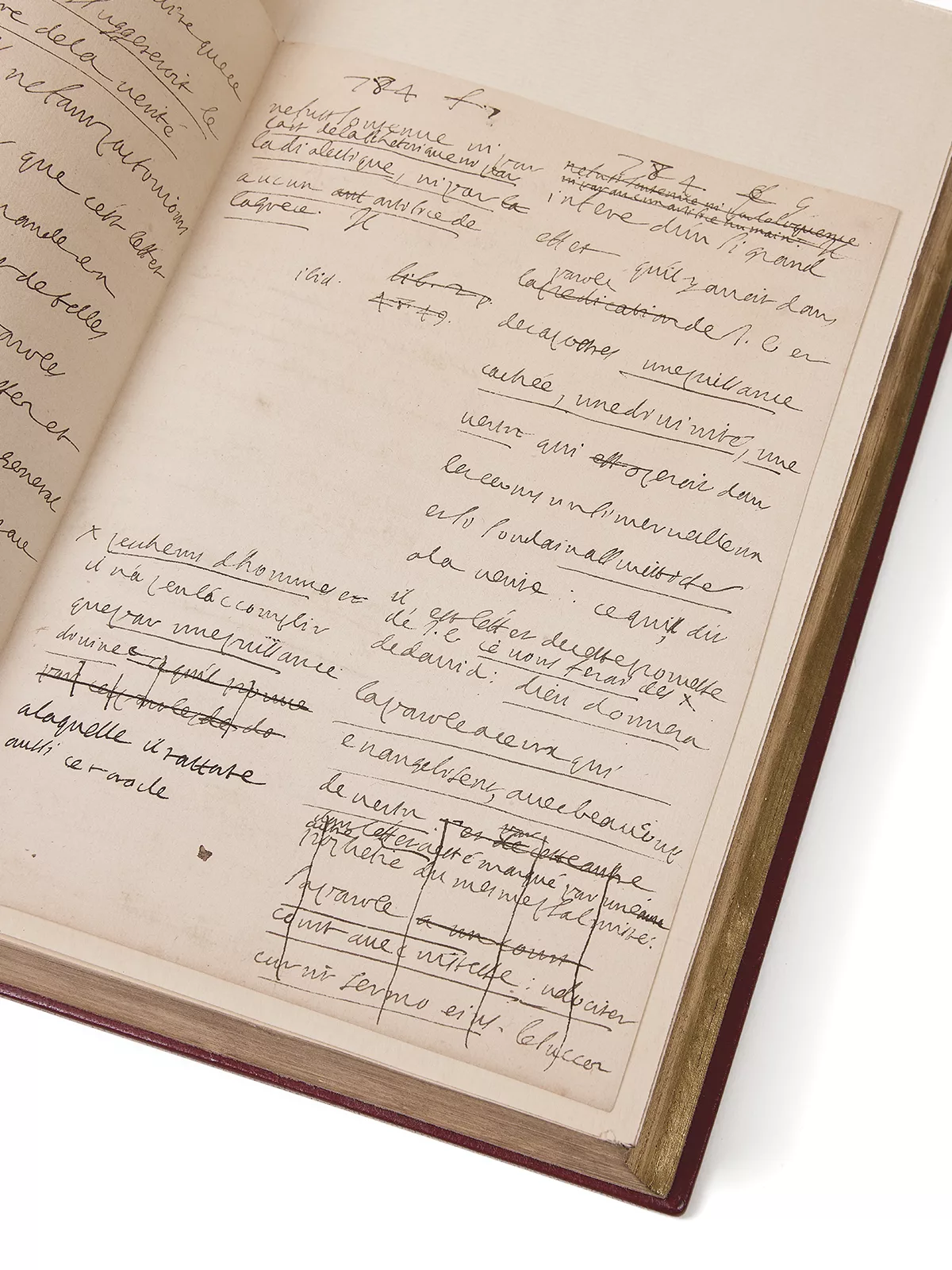
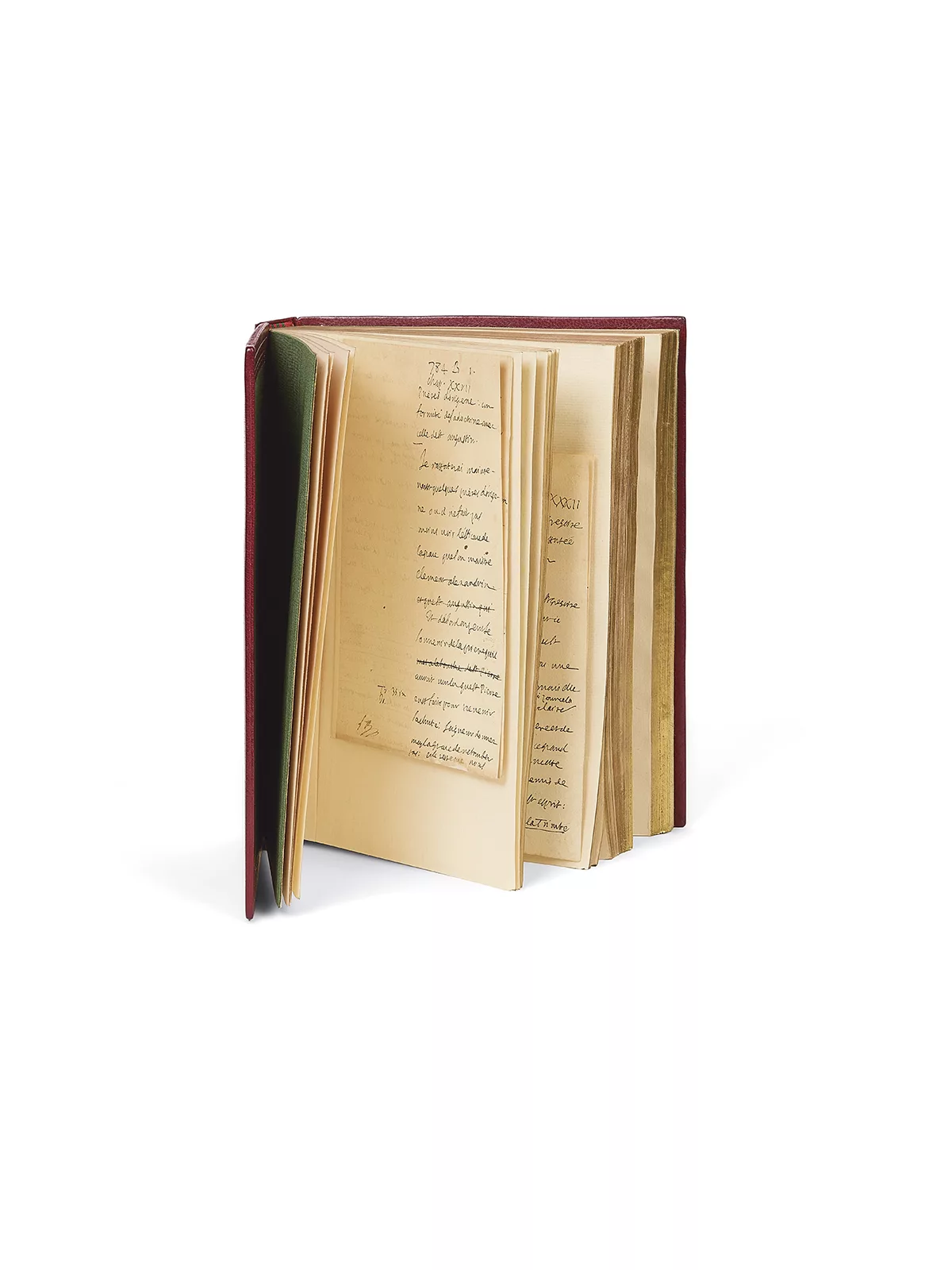
The manuscript bound at the head of this copy of the Discours sur l’histoire universelle (1681) is a fragment of the Défense de la Tradition et des Saints Pères, first published posthumously in 1753. It corresponds to six of the final chapters of this substantial work, whose printed edition runs to about a thousand pages.
The context of the Défense de la Tradition…:
In it, Bossuet refutes the thesis of the priest and scholar Richard Simon (Dieppe, 1638–1712) on the doctrine of Saint Augustine (Bossuet’s undisputed master), as set out in Simon’s work published in 1693 by Reinier Leers in Rotterdam (to escape censorship) under the title Histoire critique des principaux commentateurs du Nouveau Testament. Celebrated for his mastery of the sermon, Bossuet also excelled in the art of controversy, an art much needed in an age when the doctrines of Calvin and Luther were widely circulating. “With his customary gentleness, he confounded false systems without wounding anyone, and forced heretics to admit defeat; he never forgot the great rule of all religious discussion: unity in what is necessary, liberty in what is doubtful, and charity in all cases.” (Histoire de Bossuet, Ardant et Thibaut, 1868).
This substantial polemical text, which Bossuet did not have time to have printed and on which he worked until his death, was first published in the second volume of his Œuvres posthumes (Amsterdam, Aux dépens de la Compagnie, 1753), then in a separate edition under the title Défense de la Tradition et des Saints Pères (Paris, Hérissant & Estienne, 1763). It is arranged in two parts, the second being the more important. The first contains Books I to IV, and the second Books V to XII — this last book being where our manuscript, containing 6 of its 39 chapters, belongs. Bossuet drafted a Book XIII, which was not published until later and appears in neither the Œuvres posthumes (1753) nor the separate edition (1763).
Of the Défense de la Tradition…, only the near-complete manuscript of this Book XIII (Part II, 292 leaves) is known today, along with a working copy preserved at the BnF under shelfmark NAF 28227 (13) in the Bossuet collection, originating from the library of the Grand Séminaire de Meaux, and described by Bourseaud as “very incomplete.” Like our manuscript, it is laid out in two columns, but its left-hand column is in a hand other than Bossuet’s, with only the notes, corrections or additions on the right being autograph, whereas our fragment is entirely in Bossuet’s hand. In the lower right margin, as on our autograph manuscript, appear the initials “LB” of Father Vivien de la Borde (1680–1748), a friend of Bossuet’s nephew, the Bishop of Troyes (1664–1743). The nephew, who inherited his uncle’s papers, was the first to undertake their classification and to plan their publication with La Borde’s help. “Bossuet himself published only part of his writings. Between 1655 and 1704, he issued 75 or 80 of them; his nephew published 7 or 8 between 1709 and 1741, and all the rest were printed between 1745 and 1897.” (Bourseaud, Histoire et description des manuscrits, p. XXVII). The gradual dispersal of Bossuet’s very extensive manuscript collection, following the deaths of his nephew and of La Borde — part of which entered the royal library’s collections in 1817, while other portions were sold privately by the bookseller Lamy — may explain the survival of these leaves, fortunately preserved thanks to the initiative of whoever commissioned the binding of our copy. It should be noted that the significant number of Bossuet manuscripts in the James de Rothschild collection consists mostly of letters.
Details of the manuscript fragment of the Défense de la Tradition et des Saints Pères:
38 pages on 20 leaves (135 x 195 mm) of laid paper, numbered “784 B 1 to 784 B 6, 784 D to 784 Z (except I, V, W), 784 AA to 784 HH, and 785 A to H,” and initialed “LB” in the lower left margin. The text is arranged in two columns: the right-hand column for the text itself, the left-hand column for notes, references, additions and corrections. Passages underlined by Bossuet appear in italics in the printed edition.
This fragment covers chapters XXVII to XXXIV of Book Twelve, “The Constant Tradition of Saint Augustine’s Doctrine on Predestination,” from the second part, “Errors Concerning Original Sin and Grace.” The beginning of chapter XXVIII, “Other Prayers of Origen…,” and the end of chapter XXXIV are, however, missing.
Chapter titles as noted by Bossuet:
– chap. XXVII: “Prayers of Origen: agreement of his doctrine with that of St. Augustine”;
– chap. XXVIII–IX: “God does what He wills, both in good and in evil: a fine passage from Origen showing that God kept the persecutors in check”;
– chap. XXX: “The great power of the Doctrine and Grace of Jesus Christ, how demonstrated and explained by Origen”;
– chap. XXXI: “That this grace acknowledged by Origen is prevenient, and how it relates to Prayer”;
– chap. XXXII: “Prayer of St. Gregory of Nazianzus, reported by St. Augustine”;
– chap. XXXIII: “Prayer of Guillaume, Abbot of St. Arnoult de Metz”;
– chap. XXXIV: “St. Augustine proves that the earlier Doctors recognized the preceding doctrine of Predestination: his response to passages where they attribute it to foreknowledge.”