

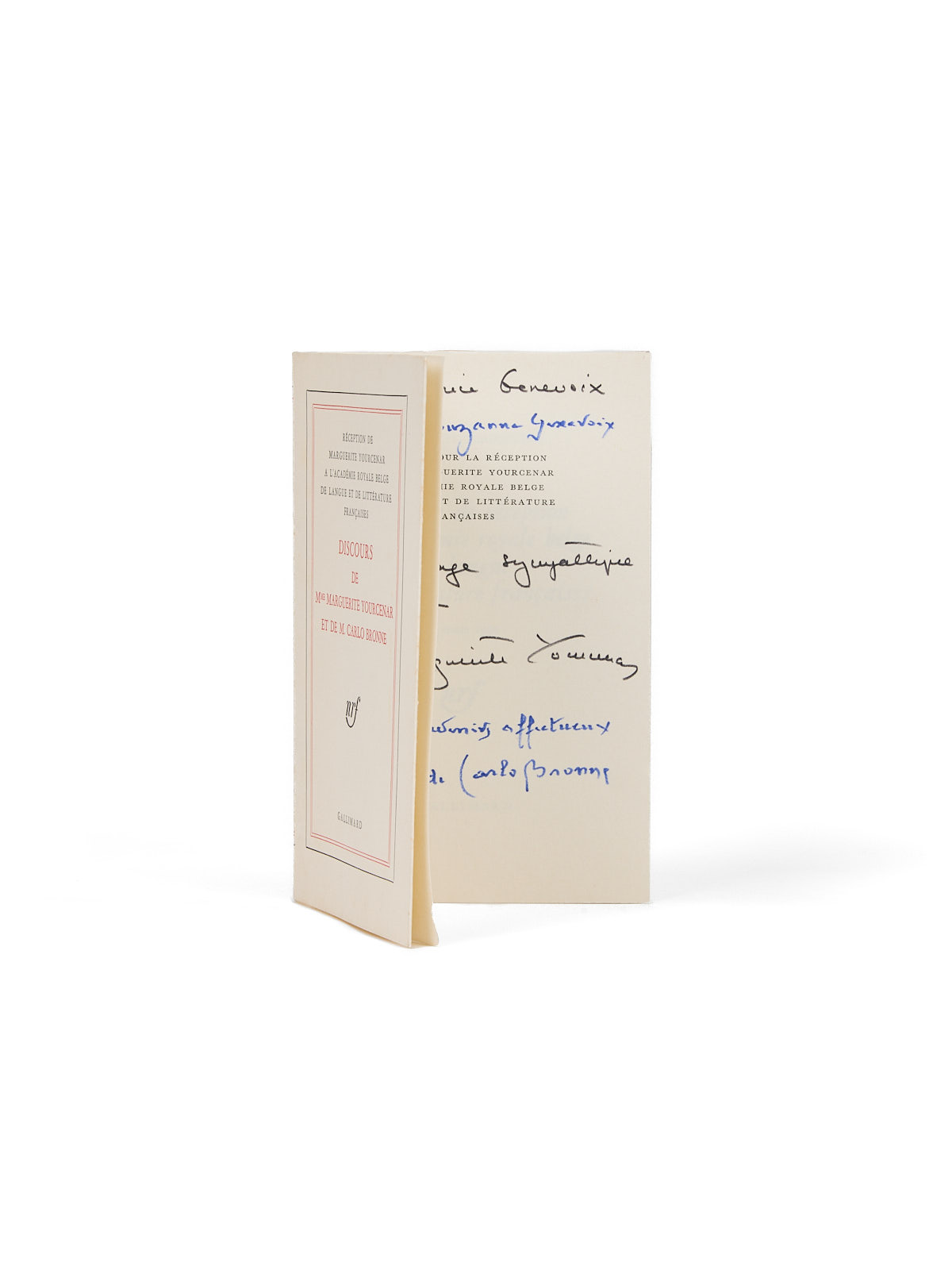
Discours de réception à l’Académie royale belge…
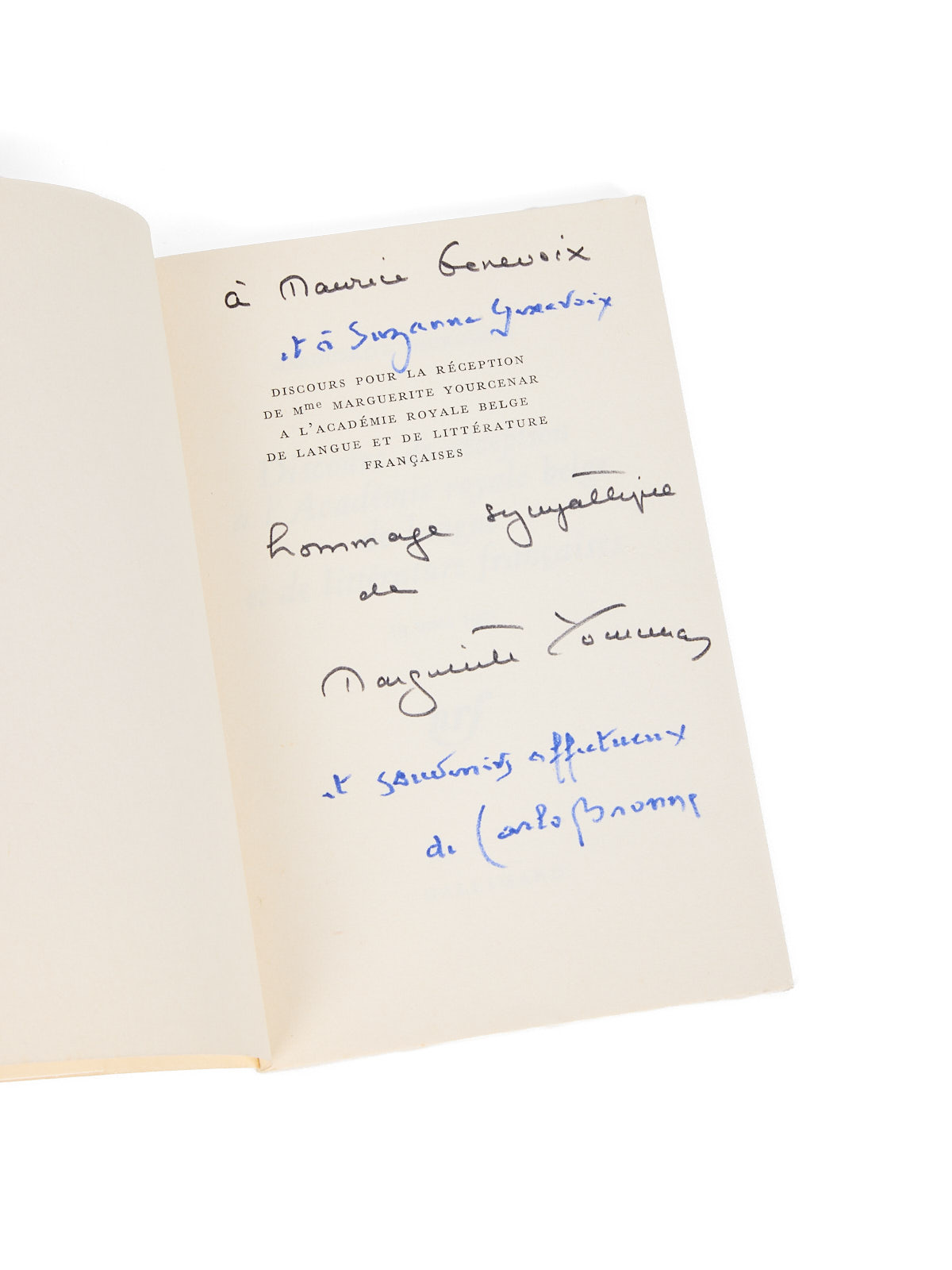
Crossed presentation inscriptions, in black and blue felt pen: “à Maurice Genevoix, hommage sympathique de Marguerite Yourcenar”; “et à Suzanne Genevoix, souvenirs affectueux de Carlo Bronne.”
The Académie de Langue et de Littérature françaises was founded in 1919 at the instigation of Jules Destrée, Minister of Sciences and Arts in the first post-war national unity government, with the king’s approval. Its founding principles were remarkably progressive: it advocated electing foreign members from every country where French was spoken, thereby anticipating, avant la lettre, the notion of Francophonie. It also recommended the election of women members, arguing that “in recent years, women of letters have given too many undeniable proofs of talent for one to consider excluding them from a literary Company.”
The Academy was to comprise 30 Belgian members and 10 foreign members, with the aim of studying, practicing and promoting the French language and literature; unlike the Académie française, it does not compile a dictionary and imposes no particular costume or insignia on its members. Marguerite Yourcenar was received into it on 27 March 1971, before a packed hall and in the presence of Queen Fabiola.
Maurice Genevoix was present: the permanent secretary of the Académie française had come to present the Prix Habif, the Grand Prix for French literature written outside France, to the Canadian writer Anne Hébert.
Less than ten years later, on 6 March 1980, Yourcenar was elected to the Académie française at the quai de Conti. She was received in January 1981: a ceremony Genevoix did not attend, having died on 8 September 1980. In her address, she bore no grudge against those who had, until the end, opposed her election: “One cannot therefore claim that in this French society, so imbued with feminine influences, the Academy was particularly misogynistic; it simply conformed to customs that readily placed women on a pedestal, but did not yet allow one to officially offer them a seat. I have no reason, then, to take pride in the honor done to me, however great, but almost fortuitous and, on my part, almost involuntary; I have all the more reason to thank those who extended their hand to help me cross the threshold.”