

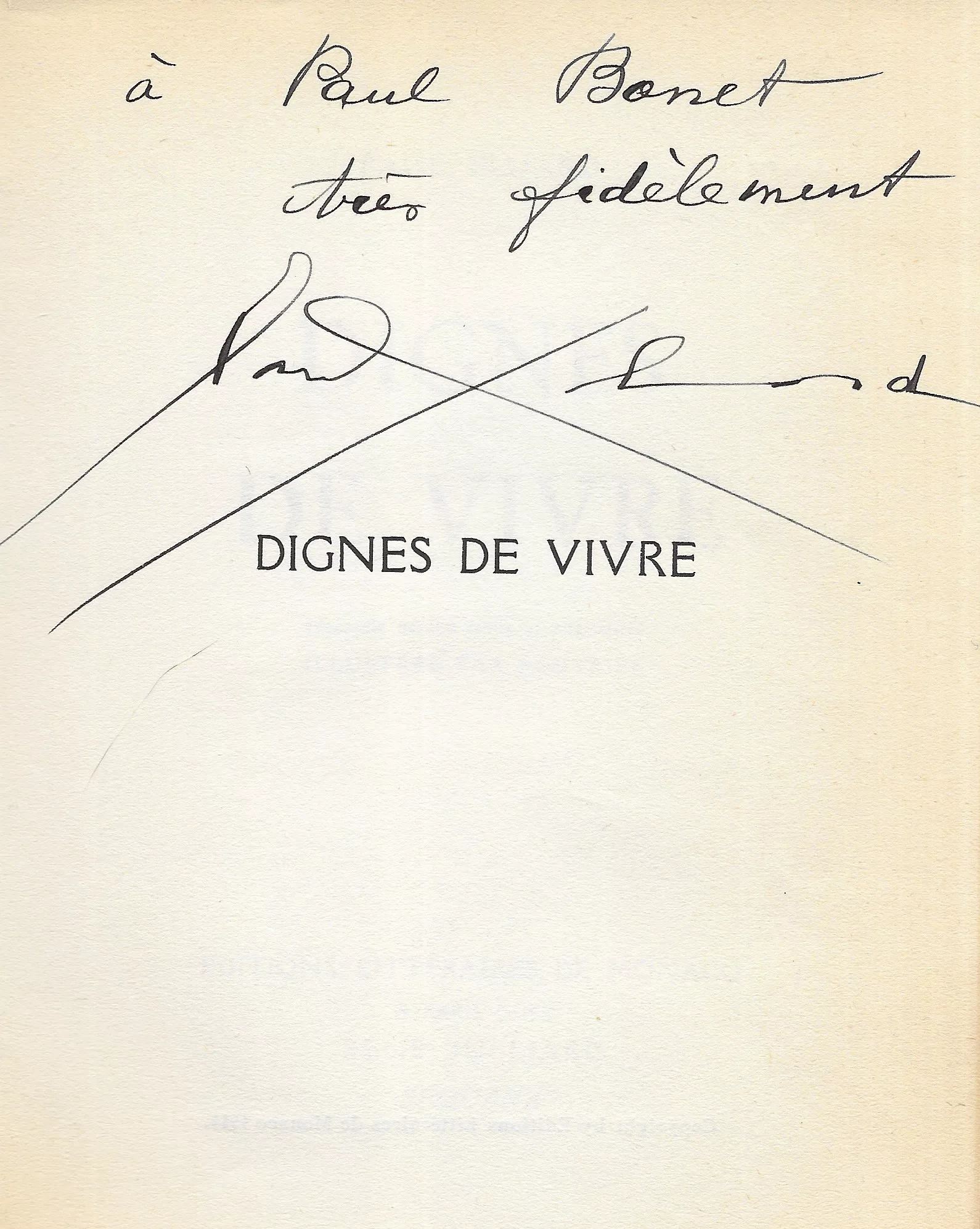
Dignes de vivre. Illustrations par Fautrier
Inscribed and signed by Éluard to Paul Bonet: “à Paul Bonet, très fidèlement, Paul Éluard.”
Éluard did not meet Fautrier until the end of the war, through Paulhan, and was fascinated by the painter’s recent work: replacing canvas with heavily sized paper, Fautrier carved reliefs using a process of his own invention, building up the surface with layered papers, pastel, glue and oil paint.
The curves of Dignes de vivre, however, are pen drawings, which delighted Éluard, who declared himself “marvelling at my great Fautrier — the reddish man with the open belly.” Reworking the second edition of Poésie et Vérité 1942, Éluard added several poems, removed the poem “L’Âne,” and gave the collection a new title, Digne de vivre. The volume is thus a reworking and expansion of Poésie et Vérité 1942, hence its subtitle “Édition nouvelle, revue et augmentée.”
A fine copy of exceptional provenance. Éluard first met Paul Bonet in the 1930s; the binder had been established since 1924, four years after discovering bookbinding. He was thirty-five, and his first bindings were exhibited the following year at the Musée Galliera and at the Exposition des Arts du Livre Français, where his talent went unnoticed. Nonetheless, as he notes in his Carnets, these exhibitions “earned me a few commissions for half-bindings (…). That was my real beginning, and I knew no bibliophiles.” Invited to Brussels by the bookseller Simonson, he met René Gaffé, who entrusted him with his first bindings of Surrealist authors: first the complete run of La Révolution surréaliste, then four titles by Aragon — Anicet, Le Traité du style, Le Libertinage and Le Paysan de Paris. The Manifeste du surréalisme and Ralentir travaux followed, leading to Bonet’s meeting with André Breton and Paul Éluard.
Éluard was the first to entrust him with work — beginning with his own copy of Nadja in February 1931 — while Breton commissioned a group of bindings and half-bindings from him in October, noted by Bonet in his Carnets as “various other bindings on works by Breton and Éluard,” made for the two poets and for the bibliophile René Gaffé.
Thereafter, Bonet continued to work closely with Éluard, both out of friendship and shared bibliophilic sensibility. Along with Apollinaire (whom Bonet never knew personally), Éluard is the poet whose work he bound most often: 75 copies, not counting the half-bindings. Only Apollinaire was (far) better served, with 149 recorded bindings, owing to a larger number of patrons.