

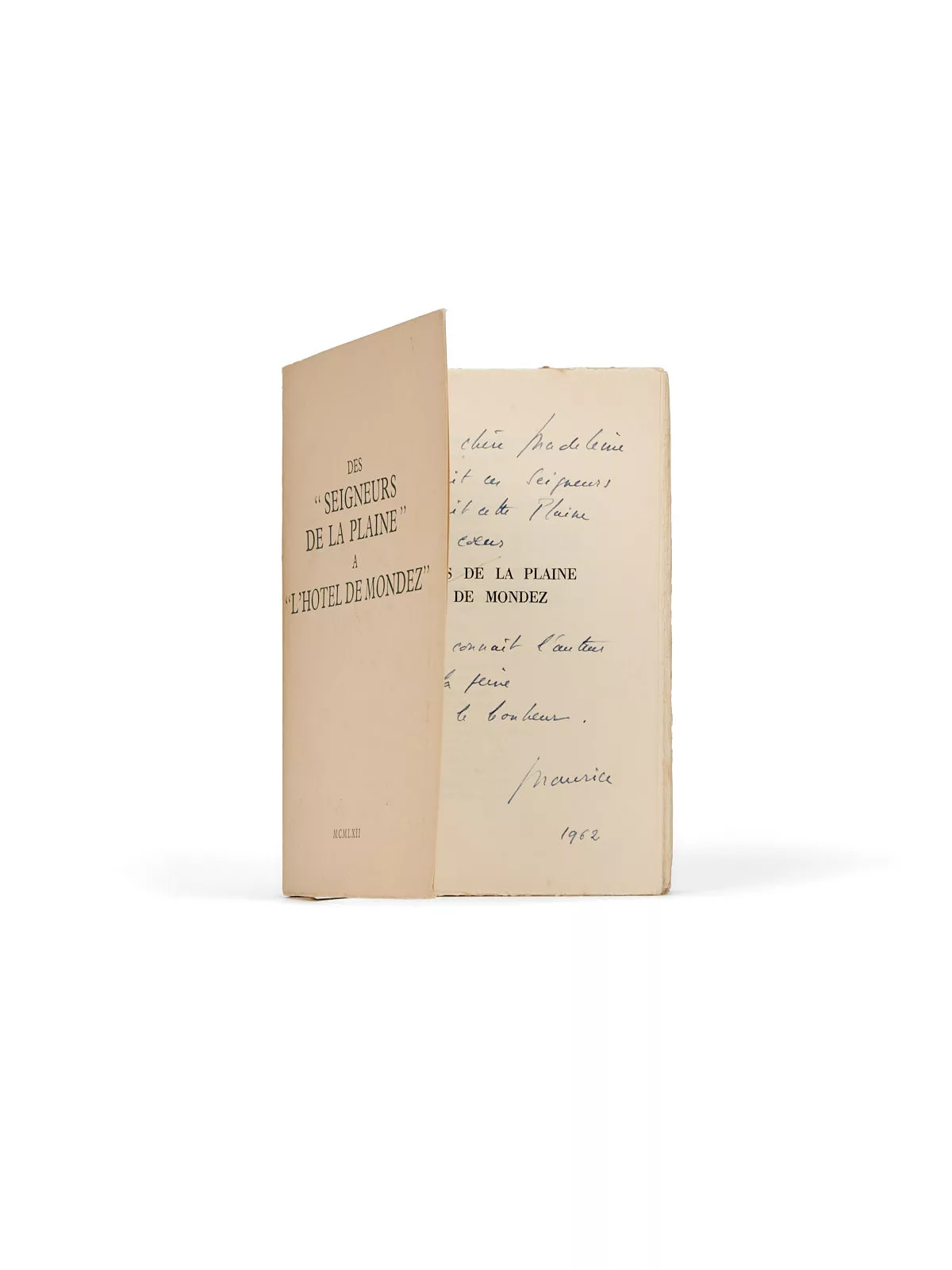
One of 50 copies on alfa d'Avignon paper from the deluxe issue, this one a hors commerce copy reserved for the author.
Signed presentation inscription: “Pour ma chère Madeleine qui connaît ces Seigneurs et connaît cette Plaine par cœur, comme elle connaît l'auteur dans la peine et dans le bonheur. Maurice, 1962.”
The first story, Le Sonneur de Bien Aller, appeared in the review Littérature in 1943 and is one of the very first texts written by Druon, composed together with Joseph Kessel in the south of France, at Anthéor, at the foot of the Esterel, in the refuge villa of Germaine Sablon.
It was there, in this sort of phalanstery on the Riviera, that Druon and Kessel lived for several months between 1941 and 1942, fleeing Vichy and dreaming of a future of writing and action. Kessel wrote Les Maudru there and began Le Tour du malheur, while Druon shaped his earliest texts — Mégarée, La Dernière Brigade… and this Sonneur de Bien Aller, the first milestone of a body of work still to come.
This medieval, fantastical tale, steeped in rural tradition, hunting and hunting-horn calls, depicts an archaic and brutal world. It evokes a collective memory on the verge of disappearing, a world before the machine, populated by lords and servants, superstition and bloody struggle. This rough-hewn tale is the first — and, with “L’Hôtel de Mondez” which closes the collection, the longest — of the thirteen stories making up the collection Des Seigneurs de la plaine, published twenty years later. The whole collection, composed before Les Rois Maudits, already announces the world of the great saga to come.
An important copy, presented to the woman who was then only his private secretary, but already his confidante: Madeleine Marignac.
Born in Spain into a family of peasant stock from the southwest of France, Madeleine Mérignac was the daughter of an officer of the Légion d’honneur who died prematurely. Raised strictly, she received a demanding education at the Maison d’éducation des Demoiselles de la Légion d’honneur, before training as a secretary at Pigier. Independent and serious-minded, she lived modestly on the rue de Grenelle, a few streets from Maurice Druon.
She met Druon upon the publication of Les Grandes Familles and became his secretary, typing his manuscripts with remarkable orthographic and syntactic rigor. Present at every stage of the writing of Les Rois Maudits, she became a discreet but constant collaborator. Her name appears from volume I to volume VI — a feat she shares only with Pierre de Lacretelle and Georges Kessel.
Over the years she became his confidante, then his companion, supplanting Edmonde Charles-Roux in Druon’s heart. Their relationship became official in 1967, when he was elected to the Académie française, and the couple married the following year.