

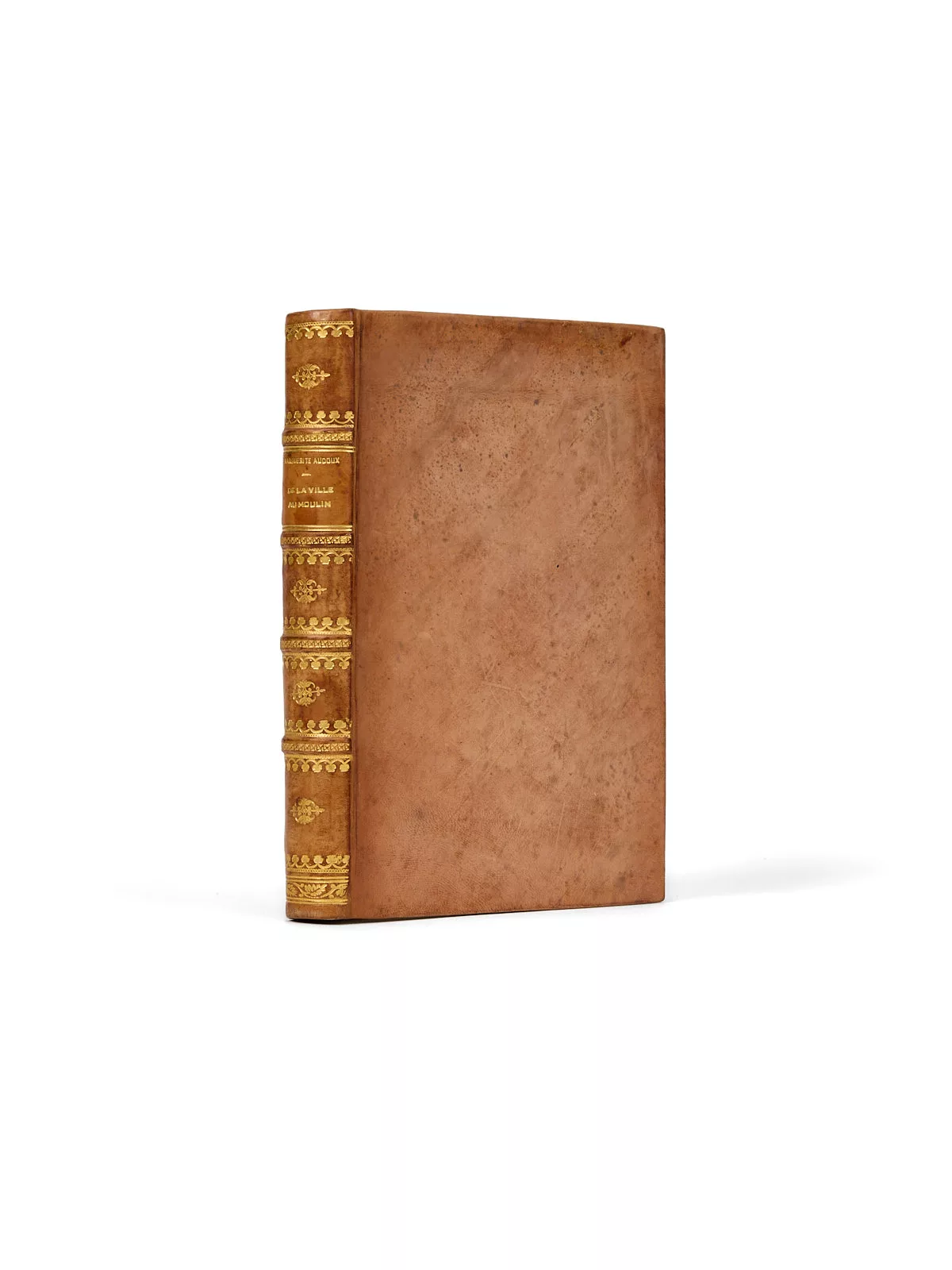
De la ville au moulin
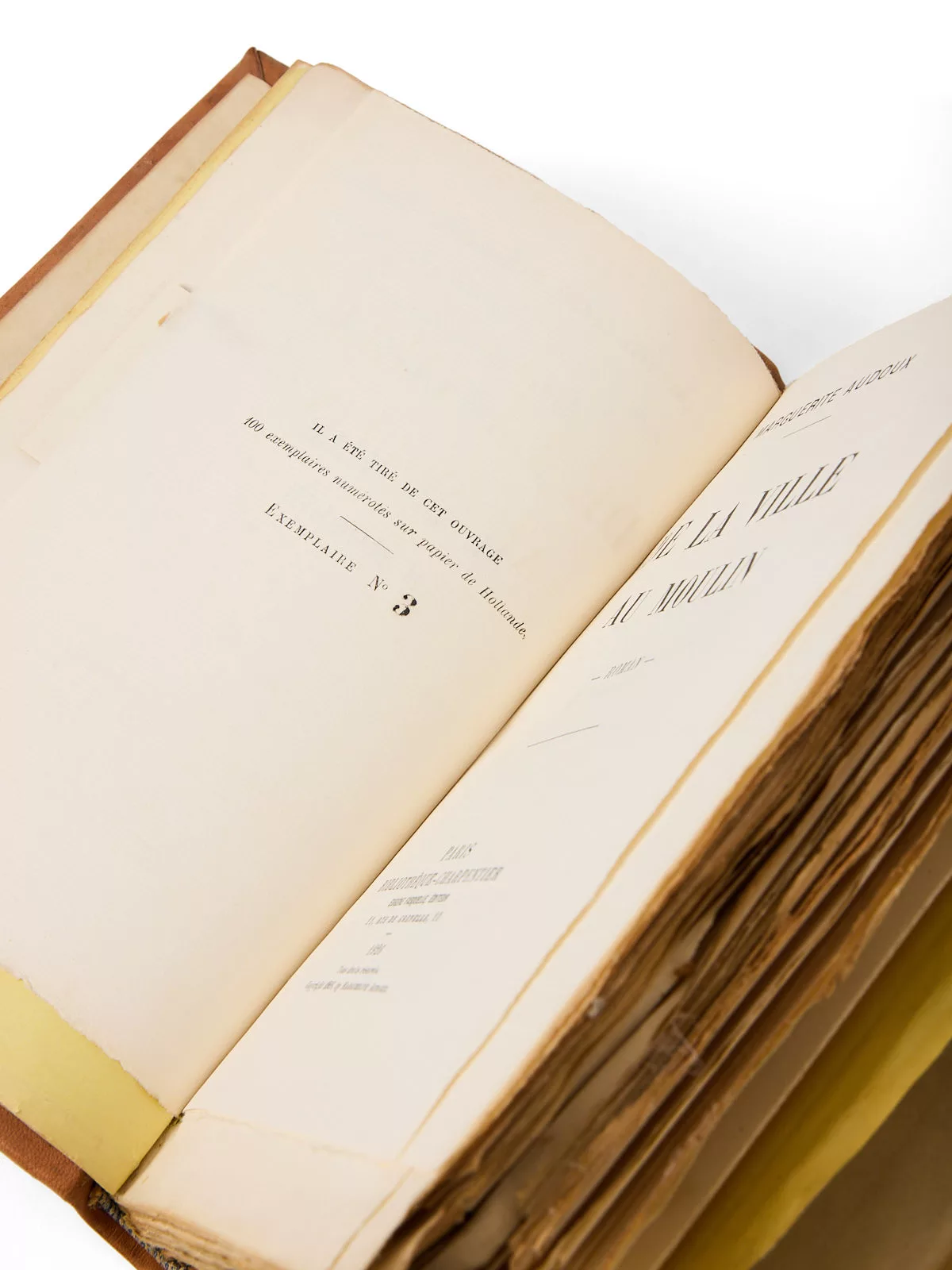
One of 100 deluxe copies on Holland paper (no. 3).
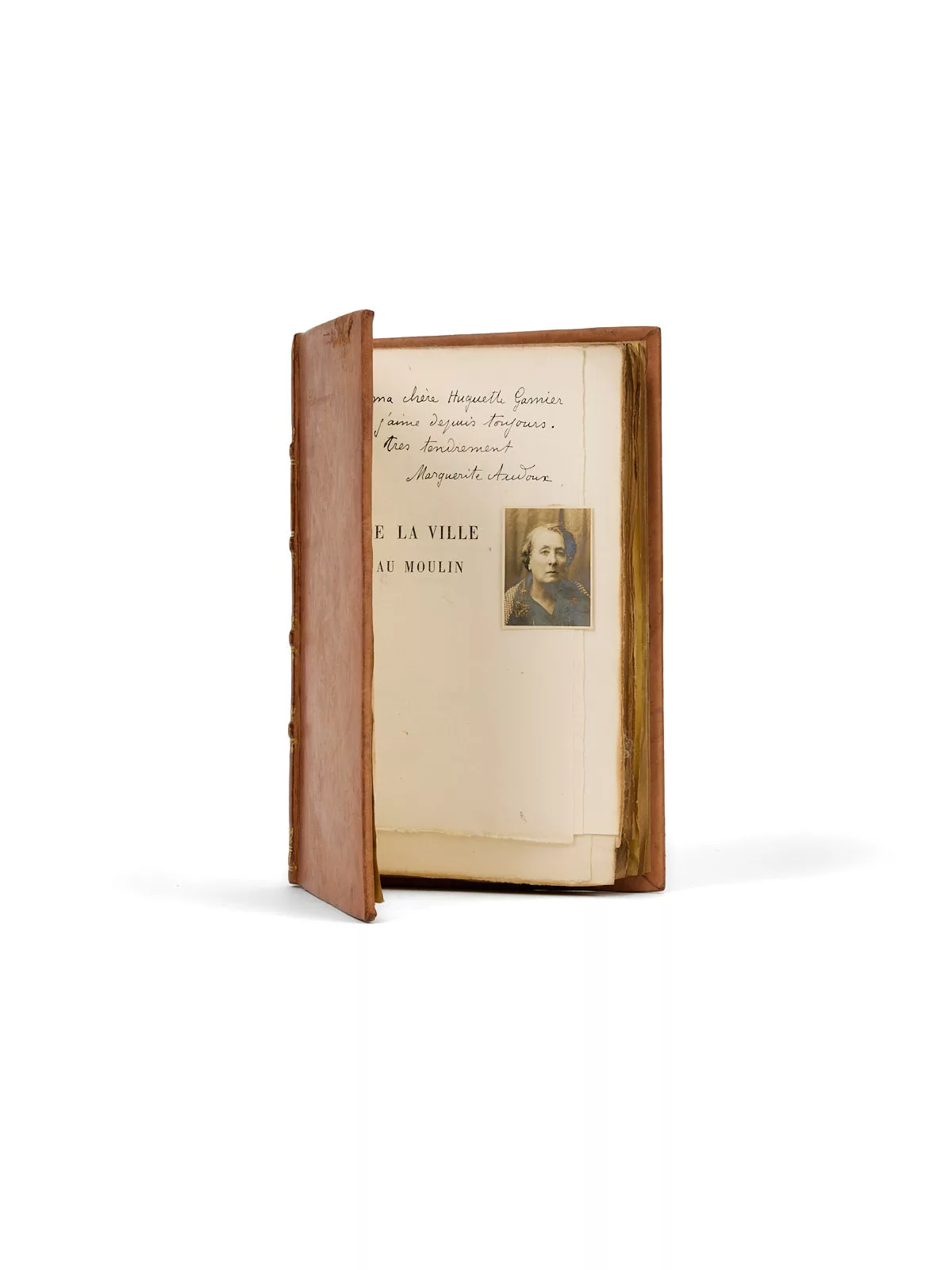
Signed presentation inscription: “à ma chère Huguette Garnier que j'aime depuis toujours. Très tendrement, Marguerite Audoux.”
The recipient of this inscription added to it a photographic portrait of her dear friend.
On 4 December 1910, the Prix Vie Heureuse (later the Prix Femina) was awarded to a novelist from the working class, Marguerite Audoux. Her novel Marie-Claire sold more than seventy thousand copies. On 5 March 1937, the title would be revived by the magazine of the same name in her honor, this former seamstress turned writer. Audoux, who had also worked as a shepherdess, farm servant, cook, warehouse worker and laundress, straddled two centuries, rose through the social ranks and wrote four novels. After Marie-Claire, she published L’Atelier de Marie-Claire in 1920 and De la ville au moulin in 1926. Douce lumière, published posthumously, appeared in 1937.
Born in Sancoins on 7 July 1863, Audoux lost her mother at age three, and her alcoholic father abandoned her when she was only eight. She was taken in at the Hôpital général de Bourges, where she learned and practiced sewing. At fifteen, she was sent to a farm in Sologne to tend sheep; she ran away and reached Paris in 1881, where she worked various small jobs before succeeding in setting up her own dressmaking workshop, which she opened in 1895. She spent what little free time she had writing. The publication and success of Marie-Claire, with a preface by Giraudoux, brought better days; she became a close friend of Alain-Fournier, Valery Larbaud and Octave Mirbeau, to whom she dedicated De la ville au moulin.
A fine copy given to her friend Huguette Garnier. “Her novels, with inscriptions, are held in the library of the ‘seamstress of letters’ at the Musée Marguerite-Audoux in Sainte-Montaine: Le Cœur et la Robe, Ferenczi, 1922 (‘A la bonne Marguerite Audoux que j’aime, sa blonde Huguette Garnier’); Quand nous étions deux…, Ferenczi et fils, 1923 (‘À Marguerite Audoux avec l’affection de sa blonde Huguette Garnier’); La Braconnière, Flammarion, 1927 (‘À Marguerite Audoux, sa soeur Huguette Garnier’); La Maison des Amants, La Nouvelle Revue critique, 1927 (‘À ma douce et chère Marguerite Audoux, avec toute la tendresse de sa blonde Huguette Garnier’).” (Archives Marguerite Audoux, EMAN, online).
A letter of 11 April 1923 from Alice Mirbeau — Octave Mirbeau’s wife — asks Marguerite Audoux about her: “I would have written to you in the coming days to ask whether Mme Huguette Garnier is a friend of yours.” Evidently she was! A letter from Audoux to Garnier, dated September 1921, began: “Arrive! arrive! ma blonde jolie.”
Huguette Garnier mounted a photographic portrait of her dear friend onto the page bearing the inscription.
Georges Reyer, Marguerite Audoux, un cœur pur, Paris, Grasset, 1942; Bernard Marie Garreau, Archives Marguerite Audoux, eman-archives.org.