

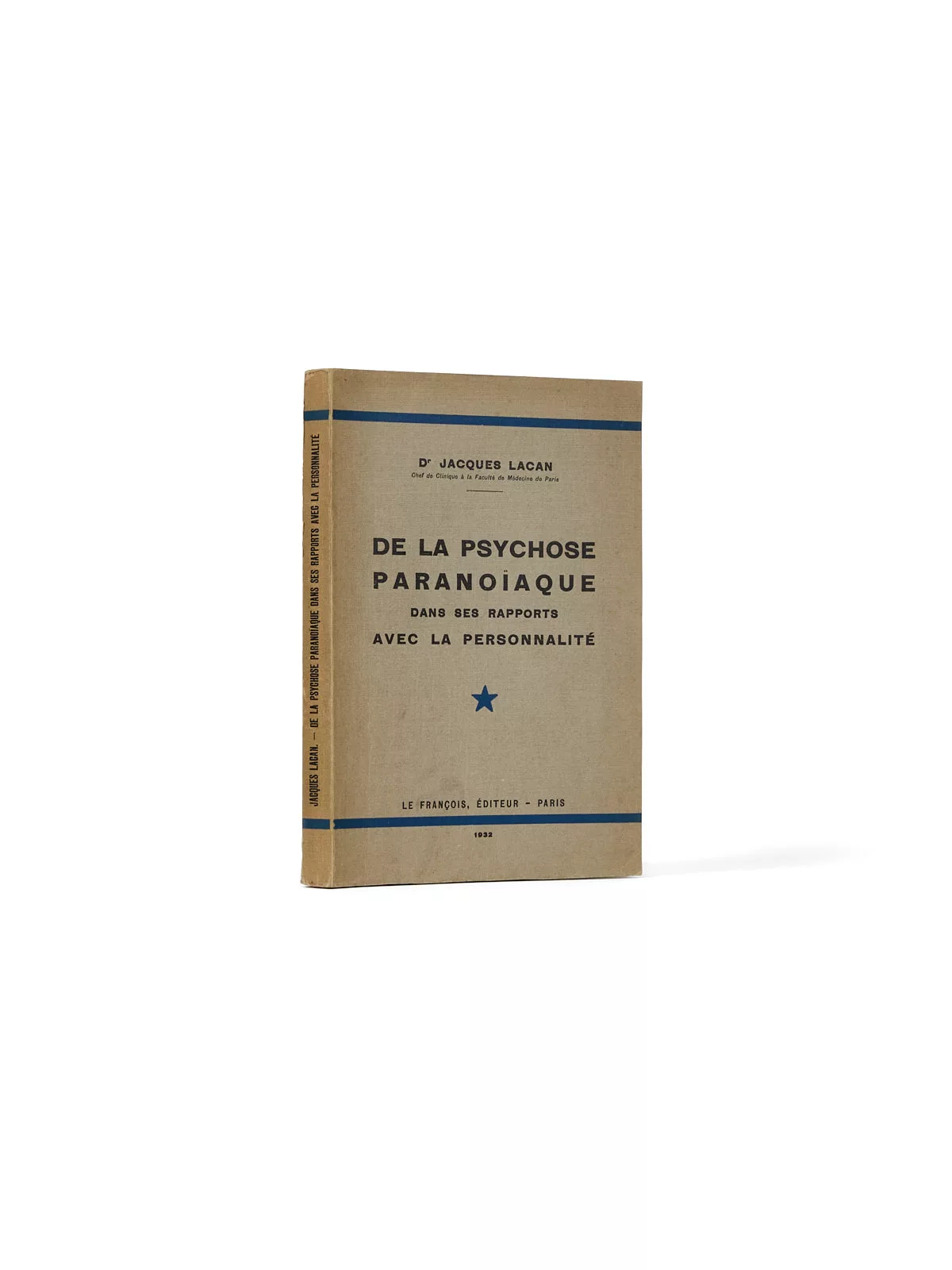
On 18 June 1931, at the Sainte-Anne hospital, Lacan first encountered Marguerite Anzieu, née Pantaine (1892–1981). Hospitalized after attempting to stab the actress Huguette Duflos, whom she believed was threatening the life of her young son Didier, the patient captured Lacan’s full attention, “who made of her a case of erotomania and self-punishing paranoia. Between the psychiatrist and Marguerite there was never the slightest understanding. She sought no treatment or care, and he made no attempt to persuade her to see herself as a patient, for his interest in this woman was solely to illustrate his theory of paranoia” (Élisabeth Roudinesco, Lacan, envers et contre tout, 2011). Two years later, building on this case study, Lacan completed his doctoral thesis, La psychose paranoïaque dans ses rapports avec la personnalité.
Lacan “[…] defended it in 1932 before a jury chaired by Henri Claude. In this thesis, he did not hesitate to propose a renewal of psychiatry: a partial renewal, grounded in psychoanalysis, which led him to introduce psychosis into the field of psychoanalysis through paranoia, rather than through schizophrenia as Jung had done. The thesis was published by Le François in Paris […]. The publication was noted by Paul Nizan in L’Humanité, by René Crevel in Le Surréalisme au service de la révolution, by Salvador Dalí in Le Minotaure, and by Jean Bernier in La Critique sociale (a Marxist review founded by Boris Souvarine)” (Jacques Sédat). Lacan was also awarded the Jules Baillarger prize — named after a nineteenth-century alienist — from the Académie nationale de médecine, announced on 13 March 1934 and conferred on Lacan on 11 December.
The Le François edition of the thesis exists in two nearly identical states, sharing a common printing date of 1 October 1932: the entire edition was printed before the defense, which took place in early November, with Henri Claude presiding over the jury. At the time, Lacan was involved with Marie-Thérèse de Bergerot, fifteen years his senior, and then with Olesia Sienkiewicz, the second wife of his future friend Pierre Drieu la Rochelle. The former typed the thesis; the latter financed its printing by the scientific publisher Le François.
As soon as it was printed, some two weeks before his defense, Jacques Lacan gave away a number of copies of his thesis — first to his parents, then to colleagues within his immediate circle, continuing until 1933. Less than a month after his defense, in November, he was appointed by prefectoral decree “Chef de clinique titulaire de la clinique de neuropsychiatrie infantile de l’Asile clinique de l’hôpital Sainte-Anne.” Whether at his own request or at the initiative of his publisher Le François, it was decided to add this appointment to the publication: the wrappers and title pages were accordingly altered, adding beneath his name the words “chef de clinique à la Faculté de Médecine de Paris.” This copy belongs to the second state, bearing the mention “Chef de clinique.”
This alteration probably occurred in early 1933. Of the total print run of the thesis, estimated at around a hundred copies, those not given away in 1932 and 1933 remained available at the publisher’s for a long time, until Lacan decided to buy them back from Le François — in order to destroy them. This was in 1952, precisely when he agreed to take Didier Anzieu into analysis: the grown son of Marguerite Pantaine-Anzieu, the subject of his thesis twenty years earlier, without ever informing him of the connection!
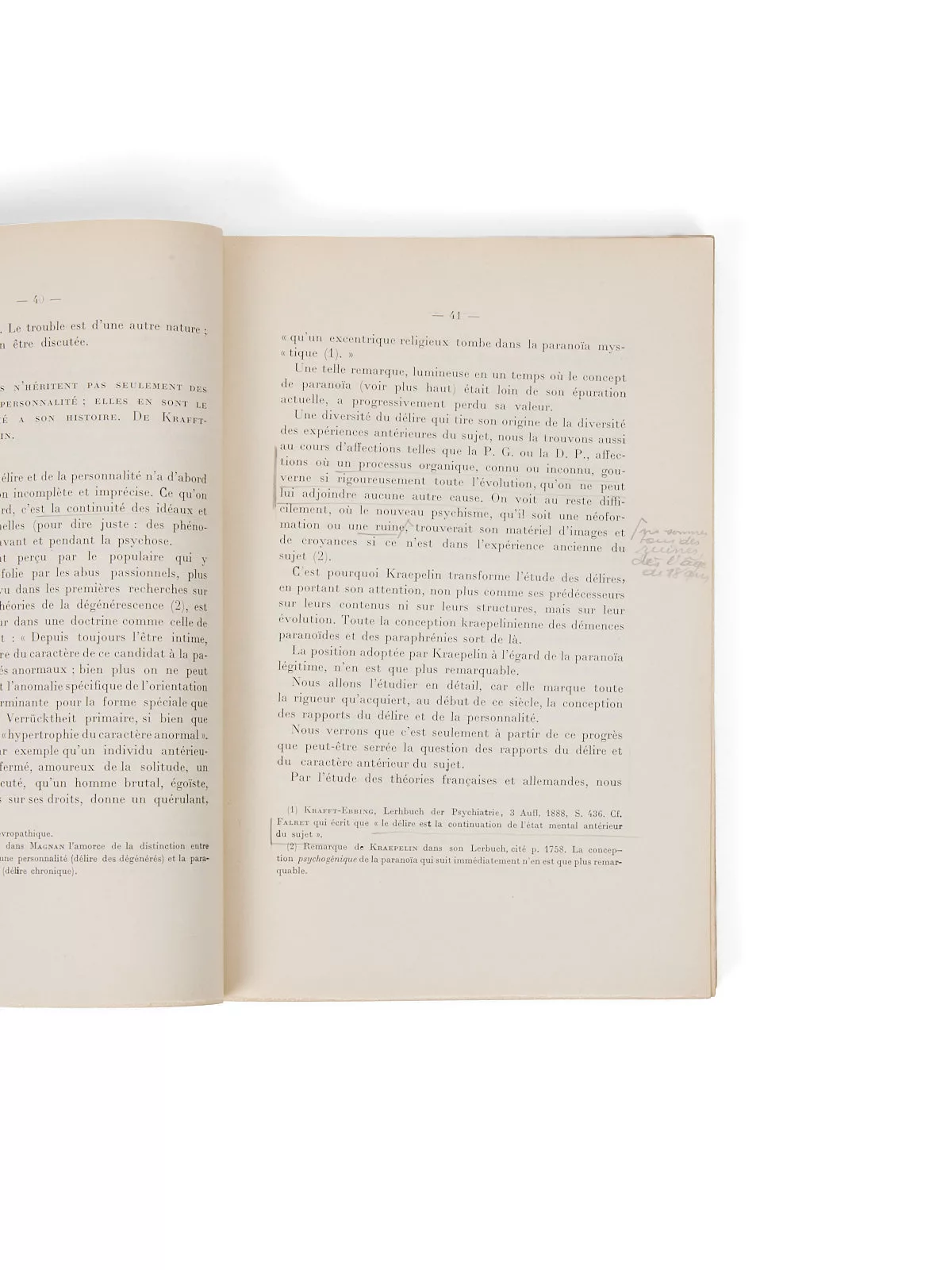
A few annotations in pencil, in an unknown hand.
To date, 24 inscribed copies and around twenty unsigned copies have been recorded elsewhere, the latter mostly belonging to the second printing.
Jacques Sédat, “Lacan et la psychiatrie, Lacan et les psychiatres,” in Topique, no. 88, pp. 37–46.