

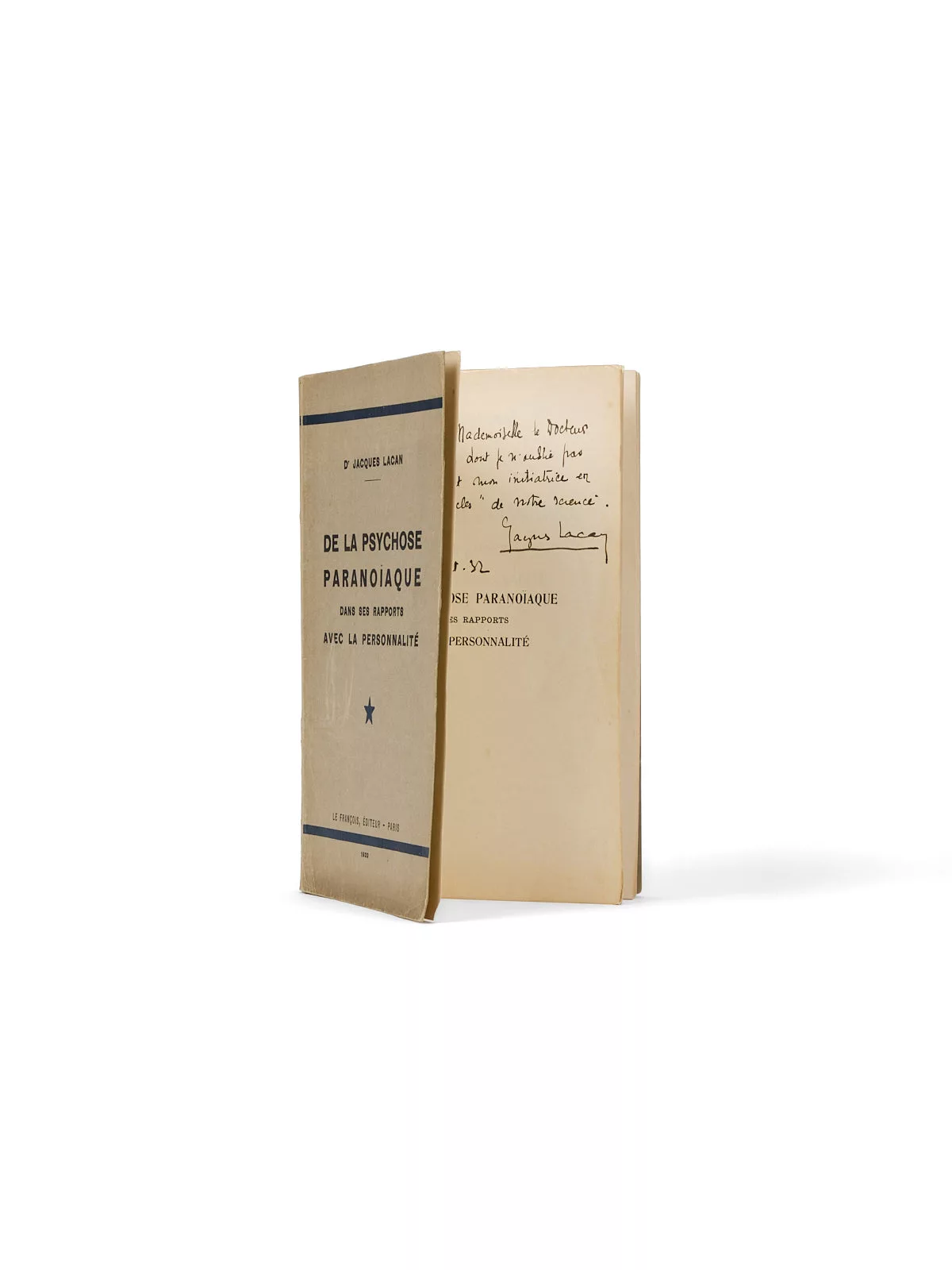
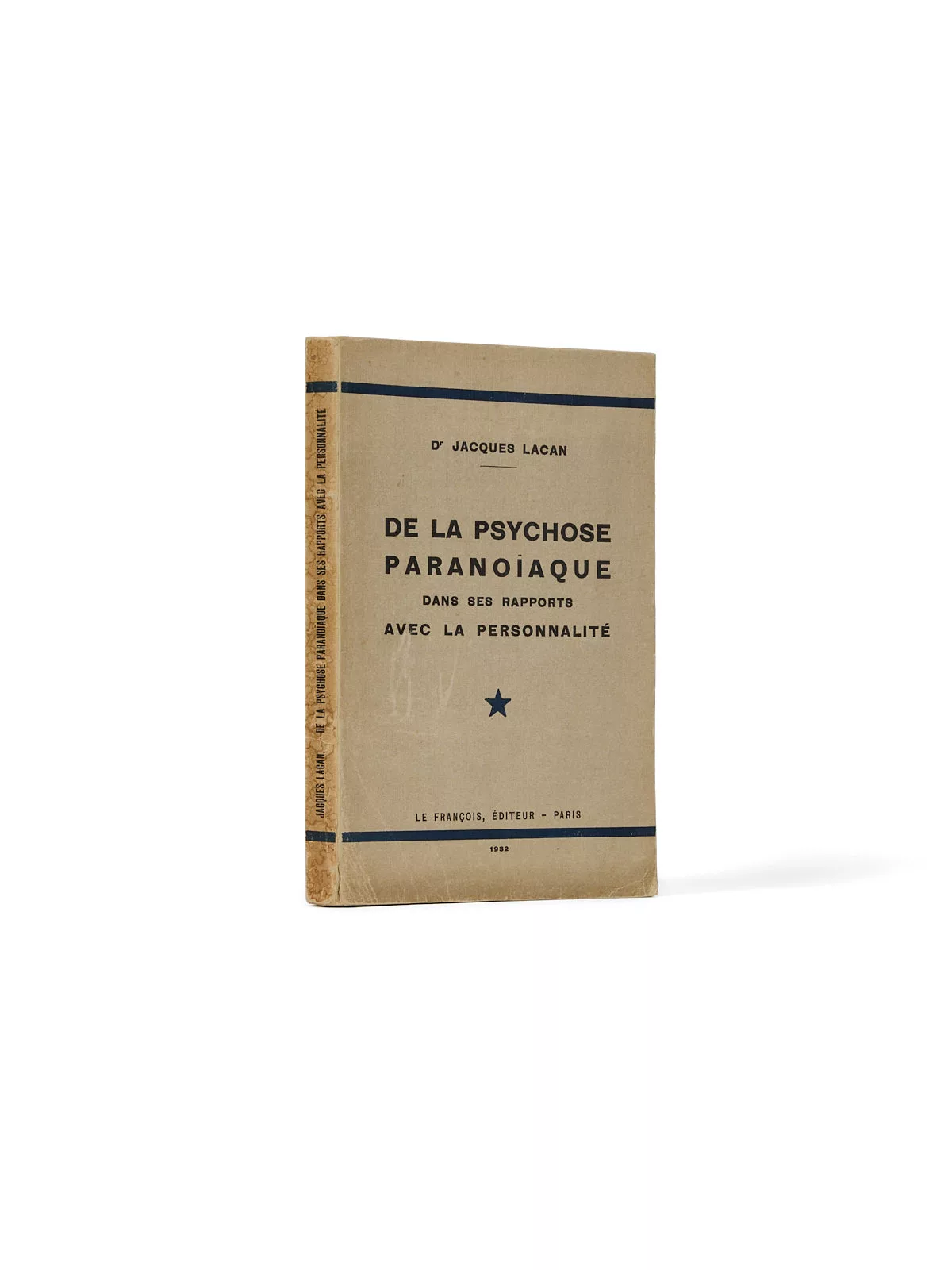
First-state copy.
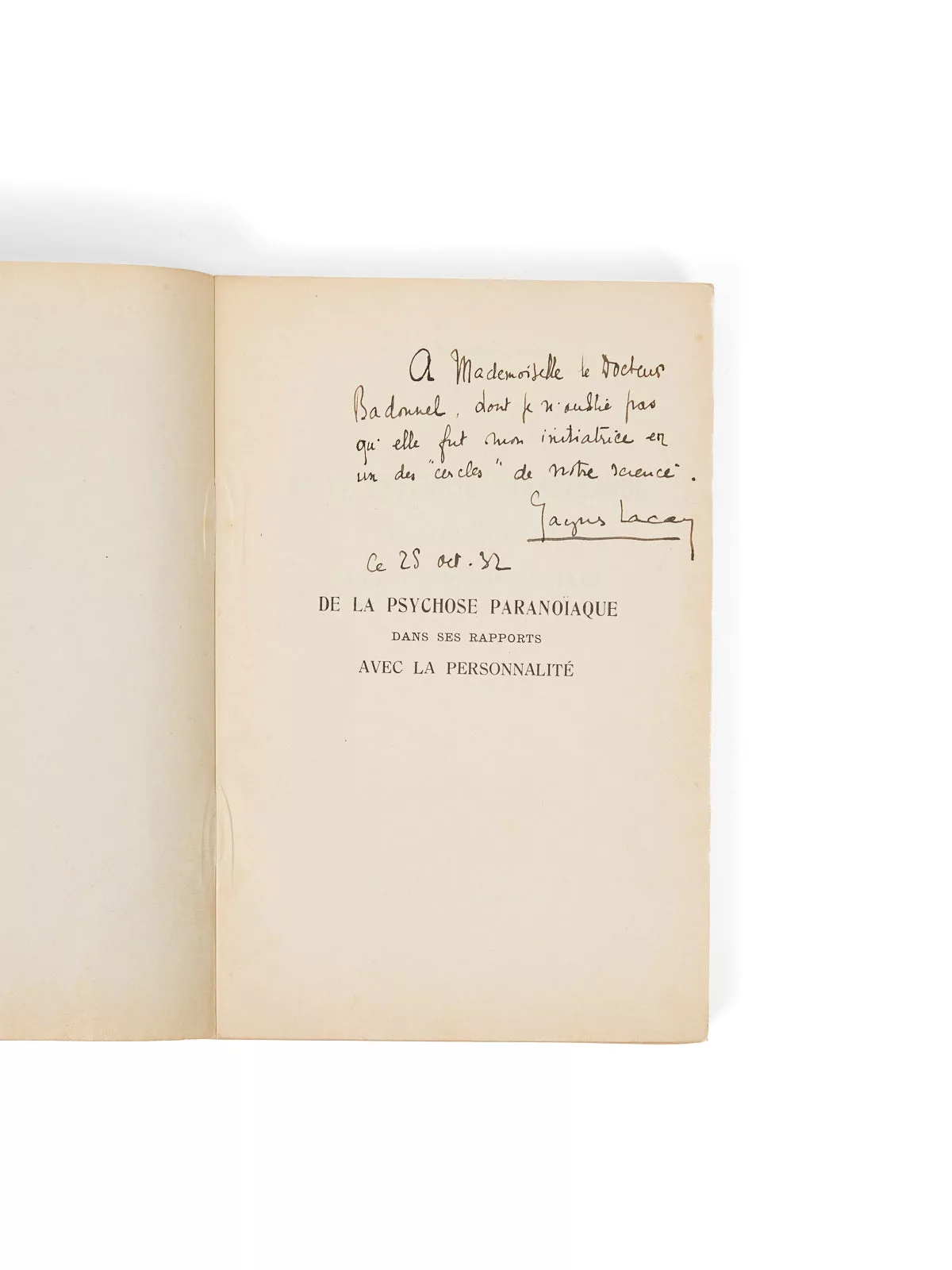
Inscribed and signed by Lacan to Marguerite Badonnel:
“À Mademoiselle le Docteur Badonnel, dont je n'oublie pas qu'elle fut l'initiatrice en un des « cercles » de notre science. Jacques Lacan, ce 25 oct. 32.”
An early and precious copy of the thesis, presented as soon as 25 October 1932 to Marguerite Badonnel, then chef de clinique at Sainte-Anne; she had had the young Jacques Lacan as an intern a year earlier.
Lacan had inscribed the first copy he received to his parents, on 23 October. Two further inscriptions followed, to colleagues, the next day. Then, on 25 October, two more, of which this is the first to a woman. Her rich career as a psychiatrist had begun more than ten years earlier: after a year as a substitute intern in Professor Henri Claude’s department at Sainte-Anne from November 1919 to December 1920, Marguerite Badonnel passed the 1920 competitive examination for the internship in medicine of the asylums of the Seine. Her doctoral thesis was defended in June 1924 and earned her the title of lauréat of the faculty. It was entitled Contribution à l’étude des troubles des fonctions organiques dans la Mélancolie. She returned once more to Sainte-Anne and became, from November 1924, adjunct chef de clinique at the Clinique des maladies mentales still directed by Henri Claude, before being seconded, after examination, as titular chef de clinique in infant neuropsychiatry in Georges Heuyer’s department: she was the first to hold this position and was, at thirty, the youngest chef de clinique in psychiatry in France. Claire Vogt-Popp — to whom Lacan would present his thesis on 25 November — succeeded her in this post in 1929, when Badonnel joined the Centre de psychiatrie Henri-Rousselle: then the most advanced establishment in psychiatric research. Located within the grounds of Sainte-Anne, it comprised a dispensary, a social service, a consultation for children, two laboratories of clinical research and psychology, and a “departmental service of mental prophylaxis.” In April 1941 the establishment was definitively attached to the Sainte-Anne clinical asylum.
Jacques Lacan, for his part, passed the examination that allowed him to begin his internship in 1927 in the “Clinique des maladies mentales et de l’encéphale” directed by Henri Claude; from 1931 he then continued his internship at the Henri Rousselle hospital, where he had Marguerite Badonnel as chef de clinique. It was there that he obtained a diploma in forensic medicine and above all that he was able to observe the genesis of paranoia and the development of delusion in his own patients.
Lacan’s inscription refers directly to this period so important to him, describing her as “the initiator into one of the ‘circles’ of our science.”
It was during that same year that he met for the first time, at the Sainte-Anne hospital, on 18 June 1931, Marguerite Anzieu, née Pantaine (1892–1981): hospitalized for having attempted to stab an actress, Huguette Duflos, on the grounds that she was threatening the life of her young son Didier, the patient held all of Lacan’s attention, “who made of her a case of erotomania and self-punitive paranoia. Between the psychiatrist and Marguerite there was never the slightest understanding. She in no way sought to be treated or taken in charge, and he did not seek to convince her to regard herself as a patient. For he was interested in this woman only to illustrate his doctrine of paranoia” (Élisabeth Roudinesco, Lacan, envers et contre tout, 2011). A year later, on the basis of the case study, his doctoral work was completed, devoted to La psychose paranoïaque dans ses rapports avec la personnalité.
Jacques Lacan “[…] defended it in 1932 before a jury presided over by Henri Claude. In this thesis, he does not hesitate to propose a renovation of psychiatry: a partial renovation, founded on psychoanalysis, but one that leads him to introduce psychosis into the field of psychoanalysis, by way of paranoia, and not by way of schizophrenia as Jung did. The thesis was published by Le François in Paris […]. The publication was noticed by Paul Nizan in L’Humanité, by René Crevel in Le Surréalisme au service de la révolution, by Salvador Dalí in Le Minotaure, and by Jean Bernier in La Critique sociale (a Marxist review founded by Boris Souvarine)” (Jacques Sédat). Lacan also received the Prix Jules Baillarger — named after a nineteenth-century alienist — of the Académie nationale de médecine, announced on 13 March 1934 and awarded to Lacan on 11 December.
The Le François edition of the thesis exists in two forms, almost identical and sharing a common achevé d’imprimer of 1 October 1932: the whole edition was printed before the defense, which took place at the beginning of November, with Henri Claude as president of the jury. Lacan was then the lover of Marie-Thérèse de Bergerot, fifteen years his senior, then of Olesia Sienkiewicz, second wife of his future friend Pierre Drieu la Rochelle. The former typed the thesis, the latter financed its printing, at the scientific publisher Le François.
As soon as it was printed, and some fifteen days before his defense, Jacques Lacan began to present a few copies of his thesis; first to his parents, then to his female and male colleagues of the “first circle,” and up to 1933.
In November he was appointed, by prefectoral decree, “Titular chef de clinique of the clinic of infant neuropsychiatry of the clinical asylum of the Sainte-Anne hospital”: whether at his own request or a change desired by his publisher Le François is not known, but it was decided to add this appointment to the publication: the covers and title pages were thus modified with the addition, beneath his name, of the mention “chef de clinique at the Faculty of Medicine of Paris.” This modification probably occurred at the beginning of 1933. Of the total print run of the thesis, which may be estimated at around a hundred copies, those not presented in 1932 and 1933 remained available for a long time at the publisher’s, until Jacques Lacan decided to buy them back from him… in order to destroy them. This was in 1952, the moment when he agreed to take Didier Anzieu into analysis. The now-grown son of Marguerite Pantaine-Anzieu, the subject of his thesis twenty years earlier — and this without informing him! “It was, perhaps, at the moment when he was challenged by Didier Anzieu that Jacques Lacan bought back from his publisher the remaining copies of his thesis, twenty years after its publication” (Marcel Turbiaux, “Le fils d’Aimée,” Bulletin de psychologie, 2000).
A very fine copy of remarkable provenance, in the first state of the printing.
Census of copies: to date, 24 inscribed copies are known, with the following dates and recipients:
23 October 1932, to Alfred and Émilie Lacan: “à Papa et à Maman, ce grand ouvrage de celui qui reste – quelque part en eux et quelque part en lui – leur petit garçon. Jacquot. Ce 23 octobre 32” (private collection);
24 October 1932, to J.R. Cuel: “à Cuel, dont la personnalité scientifique me fut d’abord prônée par notre maître Trénel, et dont la rencontre ne m’a pas déçu, en signe de très particulière sympathie. Jacques Lacan. Ce 24 oct. 32” (Librairie Le Feu Follet, 2020);
24 October 1932, to Pierre Migault: “À mon camarade et ami Pierre Migault, en souvenir de dix ans. Ce 24 oct. 32” (Paris, Pierre Bergé & Associés, 22 November 2011, lot 111);
25 October 1932, to Dr. Pierre Verret: “à Pierre Verret, en souvenir d’une collaboration, J. Lacan, le 25 octobre 1932,” with an autograph letter enclosed (Librairie Walden, cat. 14, 2008, no. 40; private collection);
25 October 1932, to Dr. Marguerite Badonnel: “À Mademoiselle le Docteur Badonnel, dont je n’oublie pas qu’elle fut l’initiatrice en un des « cercles » de notre science. Jacques Lacan. Ce 25 oct. 32” (Librairie Walden, June 2025);
30 October 1932: “À Colette et Emmanuel Chaumié, en souvenir d’un temps de commune solution de nos épreuves particulières : quand je défendis ma thèse, tenaient encore les f…taises. Mais quand j’advins à la clinique, ce fut la fin de la clique. Très amicalement, Jacques Lacan. Ce 30 oct 32” (Mimesis Books, Lacan & Freud, 2024, no. 1);
3 November 1932, to Dr. Sophie Morgenstern: “À Madame le docteur Morgenstein, en hommage respectueux, ce 3 nov. 32” (Librairie Walden, cat. 25, 2014, no. 75; Mimesis Books, Lacan & Freud, 2024, no. 2);
17 November 1932, to Marcelle and Guillaume de Tarde: “à Marcelle et à Guillaume de Tarde, qui se partagent mon coeur et mon esprit. Jacques Lacan, ce 17 Nov. 1932” (Librairie Walden, cat. 22, 2011, no. 123; private collection);
20 November 1932, to Sacha Nacht: “au Docteur Sacha Nacht, en témoignage de mon amitié. Jacques Lacan, ce 20 Nov. 1932” (Giquello, March 2026, lot 307);
22 November 1932, to Marie Bonaparte: “À S.A.R. la princesse Georges de Grèce, en témoignage de ma respectueuse admiration. J. Lacan, ce 22 nov. 32” (Binoche et Giquello, 19 November 2021, lot 153; private collection);
26 November 1932, to Angelo Louis Marie Hesnard: “à Monsieur le Professeur Hesnard en signe de ma respectueuse sympathie. Jacques Lacan. Ce 26 Nov. 32” (Kâ-Mondo, 30 October 2019, lot 284; then Alain de Mijolla);
25 November 1932, to Dr. Claire Popp-Vogt: “à mademoiselle le Docteur P-.Vogt, en hommage, amical et respectueux. Jacques Lacan, le 25 nov. 32” (Librairie Walden, cat. 23, 2012; private collection);
3 January 1933, to Sigmund Freud: “Au Professeur Sigmund Freud, père de la nouvelle psychiatrie, à laquelle je voudrais avoir contribué un peu par cet ouvrage, bien que j’aie dû m’y exprimer trop souvent en fonction de l’ancienne. En témoignage de mon immense admiration, Jacques Lacan le 3 janvier 32 [sic, for 1933]” (Librairie Le Feu Follet, April 2025);
20 January 1933, an inscription to an unidentified recipient (incomplete and altered inscription), on a copy printed under the aegis of the Faculty of Medicine of Paris (Bibliothèque Henri Ey, Hôpital Sainte-Anne, Paris);
23 January 1933, to Dr. Maurice Martin-Sisteron (Librairie Walden, copy seen in 2012, private collection);
23 January 1933, to Dr. Jean Picard: “en témoignage d’une amitié fondée sur la plus profonde estime intellectuelle. 23 janvier 33” (Kahn et associés, 20 April 2011, lot 71);
23 January 1933, to Dr. Ernst Kretschmer: “An Herrn Professor Dr. Kretschmer. Mit vorzüglicher Hochachtung von einem unbekannten, zum Danke verpflichteten Schüler, Jacques Lacan den 23. Jan. 33” [To Herr Professor Dr. Kretschmer. With my most sincere regards, from an unknown and grateful student] (cited by Librairie Le Feu Follet, 2025, op. cit.);
24 February 1933, to Lise and Paul Deharme: “À Lise et Paul Deharme, ce 24 fév. 33” (Giquello, 1 June 2016, lot 82; Librairie Hermann Lynge, 2025); all these copies belong to the first state;
30 March 1933, to René Char: “À Monsieur René Char, au poète d’Artine, très sympathiquement, J. Lacan, 30 mars 1933,” on a copy of the printing bearing the “chef de clinique” mention (Librairie Walden, June 2025);
9 July 1933, to Marcel Boll: “À Marcel Boll, en signe de courtoise contradiction Jacques Lacan ce 9 juillet 33” (Librairie Le Feu Follet, cat. December 2011, no. 153); first-state copy;
September 1933, to Dr. Eugène Minkowski, on a copy of the printing bearing the “chef de clinique” mention (Librairie La Nef des fous, cat. June 2011, inscription not described);
21 October 1933, to one Arnould: “À Arnould. Cet essai ambitieux, Jacques Lacan, Ce 21 octobre 1933, mieux vaut tard… et pardon,” on a copy of the printing bearing the “chef de clinique” mention (Bibliothèque Julien Bogousslavsky; Bibliothèque Pierre Bergé, VI, July 2022, lot 1528; Librairie Pitchal, 2025);
undated [1952], to Maurice Henry: “un peu de Maurice Henry aurait fait du bien à mon ‘Aimée’, beaucoup de Maurice Henry tout court l’aurait sauvée. Jacques Lacan Vingt ans après. Que personne ne sorte et que tout le monde signe [other signatures including Sylvia Bataille]” (cited by Librairie Le Feu Follet, 2025, op. cit.); state of the printing unknown;
undated, to Gaston Ferdière, inscription not described and state of the printing unknown (sale, 2001, source not found, cited by Librairie Le Feu Follet, 2025).
Jacques Sédat, “Lacan et la psychiatrie, Lacan et les psychiatres,” Topique, no. 88, pp. 37–46.