

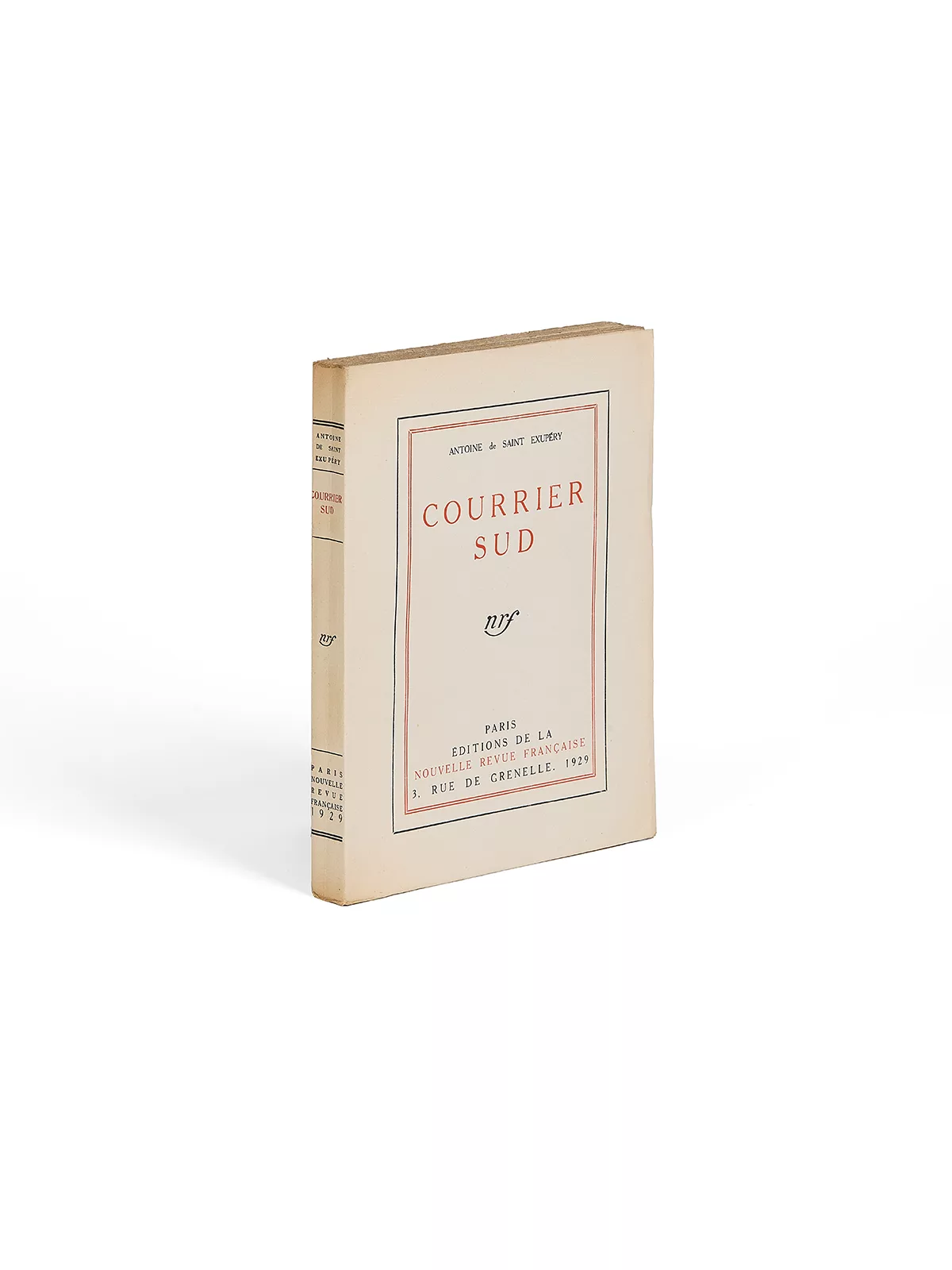
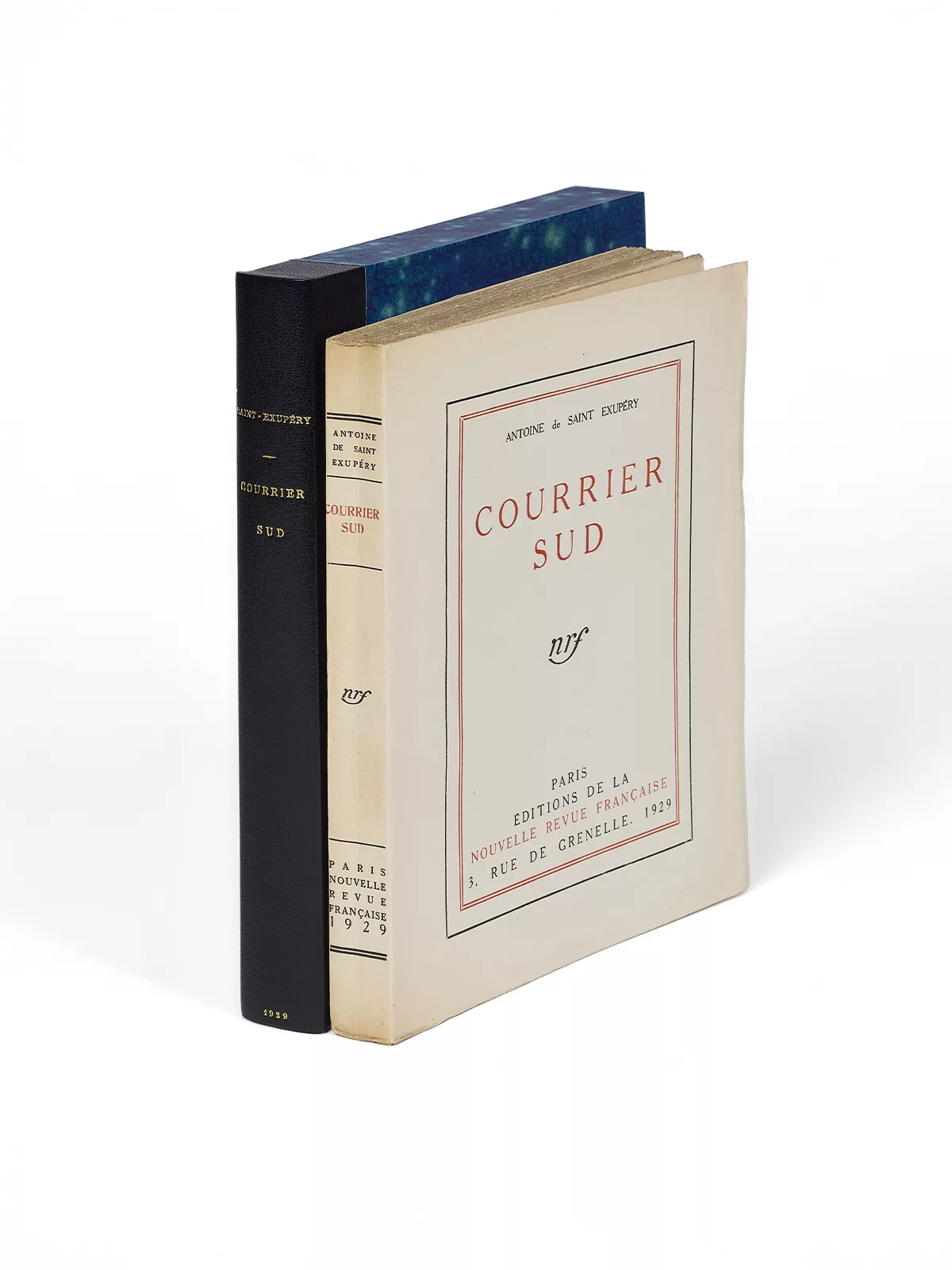
Courrier Sud
Before attempting the Aéropostale adventure in South America, Antoine de Saint-Exupéry was sent to the naval aviation school in Brest for an advanced training course. It was there that the first proofs of his book reached him, and he read passages from it to his cousin Honoré d’Estienne d’Orves, who would become his devoted reader.
Accompanied by:
Two original photographic prints: these two images were taken at Le Bourget airport, just before the entire crew of the film Courrier Sud, directed by Pierre Billon, departed for Morocco. “Drawn to the synopsis of his novel Courrier Sud, director Pierre Billon and producers Eduardo Corniglio-Molignier and André Aron asked Saint-Exupéry to write the screenplay. From the end of summer 1936, Saint-Exupéry worked intensively with Billon and Lustig, the German adapter of the novel. A young script assistant, Françoise Giroud, helped them. In October, he secured the cooperation of Air France, which lent the production two LATE 28 aircraft along with the personnel needed to maintain them. The African scenes were shot in the region of Mogador (now Essaouira) in Morocco.” (Courrier Sud au cinéma, Fondation Saint-Exupéry).
This would be his only major cinematic undertaking, the culmination of a project he had contemplated since 1931. He followed every stage of its production and even took part in the filming, serving as the stunt double for the hero, played by Pierre-Richard Wilm, in the dangerous scenes. The two photographs show one of the two aircraft and the entire film crew, including Charles Vanel. The film was released in theaters in March 1937, preceded by a voice-over introduction in which Saint-Exupéry offered a somewhat bitter reflection: “The film you are about to see recalls a time when human adventure was not yet so well hidden.” He went on to reflect nostalgically on the era of the Aéropostale, before tourism, when the mere passenger, unlike today, “still took part in an adventure. The airplane, with its leather seats, its varnish, its precise schedule, is no longer, in the traveler’s eyes, an instrument of exploration but an extension of the commercial office (…) The traveler does not even sense that this enterprise creates two kinds of men: the amiable merchants who seduced him, and the crew who will carry him among the stars.”
By then, Saint-Exupéry had lost “his brother,” Jean Mermoz, who disappeared over the Atlantic Ocean on 7 December 1936. With him, an entire world came to an end.
Published thanks to André Gide, the book carries a preface by André Beucler, who was the first to argue that “Saint-Exupéry is not a writer,” an idea later taken up and developed by André Malraux: Saint-Exupéry was no armchair writer, and “he will write nothing that his life does not guarantee, or that he has not had occasion to verify at his own risk. This is why the properly literary universe remains suspect to him, insofar as it deceives the reader by transporting him into an easy and fallacious world. Saint-Exupéry remains one of those men bound to exactness, for whom imagination may add to reality, but never take its place […].”
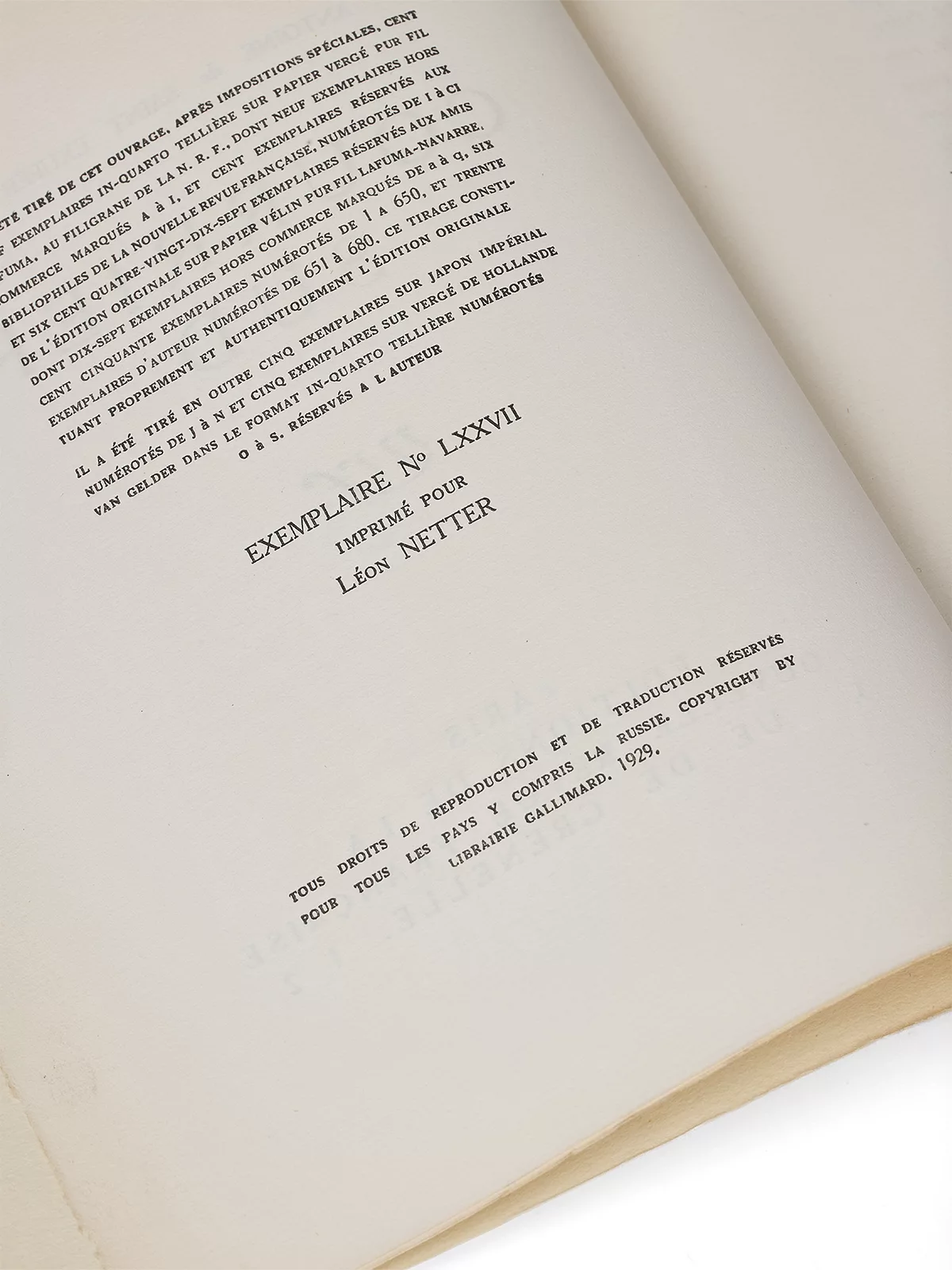
A fine copy.