


Courrier Sud
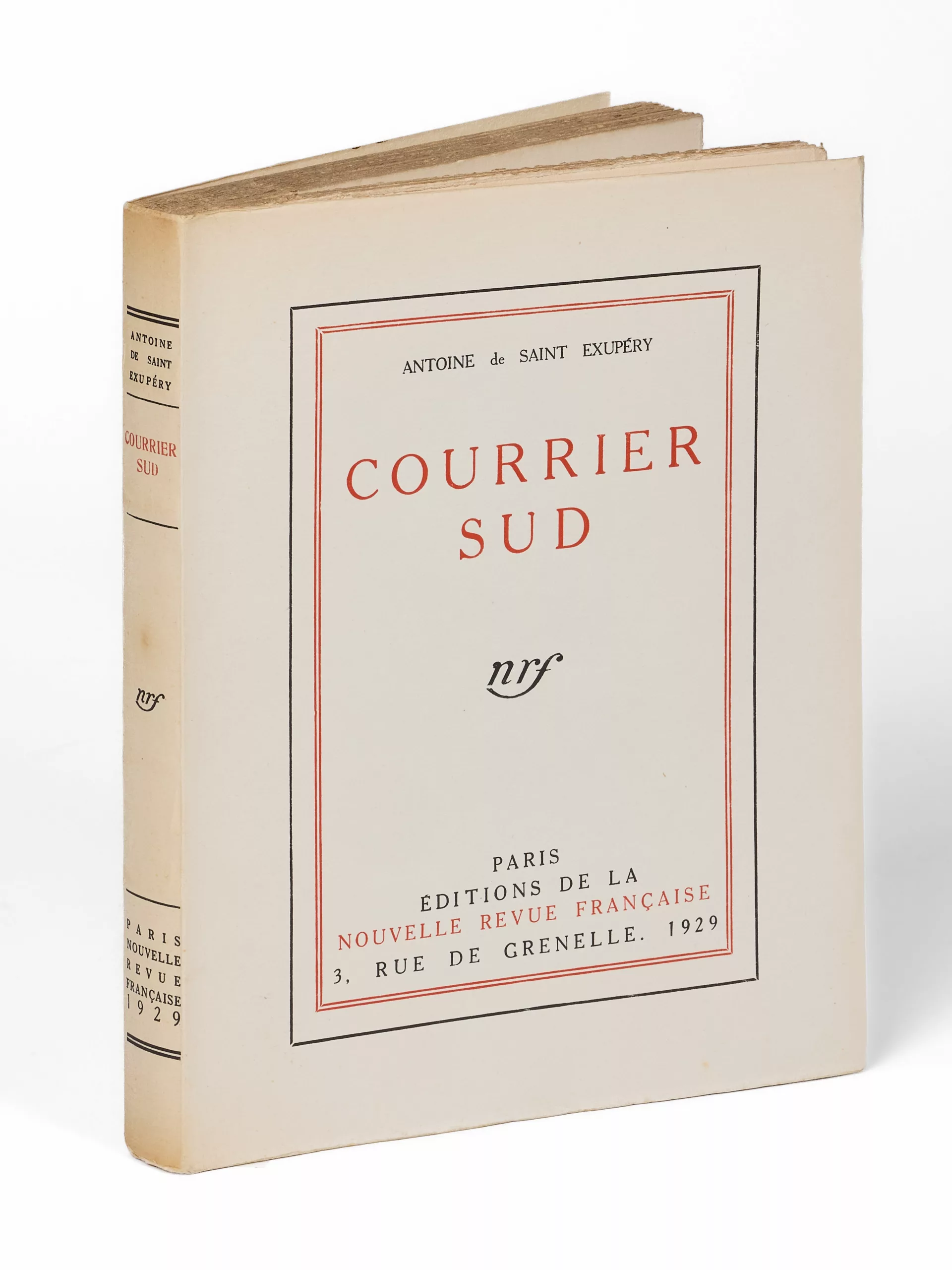
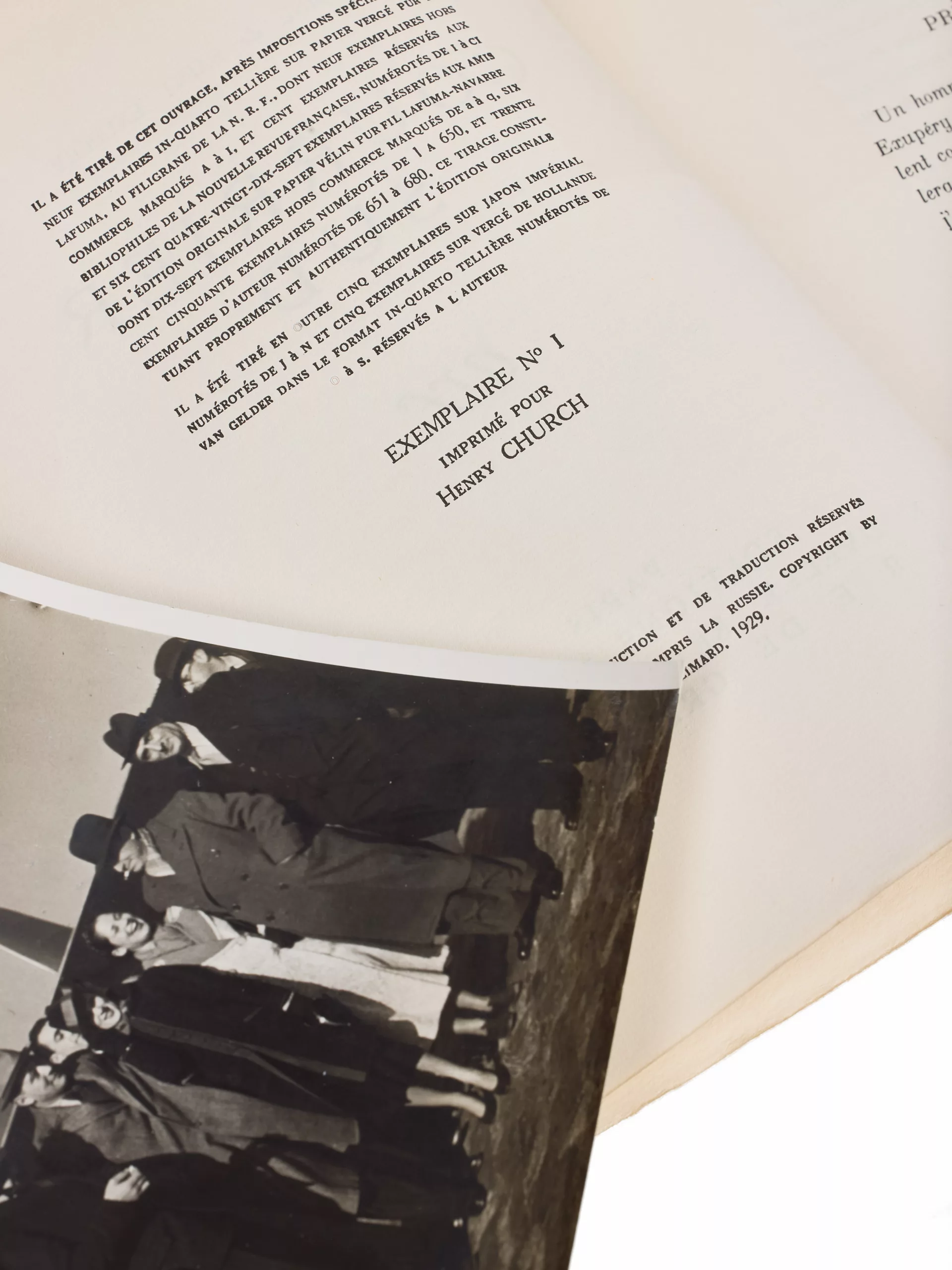
One of 109 réimposé copies on vergé paper, this one nominative for Henry Church (no. I).
The American Henry Church (1880–1947) was one of the great collectors and patrons of the twentieth century. A descendant of a Mayflower emigrant and of a pharmacist who held the monopoly on the sale of bicarbonate of soda in the United States, he devoted part of his immense fortune to the arts and letters.
From 1920 he settled in France, with his wife Barbara, at Ville-d’Avray, where between 1927 and 1929 Le Corbusier designed two, then three, adjoining villas, built by the architect and furnished by Charlotte Perriand. During this period he financed the literary review Mesures, which he founded with the help of Jean Paulhan in 1935 and co-directed with him. He became an important patron of the Parisian arts and obtained from Gaston Gallimard the allocation of copy no. 1 of the celebrated réimposé copies of the literary collection, which bore his name for more than a decade.
Ten years earlier, around 1925, Saint-Exupéry had met, in the Parisian salon of his cousin Yvonne de Lestrange, the leading figures of Éditions Gallimard: Gaston Gallimard, André Gide and Jean Schlumberger. These encounters would play a fundamental role in Saint-Exupéry’s entry into literature.
Before attempting the Aéropostale adventure in South America, Saint-Exupéry was sent to the flight navigation school in Brest for an advanced course. It was there that he received the first proofs of his book, from which he read passages to his cousin Honoré Estienne d’Orves, who would become his regular reader. He made only minor corrections, and the bon à tirer was signed in the first days of April 1929.
Published thanks to André Gide, who two years later would write the preface to Vol de nuit (Night Flight), Courrier Sud (Southern Mail) carries a preface by André Beucler, who was the first to argue that “Saint-Exupéry is not a writer,” an idea later taken up and developed by André Malraux: Saint-Exupéry was no armchair writer, and “he wants to write nothing that his life does not guarantee, or that he has not had occasion to verify at his own expense. This is why the properly literary universe remains suspect to him, insofar as it deceives the reader by transporting him into an easy and misleading world. Saint-Exupéry remains one of those men bound to exactness, for whom imagination may add to reality but never replace it…”
A fine copy.