

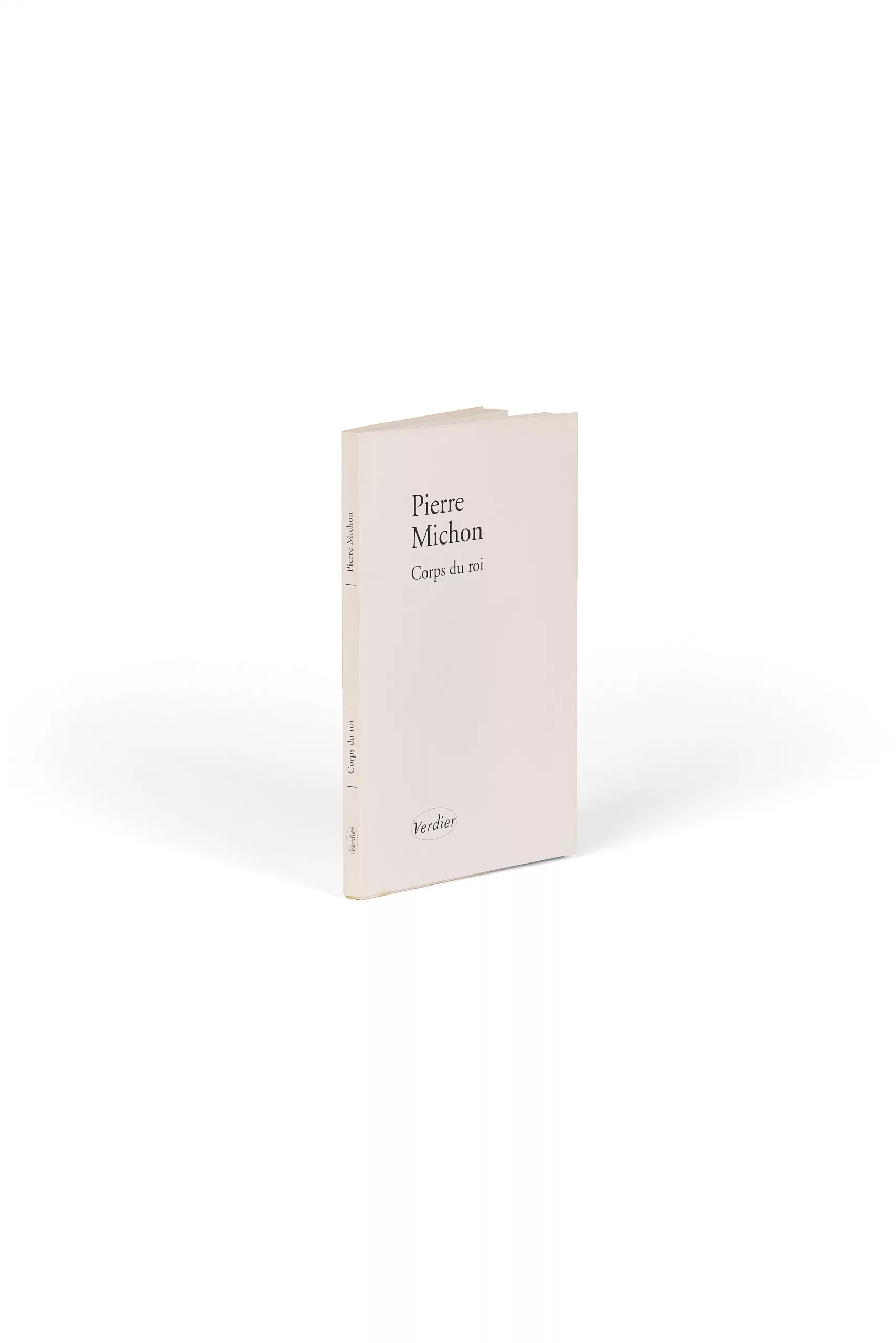
Corps du roi
One of 70 copies on vélin Rivoli (no. 63), signed.
Five narratives: four evoke Samuel Beckett, Gustave Flaubert, Ibn Manglî and William Faulkner, while the last is an autobiographically inspired piece built around Victor Hugo’s Booz endormi. “The king, as we know, has two bodies: an eternal, dynastic body, enthroned and consecrated by the text, arbitrarily called Shakespeare, Joyce, Beckett, or Bruno, Dante, Vico, Joyce, Beckett, but which is the same immortal body clothed in temporary garments; and another body, mortal, functional, relative, the cast-off garment bound for carrion, which is called and called only Dante and wears a little cap on a snub nose, only Joyce and then has rings and a myopic, dazed eye, only Shakespeare and is a stout, comfortable landlord in an Elizabethan ruff”: a striking journey in which Michon summons his literary fathers and the legacy they passed on, revealing, in small touches — notably in the last section devoted to Booz endormi — his own relationship to reading and writing.