

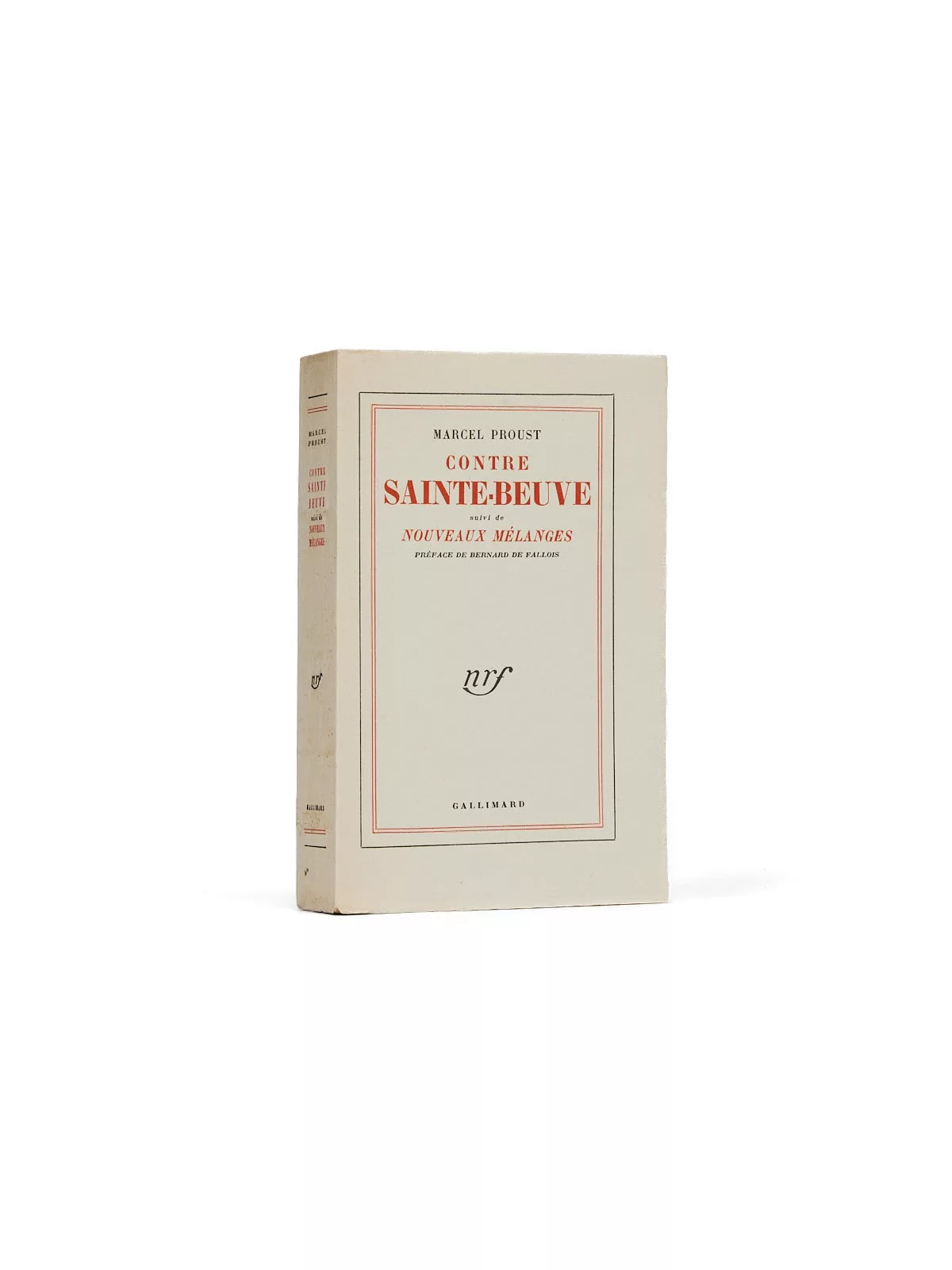
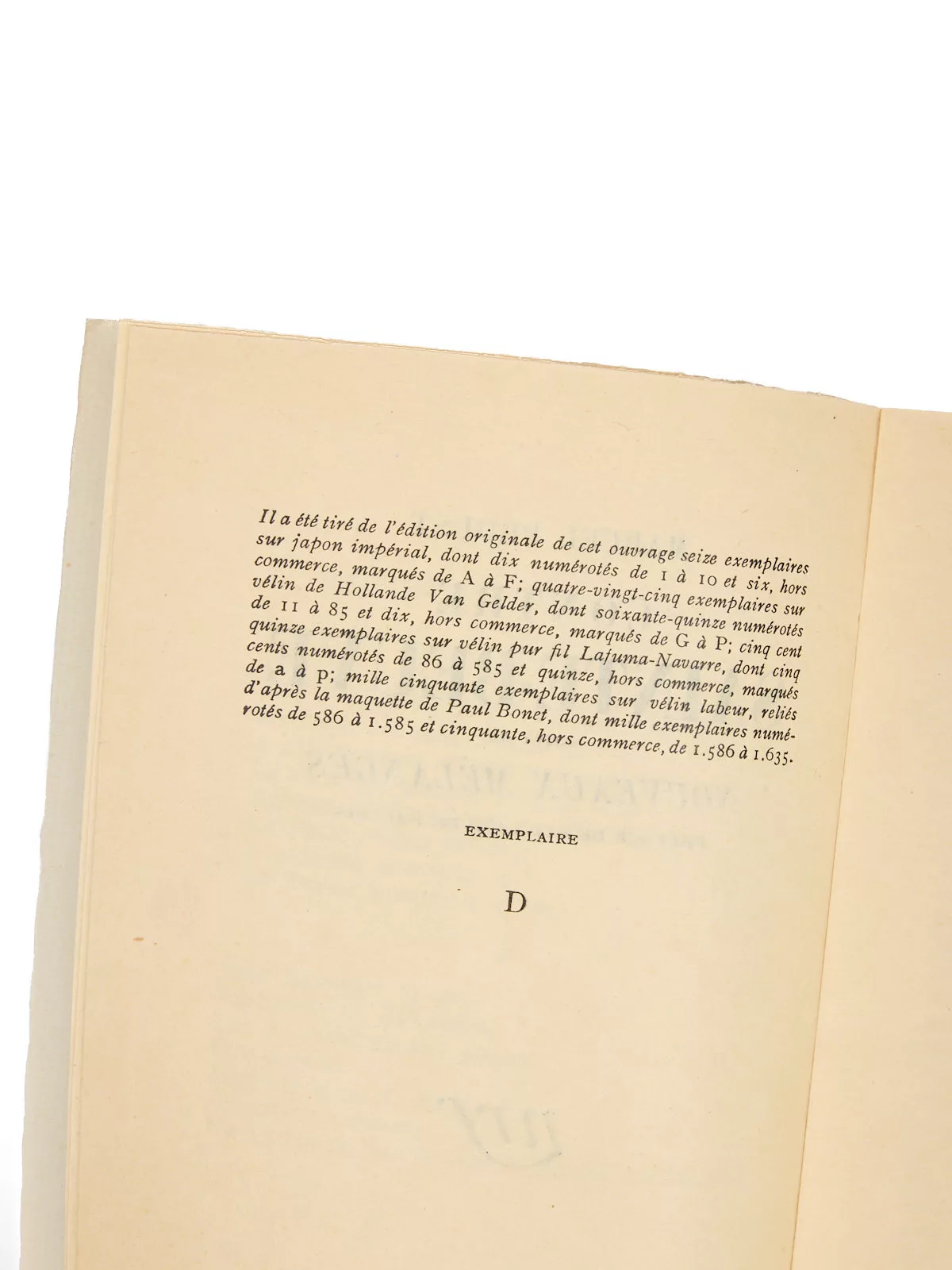
One of the first 16 copies on Japanese paper, this one hors commerce (D).
A key text for understanding the genesis of La Recherche, this volume brings together the long-unpublished essay in which Proust settles his score with the Sainte-Beuve “method” and, in doing so, articulates his own poetics.
Around the turn of 1907–1908, having returned from Cabourg and enjoying a respite in his health, Proust set aside an earlier novelistic project — the cycle known as the “75 feuillets” (in fact 76 leaves), a vast draft in six parts (“Une soirée à la campagne,” “Le côté de Villebon et le côté de Méséglise,” “Séjour au bord de la mer,” “Jeunes filles,” “Noms nobles,” “Venise”) — to begin, initially for Le Figaro, a text “against Sainte-Beuve” that within a few months swelled into an essay of nearly three hundred pages, which he kept unpublished.
Cast as a hushed conversation with his mother, the text interweaves memories, portraits, pages of literary criticism and reflection. Its central argument is clear: to reject biographical inquiry as the key to a work and to insist that a text be judged by its formal necessity and style. Proust had Reynaldo Hahn read the opening pages in November 1909, then offered the whole to the Mercure de France in mid-August 1909, while warning of passages he himself judged impossible to publish: “Contre Sainte-Beuve, Souvenir d’une matinée is a real novel, and extremely indecent in places. One of the principal characters is a homosexual” (letter to Alfred Valette, director of the Mercure de France, published by Florence Callu in the Bulletin de la Bibliothèque nationale in March 1980). Alfred Valette had already turned down the Pastiches. As Jean-Yves Tadié notes, Proust “could not conceive that his book might be refused for any reason other than its immorality” (Proust, “Introduction générale,” p. XLII).
The text was refused again, and Proust reworked it, naming the final notebook “Sainte-Beuve,” which he wished to open À la recherche du temps perdu; the invitation “to an evening” that closes these pages would later become the famous “morning” scene. In the end, the opening text was not incorporated, and Proust kept the entire text unpublished.
It was through the research and discoveries of Bernard de Fallois, who brought manuscripts and typescripts to light, that the edition could finally appear in 1954, restoring the founding act by which Proust challenged biographical positivism and asserted his immense critical sensibility.
A very fine copy in wrappers. Rare in this state.