

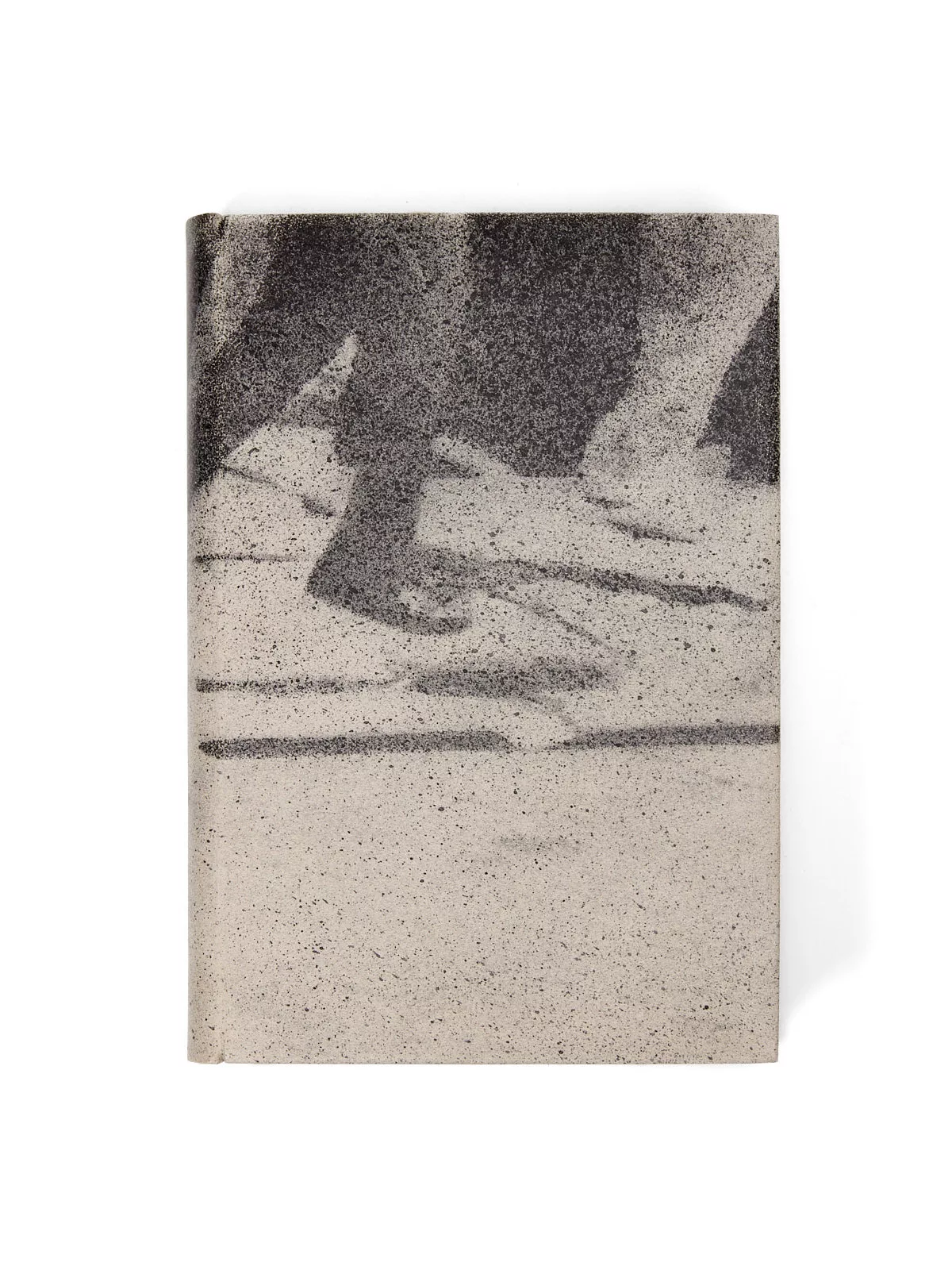

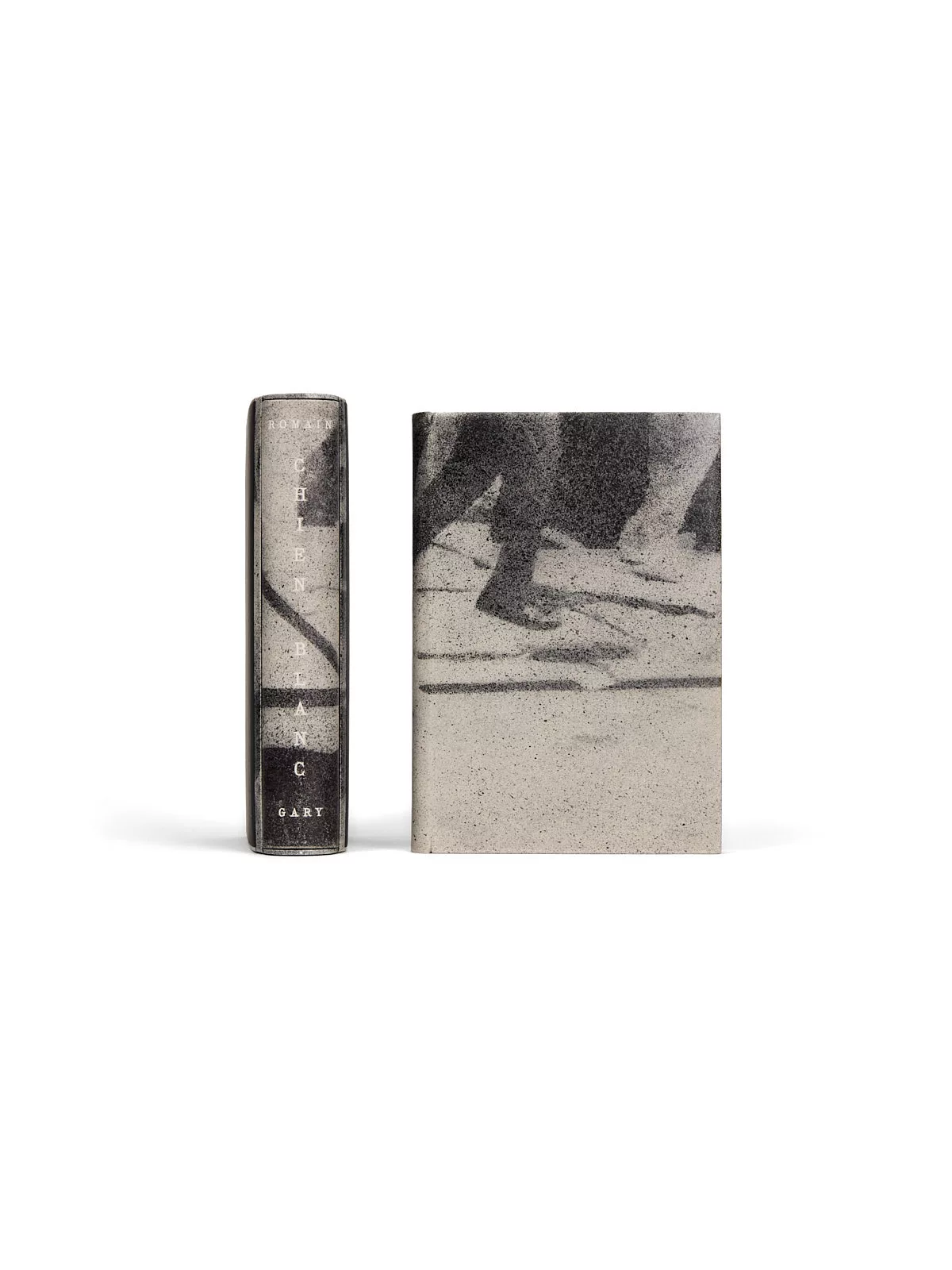
Chien blanc
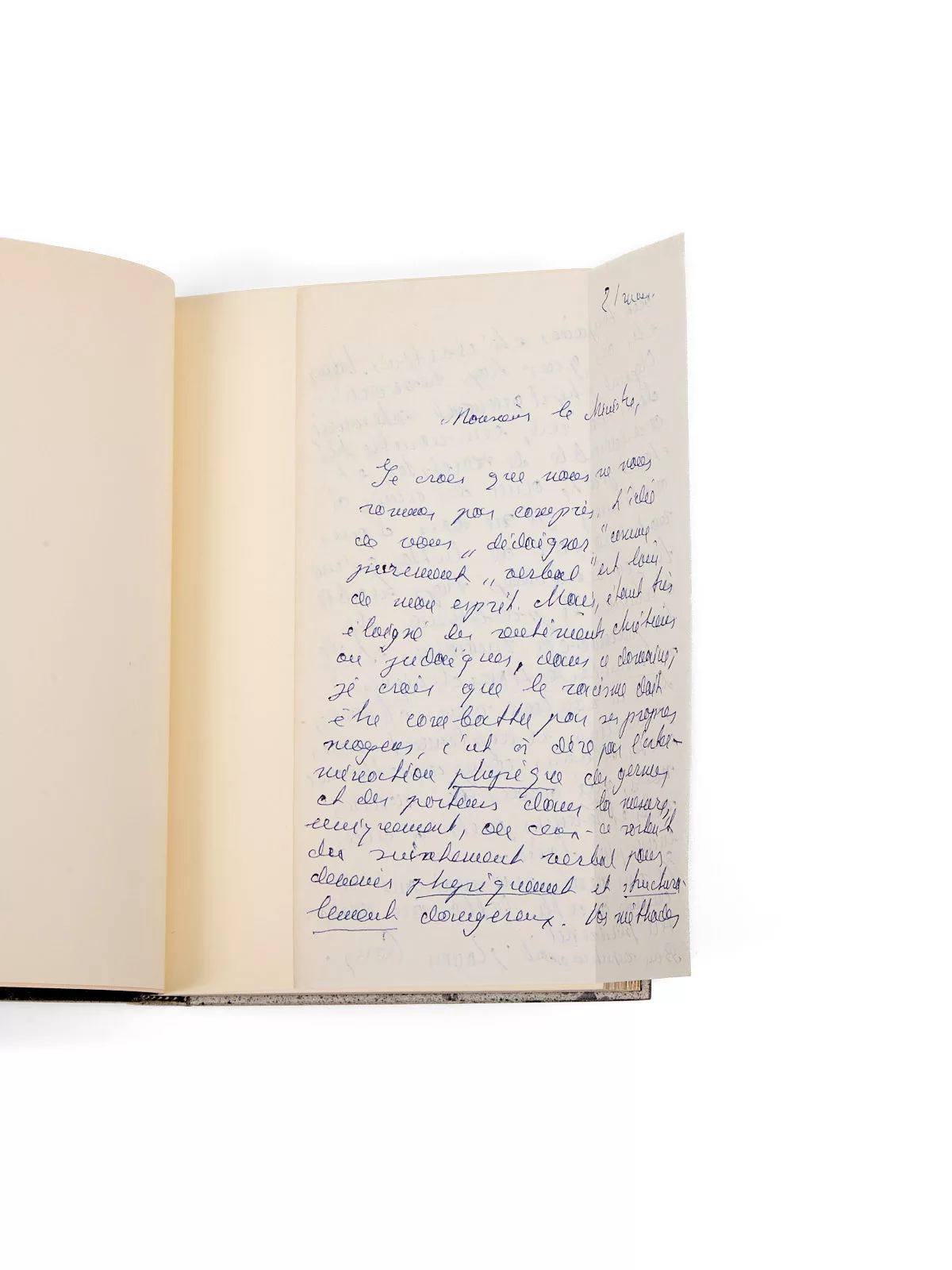
Bound in at front: autograph letter signed to a “Minister” [Jules Moch], dated 21 May [1970], two pages on 1 leaf (135 x 210 mm), in blue ballpoint pen.
In Beverly Hills, where he had joined his wife, Jean Seberg, Romain Gary encountered a trained guard dog — trained to attack Black people. It was 1968, America was living through the dark hours of segregation, and Gary set out to write a masterpiece. “I keep telling myself that the Black problem in the United States poses a question that makes it almost insoluble: that of Stupidity. Its roots lie deep within the greatest spiritual power of all time, which is Sheer Idiocy.”
Less than a year later, he finished writing Chien Blanc (White Dog), published at the end of March 1970. The book caused a sensation, and a few days later, on 9 and 11 April, Gary explained himself at the close of a series of broadcasts for Radio France: he insisted he had never wanted to meddle in the Black cause as such, having already spent thirty years in every ideological battle of his time; he did not wish to add seventeen million Americans to his conscience. Blacks, he argued, were men like any others, with their share of scoundrels, opportunists and profiteers, and within the Black movement itself there existed a parasitic fringe that lived off both the justice of the cause and the guilt of well-meaning whites. He could allow himself — and did — to see a Black man simply as a man, and when that man was a scoundrel, he recognized it; he had, he said, an inner radar that detected scoundrels regardless of skin color, ideals or doctrine, and he had seen many, several of whom were exploiting Jean Seberg. Some, far from being the majority, were genuinely admirable in their commitment, but he saw the scoundrels, whereas Jean tended not to. This, he added, existed in every movement, as it always had. He described himself as allergic to all forms of racism — using, he said, a very mild word for it. The moral problem, once it seized him, always became a book: he told Jean that if she kept drawing him into the affair, he would get rid of her “seventeen million Black people” by putting them into a book, once and for all. That, he said, is what a novelist does with the great problems of the world: he rids himself of them by writing.
His encounter with the dog, trained to kill, gave him precisely that opportunity. Beyond the fable, Gary wanted to address an America gripped by the demons of endemic racism and by the problem of minorities, at a time when Jean Seberg’s activism brought him into contact with the radical Hollywood circles mobilized for the Black cause — circles toward which he showed considerable irony.
It was precisely on leaving this recording at the Maison de la Radio that he crossed paths with Jules Moch, who was due in the studio that same day to discuss his new book on Léon Blum. The two men almost certainly spoke then, and continued the exchange by letter on the subject of racism and its political treatment; Gary’s clarifying letter almost certainly marks the end of that exchange — a letter whose request for confidentiality is easily understood.
“Monsieur le Ministre,
I believe we have misunderstood one another. The idea of ‘disdaining’ you as merely ‘verbal’ is far from my mind. But, being very distant from Christian or Judaic sentiment in this matter, I believe that racism must be fought with its own weapons, that is, by the physical extermination of its germs and carriers, only insofar as these move beyond verbal seepage to become physically and structurally dangerous. Your methods have always been civilized.
You are too honorable people. Having physically exterminated, in my life, a very considerable number of racists, and being ready, with friends, to continue, I see in your way of fighting only a far too noble way of approaching the problem of human paranoia and its clinical manifestations. Far from wishing to offend you, I simply wanted to spare you the compromise of association with us, who have dirty hands and are prepared to go still further…
I would be grateful if you would keep this letter personal.
Most respectfully, Romain Gary.”
Jules Moch served as a minister on several occasions under the Third Republic and, above all, the Fourth, holding eight ministerial portfolios, notably the Interior and Defense. A graduate of the École Polytechnique (class of 1912) and chief engineer of naval engineering, he was decorated with the Croix de Guerre for 1914–1918, then served in the Navy during the Second World War aboard the flagship of the Mediterranean fleet. On 10 July 1940, he was among the “eighty” who refused to grant full powers to Marshal Pétain; watched by Vichy, he was arrested on 25 September 1940 and imprisoned at Pellevoisin, alongside Max Dormoy and Georges Mandel. Released in 1941, he joined the Resistance, took part in X-Libre (a network of Polytechnique graduates) and founded the “1793” movement, active in sabotage operations in the Aude and Ardèche. From 1951 to 1960, he represented France on the United Nations Disarmament Commission and, for that reason, declined to join the government — years that overlap with Romain Gary’s own time at the United Nations, making several encounters between the two men plausible. Coming from a socialist generation shaped by Stalinism, the Cold War and anticommunism, Moch opposed the Union of the Left in the 1970s and resigned from the Socialist Party on 1 January 1975; he restated his position in his final political essay, Le Communisme, jamais! (1977).
Until Chien Blanc, animals in Gary’s work almost always appear on the “good” side: the cat in La Promesse de l’aube, the seal that opens and closes that same book — the first and last images of a still habitable world. Animals allowed him to reflect both human innocence and human derangement. With Chien Blanc, however, he refuses consolation: to write, he essentially says, is to howl, and he seeks neither smooth edges nor a happy ending. The point is not to deny a dog’s nature — a dog that can bite — but to deprogram what has been instilled in it. Believing they could “save” the animal, Gary and Jean Seberg make the fatal mistake of entrusting it to Keys, a Black trainer and militant, who methodically sets about reversing its conditioning: turning “White Dog” into “Black Dog.” The logic of revenge thus exactly reproduces the mechanisms of oppression. The narrative becomes one of disillusionment: like the sacrificed dog, humanist ideals founder — less through malice than through good conscience and misplaced trust.
Two years later, again for radio, Gary recounted how he and Seberg had tried to “re-educate” the dog: a genuine battle, fought against the backdrop of tension following the assassination of Martin Luther King. Re-educating the white dog in his charge became an obsession — a distillation of every conflict between Black and white Americans in the United States, since the idea took hold that if this dog could be saved, the cause was not hopeless. Black American violence, he suggested, was above all a psychodrama aimed at recovering dignity, at escaping the virile alienation and psychological castration imposed by two centuries of denial of their humanity. He said he had tried both to cure the animal of what was, in essence, a racism it bore despite itself.
The book is dedicated to Sandy, Gary’s own dog, with whom he gave this interview in 1970. He described his first encounter with the “white dog”: it entered his life on 17 February 1968 in Beverly Hills, where he had just joined his wife Jean Seberg during the filming of a movie. Sandy had brought home a chance companion: a graying German shepherd, some six or seven years old, a fine animal that radiated strength and intelligence. One afternoon, while writing, Gary suddenly heard a long growl from the direction of the pool, followed by the sharp, rapid, furious barking by which dogs announce both the presence of an intruder and the imminence of the fight they intend to wage. The dog hurled itself at the gate, foaming at the mouth, in a paroxysm of hatred so frightening that Sandy had crawled whimpering under a bush, reduced to the status of a doormat, while on the other side of the gate stood a Black employee who had come to check the pool filter.
Worth noting, finally, is the cinematic counterpart created by Samuel Fuller, Gary’s friend and fellow Second World War veteran, whose film shows the dog’s snarling face in close-up, more directly than Gary does in the text, underscoring on screen the violence the book only allows to surface.
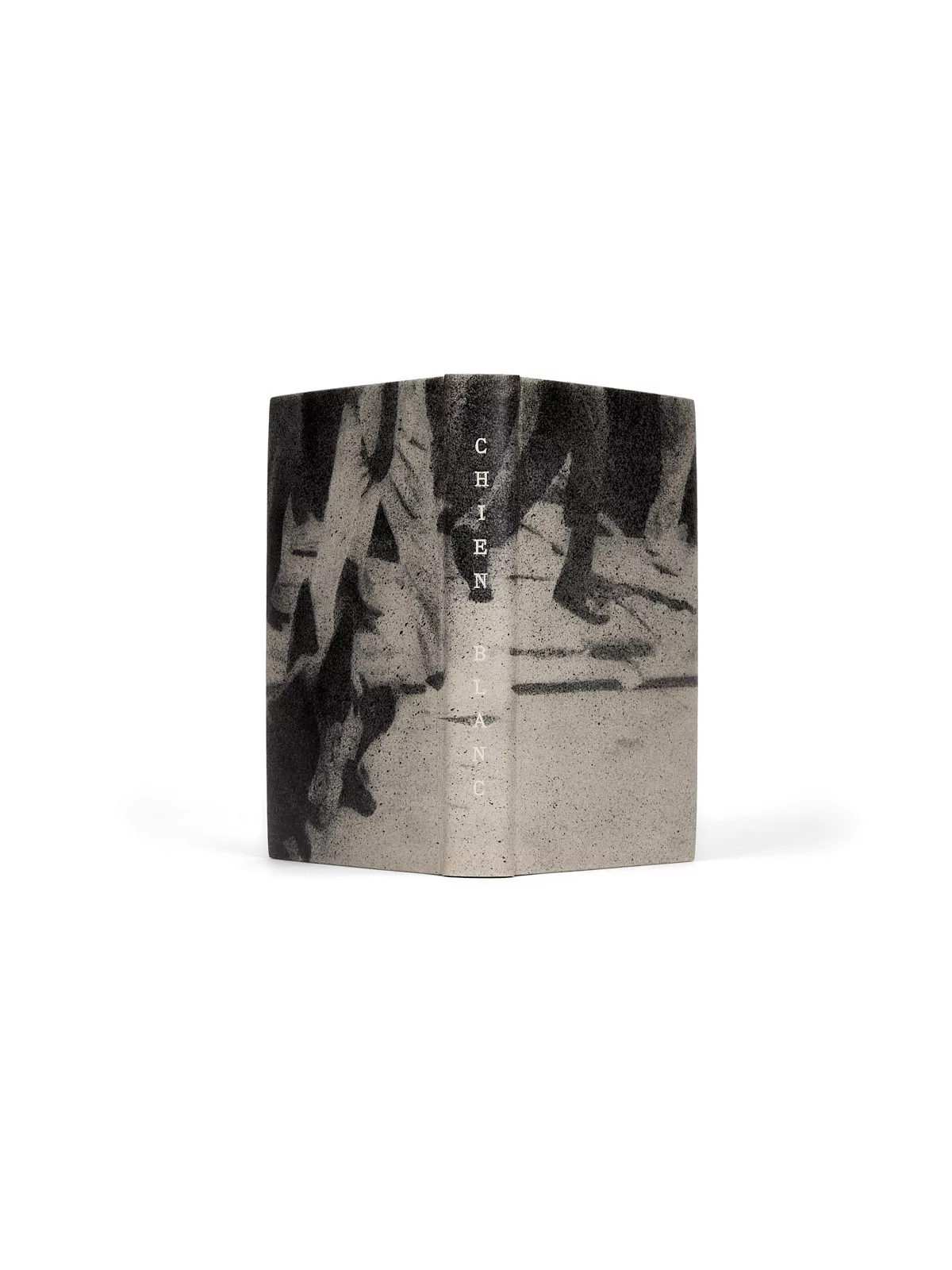
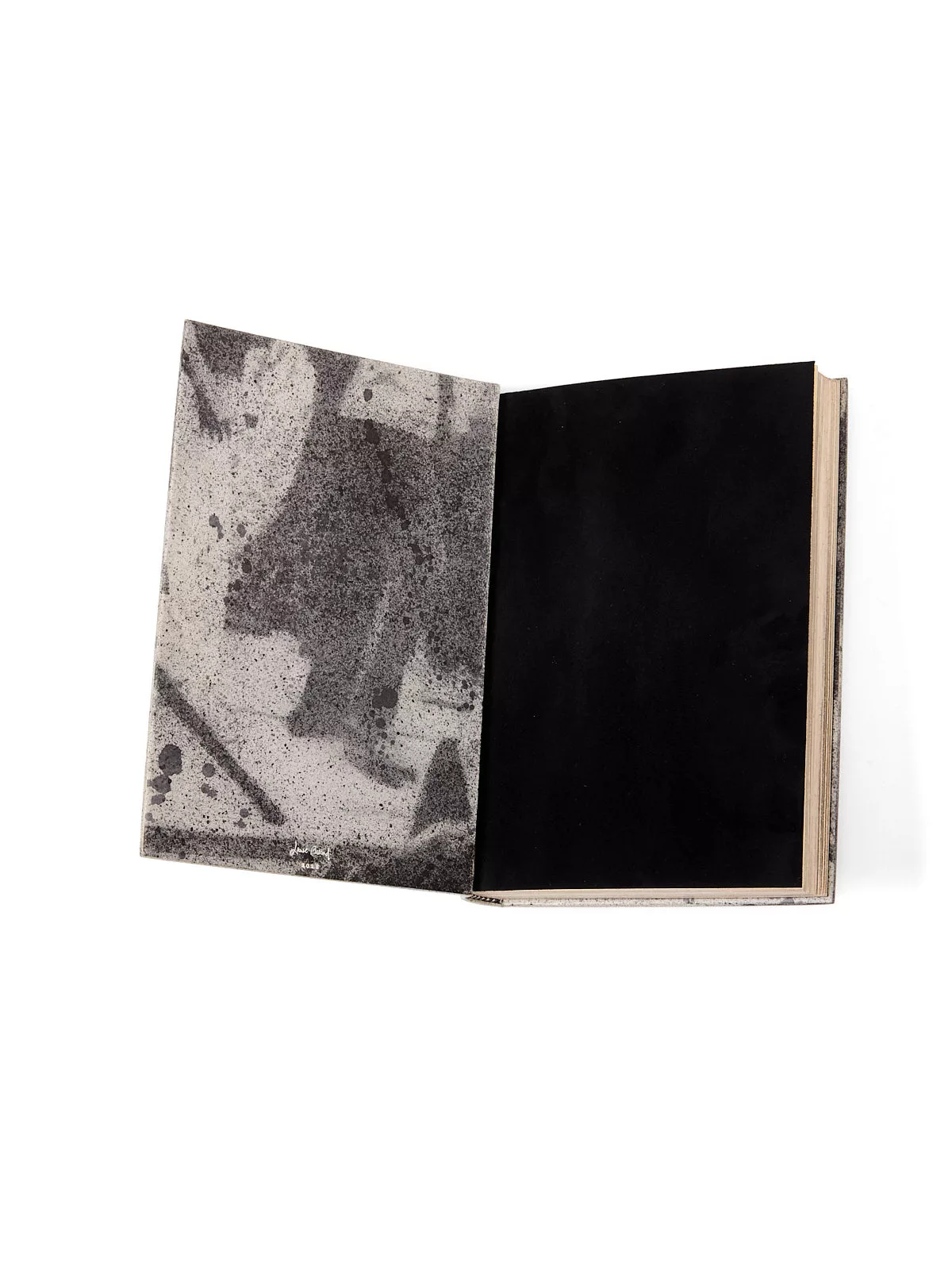
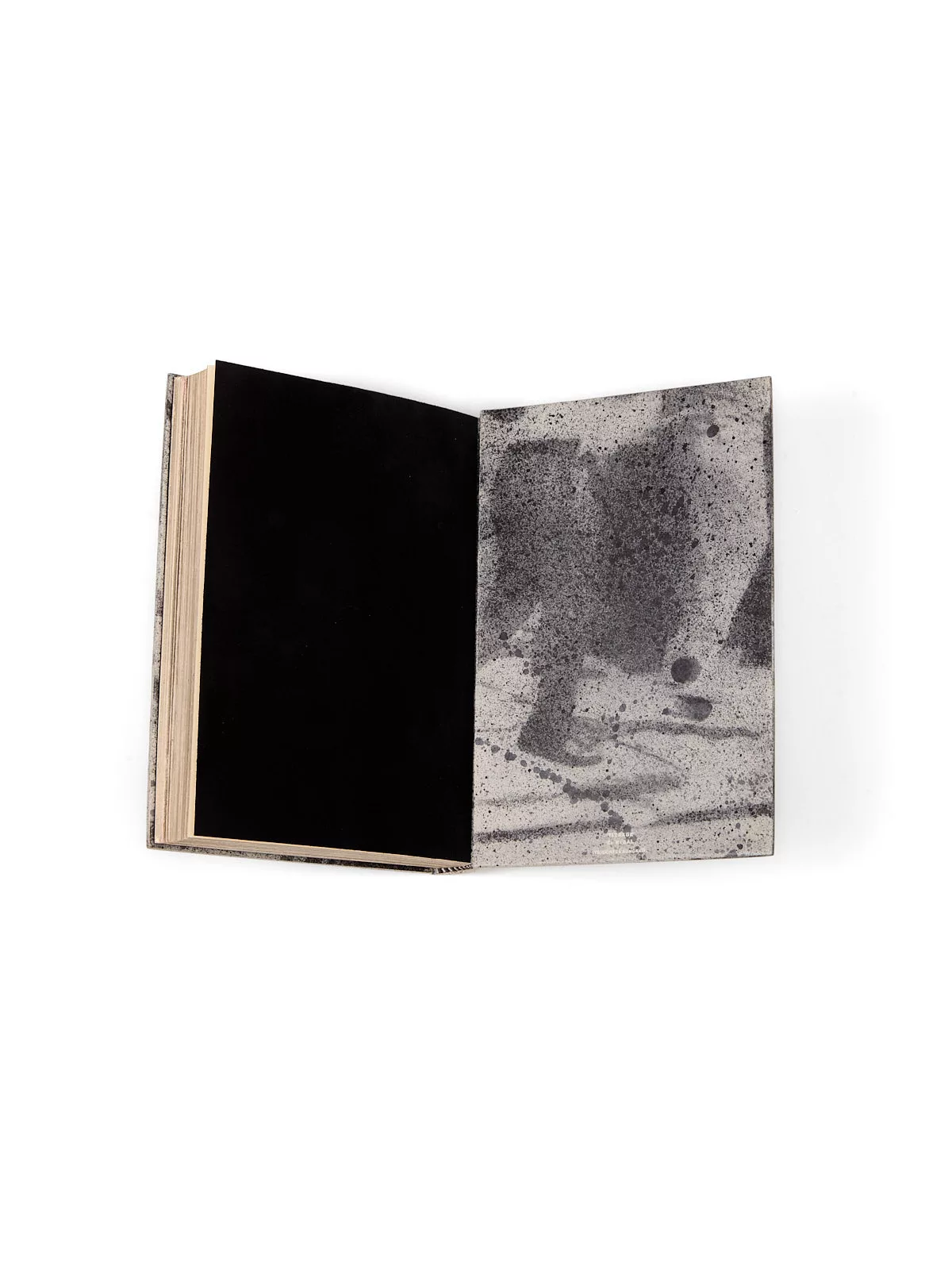
A remarkable copy, exceptionally enriched and magnificently bound by Louise Bescond.
Romain Gary et les animaux (France Culture, 9 April 1970); Romain Gary, genèse de Chien Blanc (France Inter, 11 April 1970); Entretiens avec Francis Galbault (France Inter, 1973).