

Châtiments
It was printed in 2,000 copies, a great many of which were destroyed.
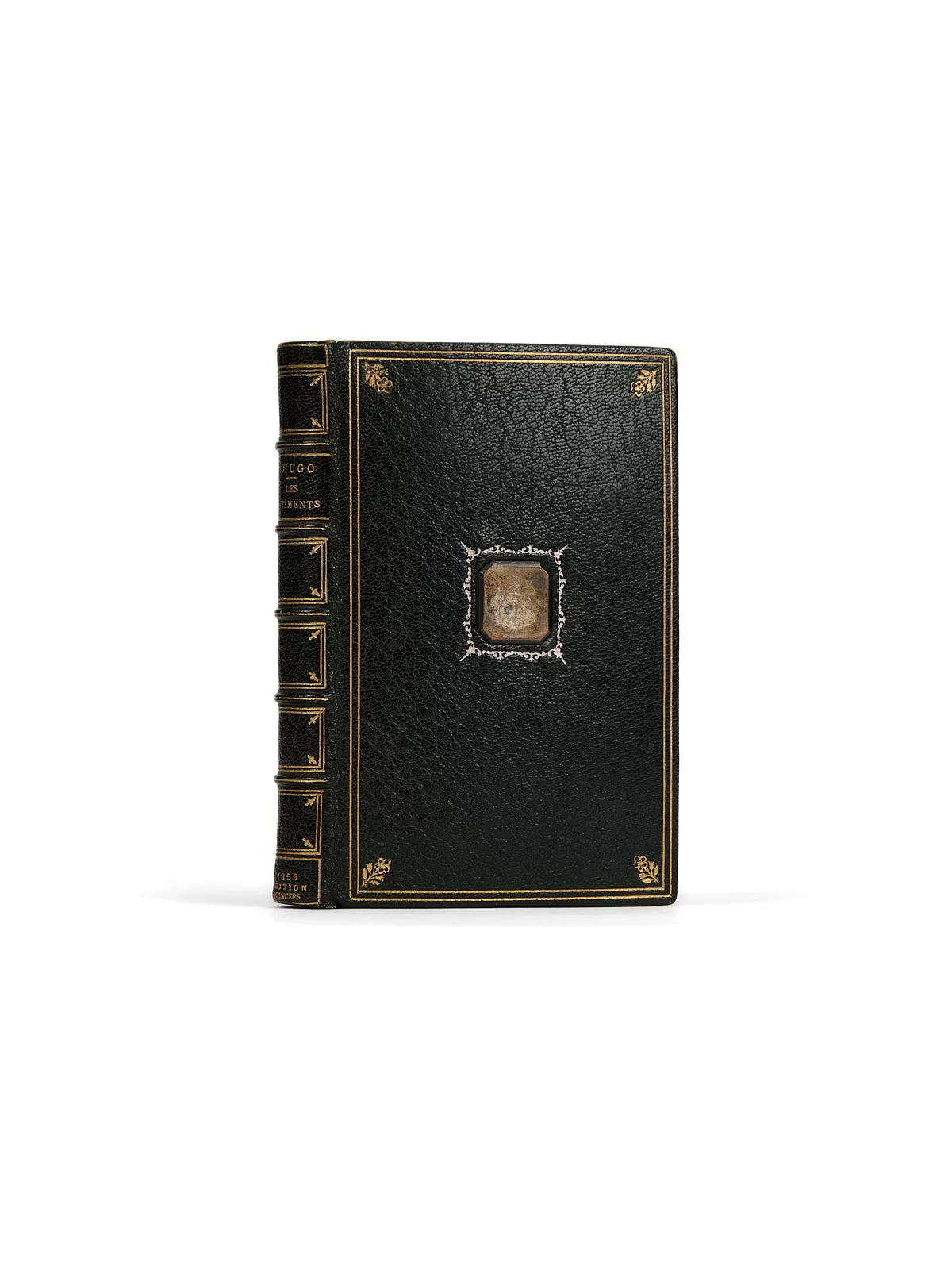
A precious copy that belonged to Julien Stirling, a great Hugo scholar and admirer of the late nineteenth and early twentieth centuries.
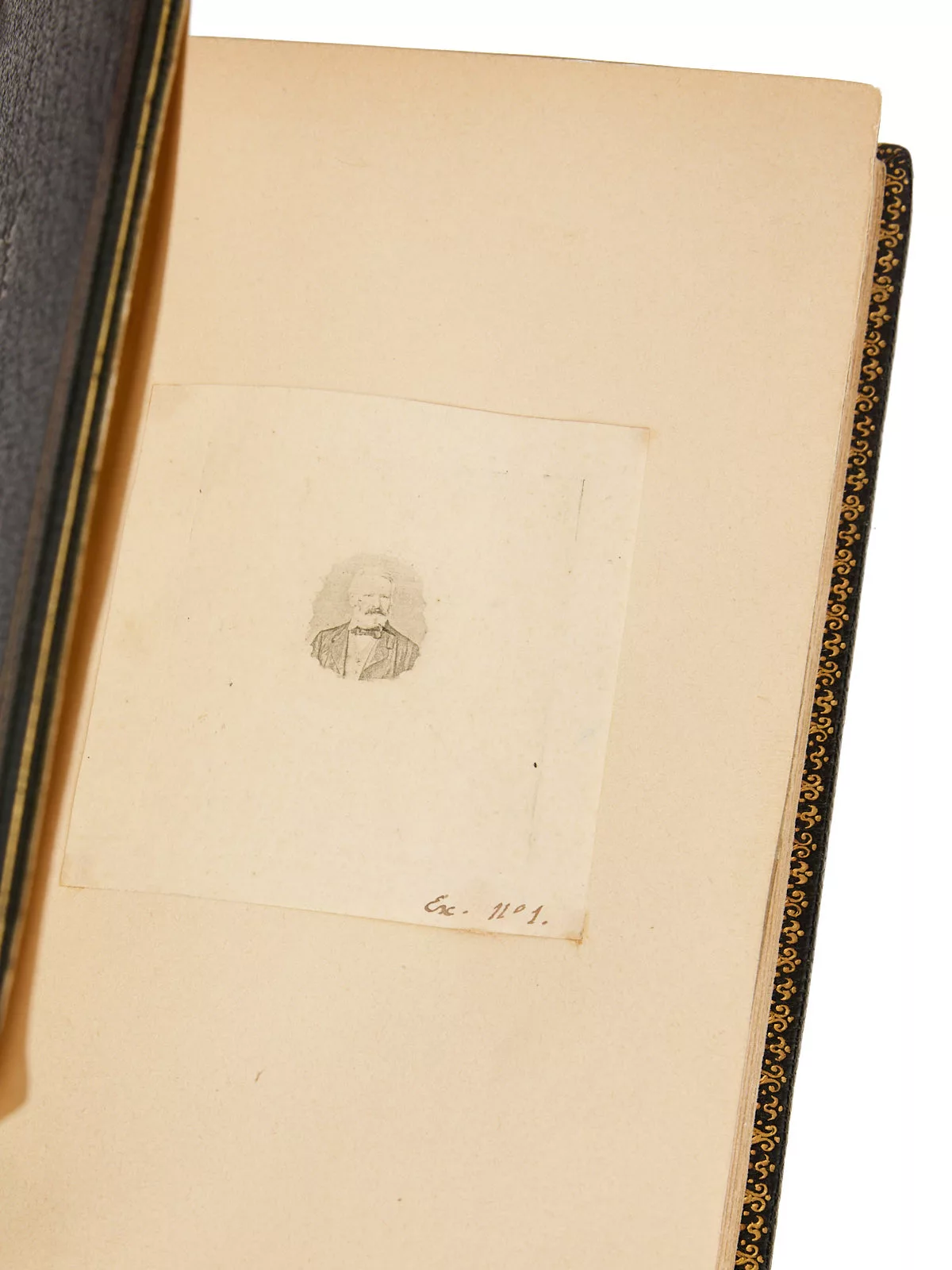
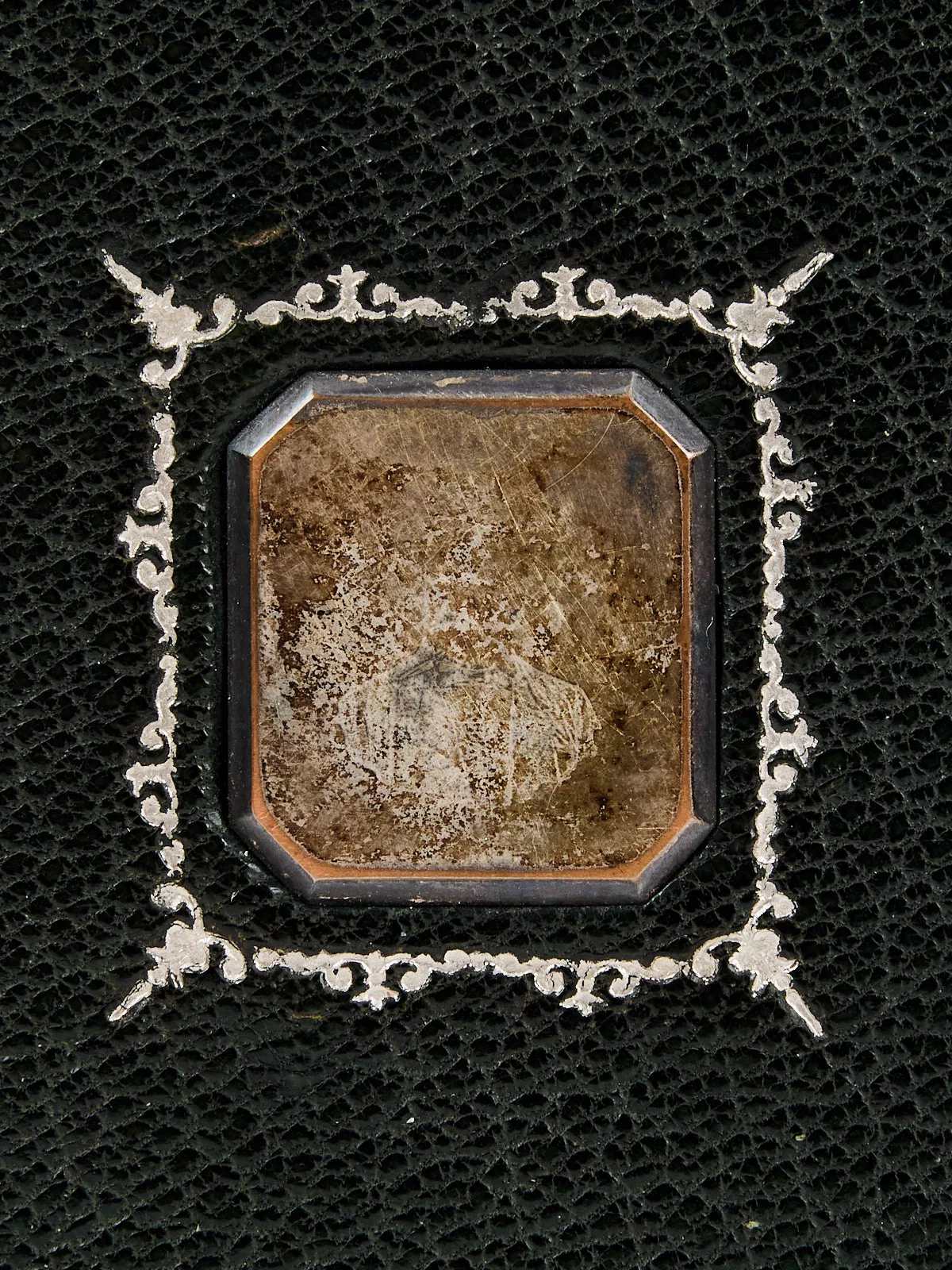
It contains proof no. 1 of the smallest engraved portrait of Victor Hugo, particularly well suited to the format of Châtiments, as well as its original copper plate, mounted on the upper cover of the binding.
Following the coup d’état of 2 December 1851, which brought Louis-Napoléon Bonaparte to power, Victor Hugo was forced into exile. Having interrupted Histoire d’un crime, which he would not publish until 1877, and just as he began writing his pamphlet Napoléon-le-petit, Hugo already had in mind its satirical counterpart, which he considered calling Les Vengeresses, then Le Chant du Vengeur, before settling on the single word Châtiments, a “threatening and simple, that is to say beautiful, title,” as he wrote to his publisher Hetzel.
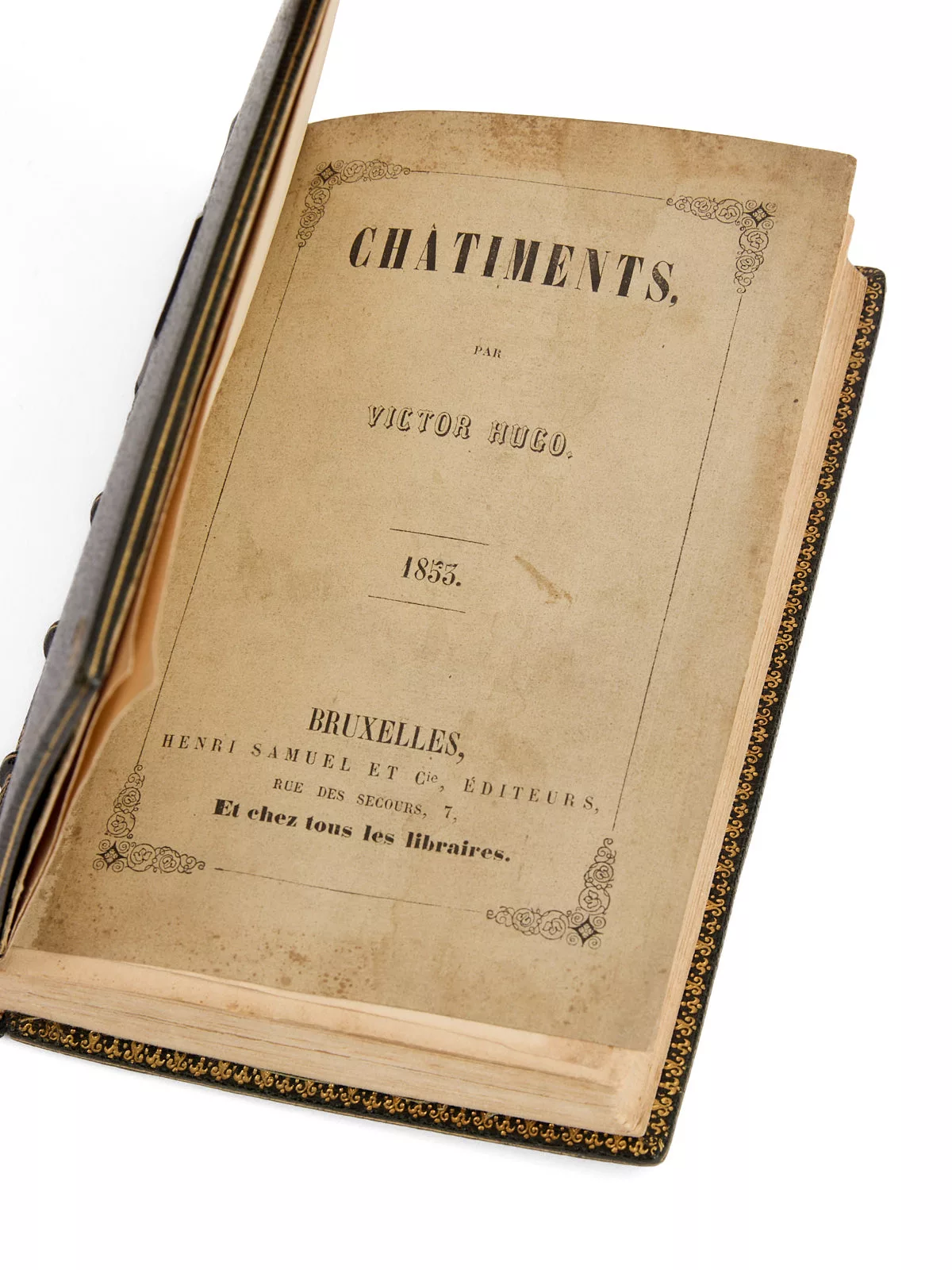
The collection appeared in a double edition in Brussels in November 1853: an official version, self-censored with rows of dots, which Hugo called “the Eunuch.” This is the true first edition of the text.
An important copy, with the original copper plate and one of only eight proofs pulled from the portrait. The portrait is the work of Julien Stirling of Strasbourg, later attached to the Service historique de la ville de Paris. Stirling was a passionate admirer of Victor Hugo, and an entire article was devoted to him in 1903 (in Le Carnet, “Un Hugolâtre [Julien Stirling],” p. 413 ff.). Before Paul Meurice purchased the collection for the founding of the museum, Louis Koch, nephew and heir of Juliette Drouet, had dispersed some items from Hauteville House, several of which were sold to Julien Stirling (in particular items from the dining room).
Stirling had engraved what constitutes the smallest of all portraits of Victor Hugo, of which only eight proofs were pulled.
One of them (no. 4) appears in the Noilly, then Claretie, copy of La Voix de Guernesey (Claretie sale, no. 713), bound by Allô, which allows the date of this portrait’s production to be established during Victor Hugo’s lifetime (Noilly sale in 1886, Allô having died in 1890).
The present copy is Stirling’s own, in which he had the original copper plate of this portrait mounted on the upper cover, while retaining proof no. 1, mounted at the front before the wrapper. We have been unable to locate any of the other proofs of this portrait, apart from that in the Noilly-Claretie copy.
This Brussels edition is indeed the true first, if not princeps, edition of Châtiments. “A great many verses are replaced there by rows of dots; but contrary to what several bibliographers have written, I have it from M. Paul Meurice that Victor Hugo, though he lent it no assistance, never disavowed this edition” (Vicaire).
From the library of Julien Stirling (bookplate).
Clouzot, p. 148; Michaux, Essais bibliographiques concernant les œuvres de Victor Hugo, parues pendant l’exil, pp. 22–23; Vicaire, IV, col. 312; Carteret, I, p. 415.