

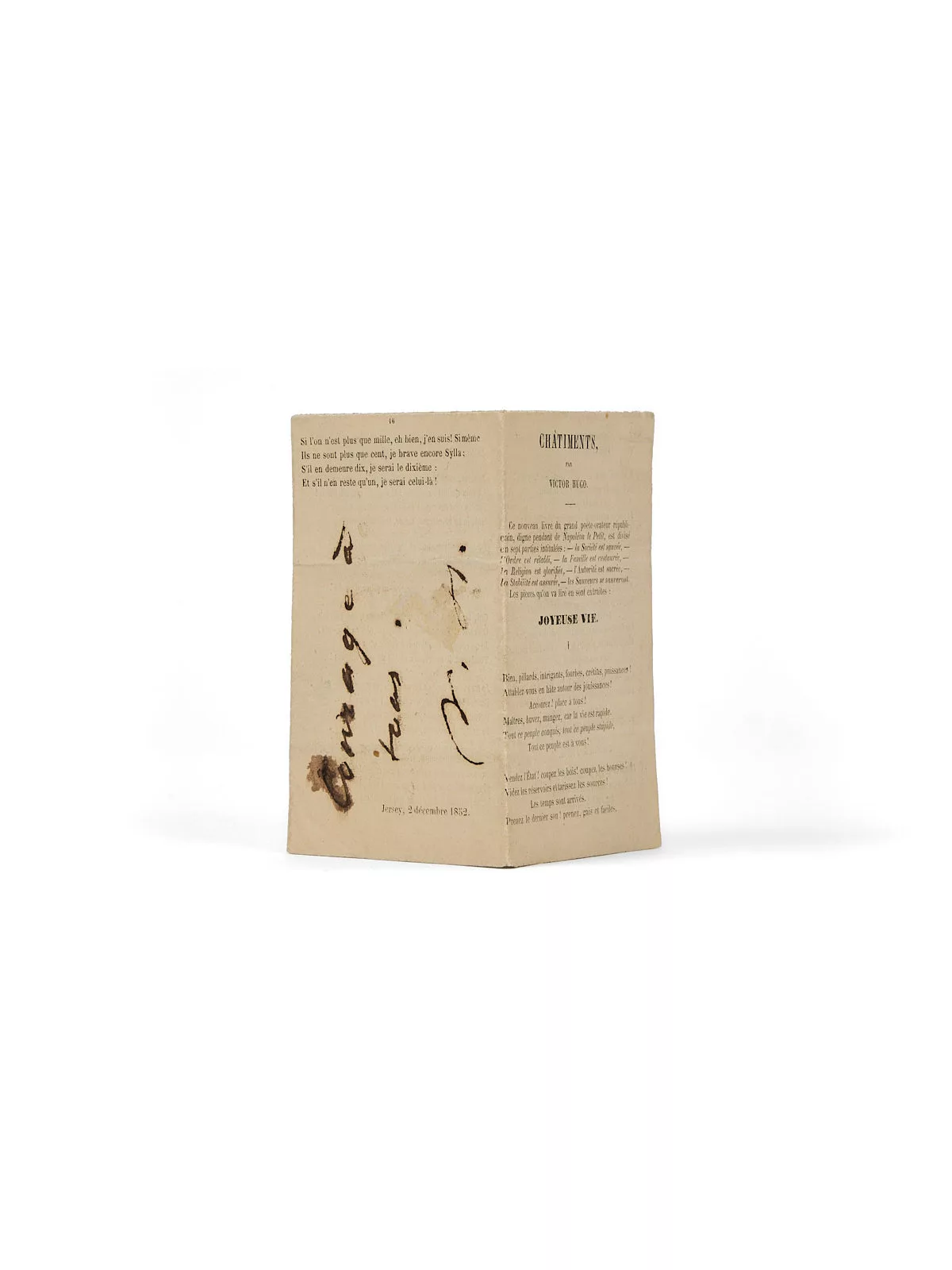
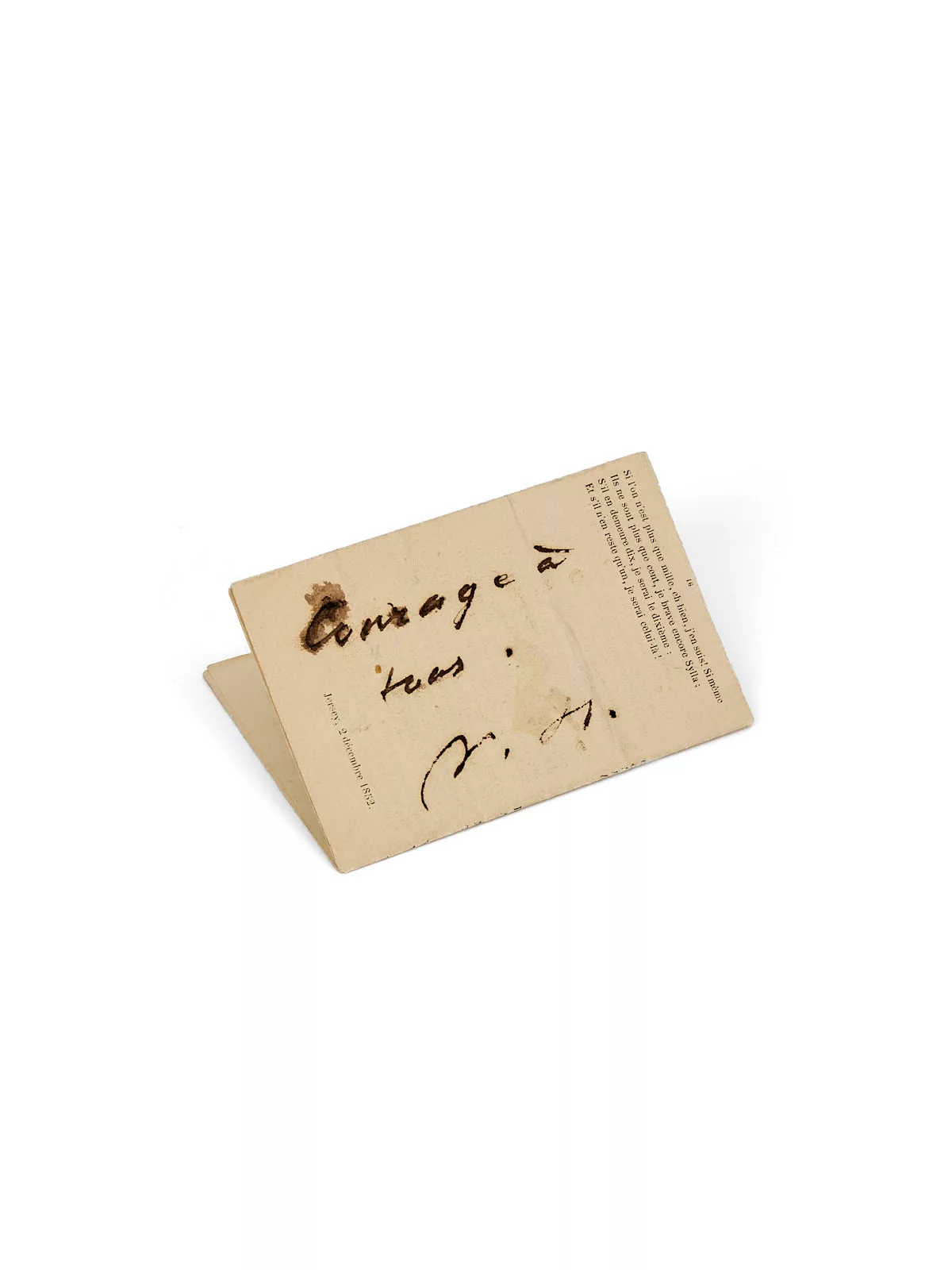
With this autograph note by the author: “Courage à tous. V. H.”.
At the request and under the guidance of the economist Adolphe Blanqui, who had just published a devastating survey of the working classes in 1848, Victor Hugo, accompanied by doctors and several other “authorities,” traveled to Lille in February 1851 to witness firsthand the appalling housing conditions of textile workers. He was horrified by what he found: entire families living and working at home in dreadful conditions, crowded into unhealthy cellars.
On his return, Hugo drafted a speech for the Assembly recounting his visit in vivid detail, citing “the first facts that came to hand, those which chance gave us during a visit that lasted only a few hours. These facts have, to the highest degree, the character of an average. They are horrible.” He never delivered this speech: Louis Bonaparte’s coup d’état of 2 December 1851 left him no time. Threatened, Hugo went into exile in Brussels, then in the Anglo-Norman Islands, where, through his organizational work and his writings, he became one of the leading figures of opposition to the regime: first with Napoléon le petit in 1852, then with Châtiments in 1853.
One of the sections making up the collection — this “Joyeuse vie” — draws directly on the February 1851 visit to Lille:
“Millions ! millions ! châteaux ! liste civile !
Un jour je descendis dans les caves de Lille ;
Je vis ce morne enfer”
which he composed in December 1852. It formed one of four separate offprints of Châtiments, published in unexpurgated extracts by his Belgian printer, Samuel. On 13 December, the latter wrote to him: “I had to hastily produce two extracts in haste, one which you already have, the other which I am sending you here, L’Expiation […] Now I am setting the pieces you indicated to me; I will send you a proof… I printed four thousand copies of the first two extracts — two thousand of each piece.”
It appears that the last two did not have the same print run, and were printed in far smaller numbers. This is particularly true of À l’Obéissance passive: the haste with which this last offprint was set, and its lack of distribution, are confirmed by the unfinished state of its title page — unlike the other three, it contains neither the general title of Châtiments, nor the author’s name, still less the introductory preface. It is also the only one dated 1853; the other three are dated November and December 1852.
A rare copy with an autograph note signed by the author, addressed to an unidentified group of exiles.