

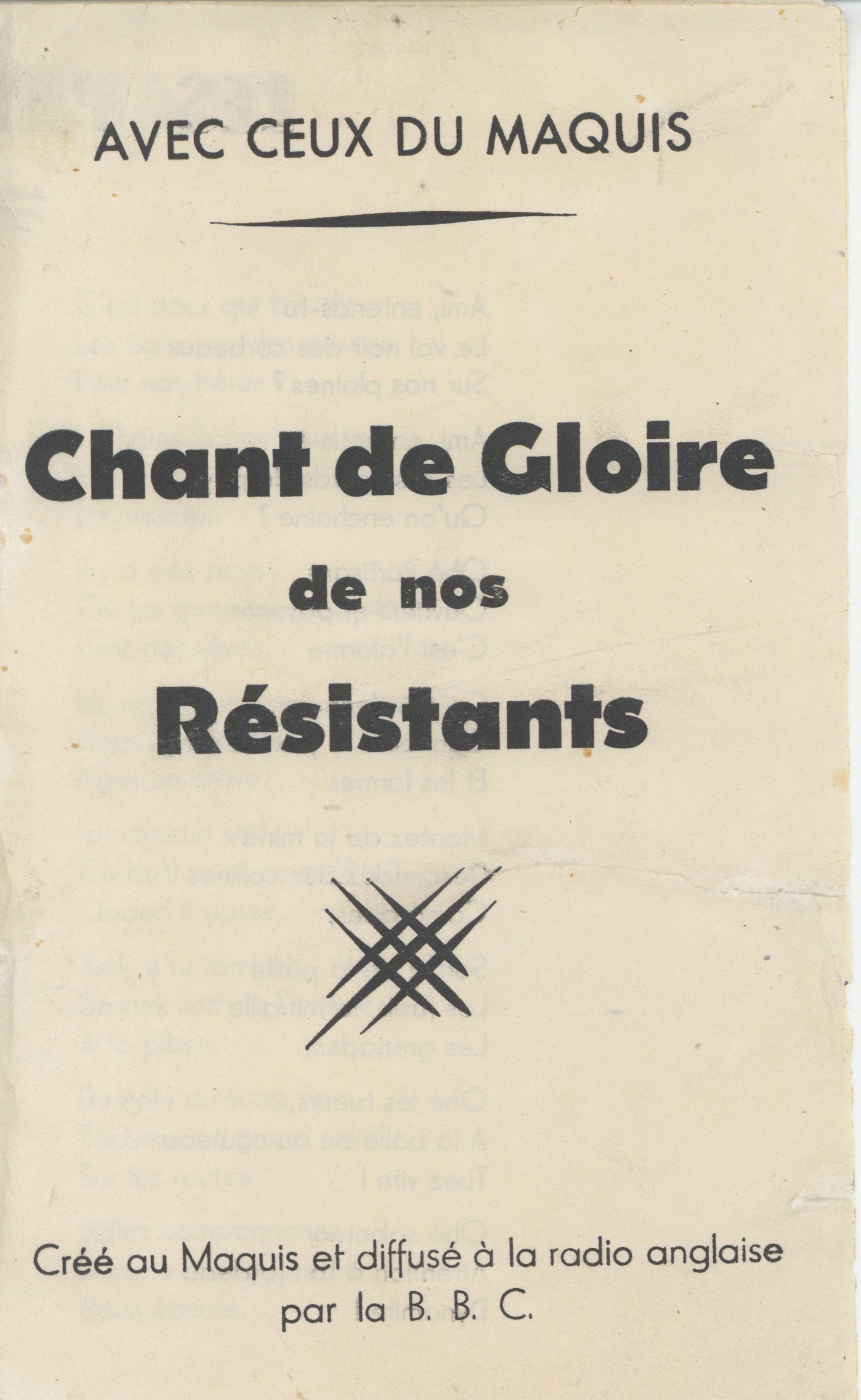
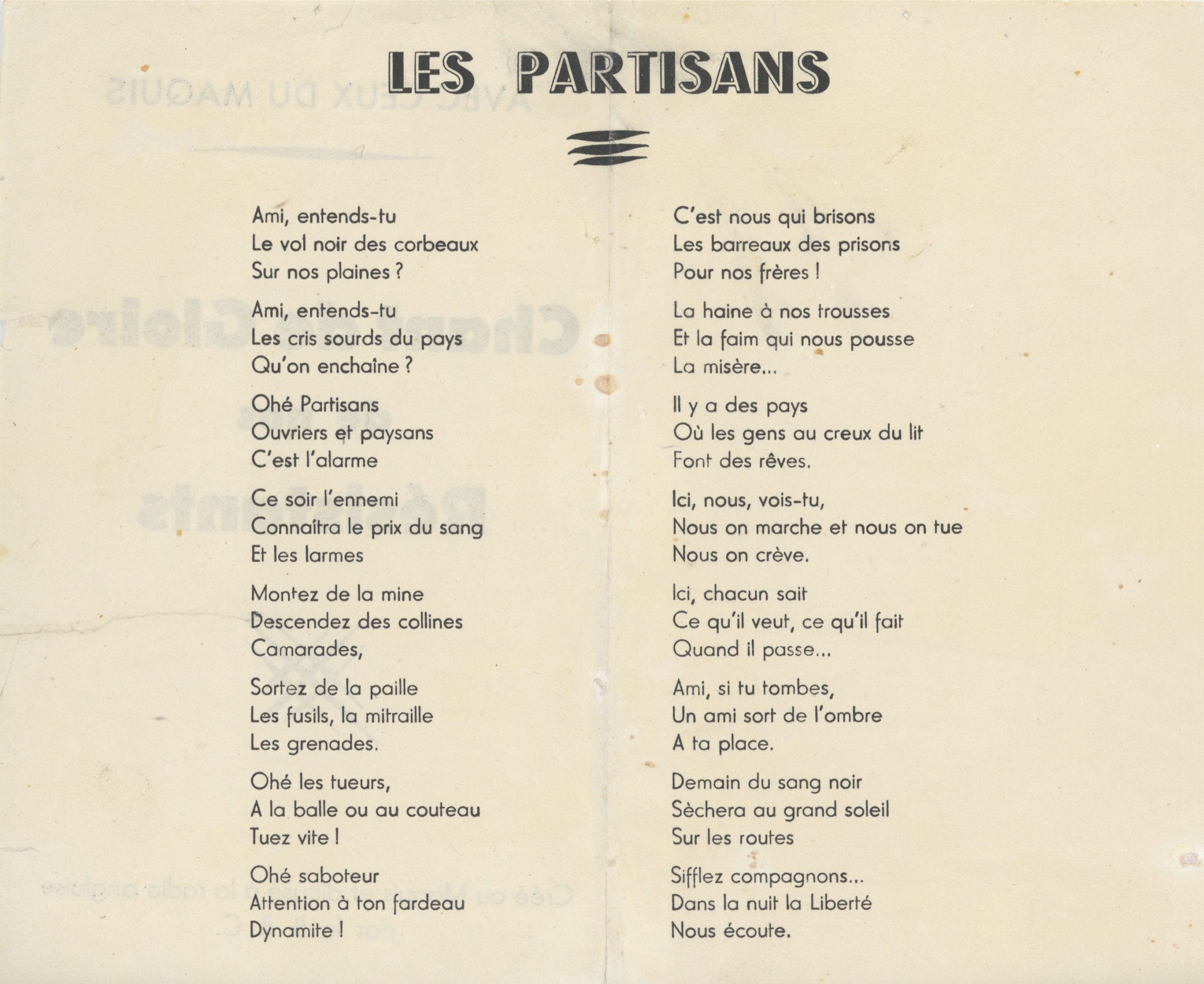
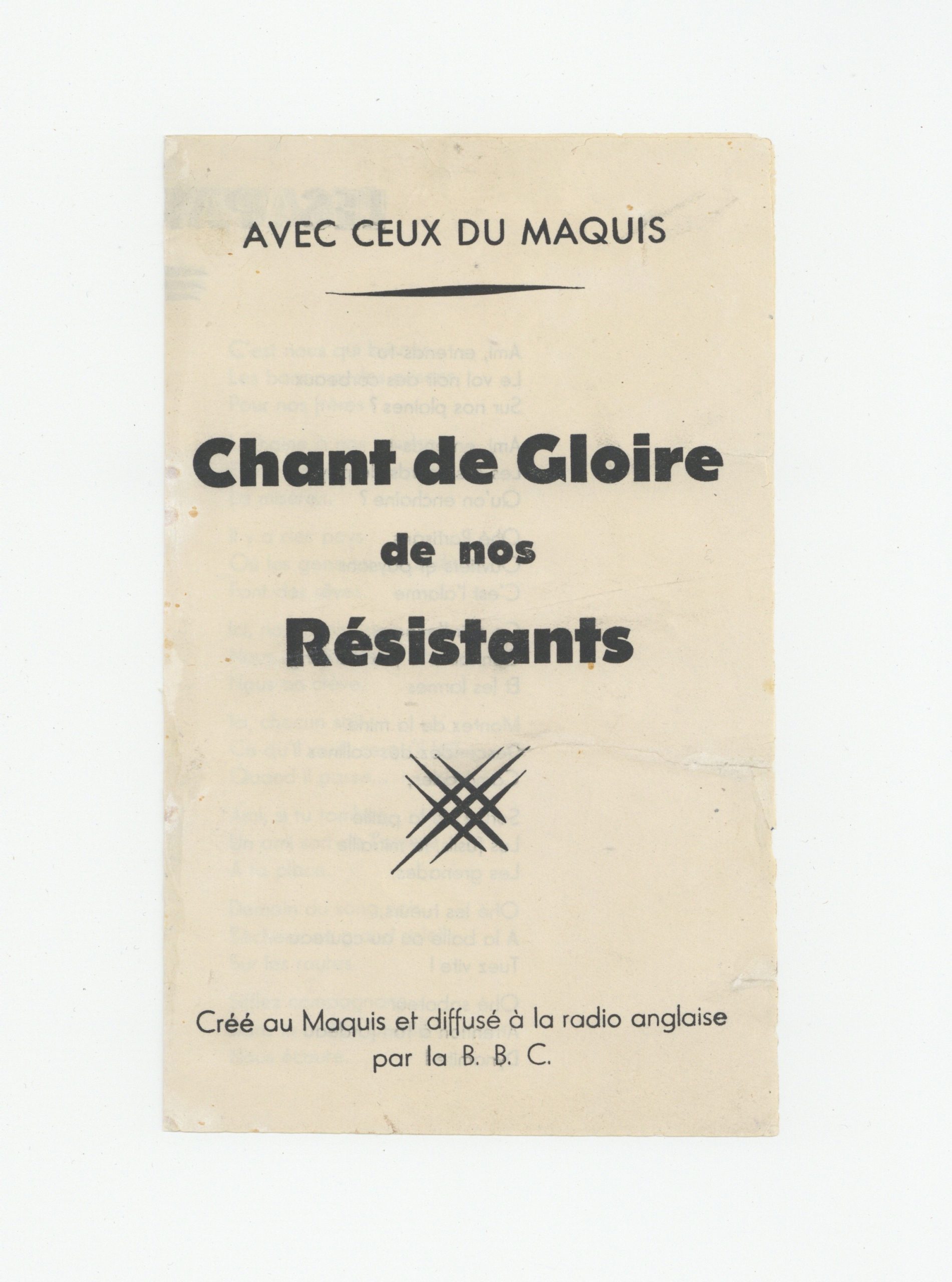
Chant de Gloire de nos Résistants [Le Chant des partisans]
“Le Chant des partisans” (“The Song of the Partisans”), sometimes called “The Marseillaise of the Liberation,” carries a particularly strong symbolic weight: this musical allegory of the struggle against the German occupier has retained the status of a patriotic anthem, and remains one of the rare Resistance melodies still performed at official ceremonies today.
It is one of France’s three official patriotic anthems — after La Marseillaise and Le Chant du départ — under a government decree of 1962.
The melody was composed by a young Russian woman, Anna Marly (1917–2006), who fled Russia after her father’s execution in Petrograd (Saint Petersburg) during the Bolshevik Revolution. Once a dancer with the Ballets Russes de Monte Carlo, she fled the war to England and enlisted as a canteen worker with the Free French Forces under General de Gaulle. She soon put her artistic talents to the service of the Resistance, singing for British, Czech and Polish soldiers in the Théâtre aux Armées. On tour at a British naval base in 1941, she read in a newspaper of the role Soviet partisans had played in the Battle of Smolensk on the Eastern Front. She then composed — in Russian — a song called Marche des partisans: “I scratched out a few notes and improvised words in which I already spoke of the flight of crows. I went back on stage and dared to hum it, striking my guitar to hammer out the sound of marching soldiers. The smoke-filled hall was packed with sailors. When my improvised song ended, all the English sailors fell silent at first, almost reverent. A hypnotic silence. Then they began to applaud wildly, stamping their feet frantically.”
Anna Marly performed it several times on stage, and it was at one such performance that Emmanuel d’Astier de la Vigerie, journalist and Compagnon de la Libération, heard it. He then suggested the rousing tune to André Gillois, daily host of “Honneur et patrie,” the Free French radio program broadcast by the BBC between 1940 and 1944: “Ici Londres, les Français parlent aux Français,” he announced each evening. “La Marche des partisans,” wordless and whistled, became the program’s signature tune from 17 May 1943 to 2 May 1944. For d’Astier de la Vigerie, founder of the Libération Sud movement, who believed that “a war is only won with songs,” the conclusion was simple: the Resistance needed its own song.
The decisive encounter for its composition took place a few days later, at an evening gathering of the Combat network. Joseph Kessel, newly arrived across the Channel with his companion Germaine Sablon and his nephew Maurice Druon, was captivated by the tune. Under d’Astier de la Vigerie’s direction, who gave them Anna Marly’s original Russian version — which Kessel could read perfectly — the two men and the young woman set to work writing French lyrics.
It was at a corner table of a Surrey inn, the Ashdown Park Hotel in Coulsdon South, on 23 May 1943, that the manuscript of the song was composed, and it was performed for the first time that same evening, back in London, at the home of Louba Krassine, Emmanuel d’Astier de la Vigerie’s companion.
A week later, on 30 May 1943, “Le Chant des partisans” as it has come down to us was recorded by Germaine Sablon, to provide the musical accompaniment for Three Songs about Resistance, a propaganda film featuring, as its title suggests, three songs on the theme of resistance. Its director, Alberto Cavalcanti, gives a different chronology: “One Sunday in May, Germaine Sablon telephoned me from Coulsdon South, near London, to tell me she had finally managed to get Joseph Kessel and Maurice Druon to write words that afternoon, and we arranged to meet the next day at Ealing Studios. Indeed, Germaine Sablon, accompanied by Kessel, brought me the words set to music by Anna Marly. Germaine Sablon, with the studio’s arranger, worked out the accompaniment, and by the end of the week the film was finished. That is how Germaine Sablon created Le Chant des Partisans.” (Cavalcanti, in Revue de la France libre, no. 153, November–December 1964).
On that same day, 30 May 1943, Charles de Gaulle, head of Free France, arrived in Algiers in the utmost secrecy to found the Comité de libération nationale, merging the Comité national français of London, which he led, with the French Civil and Military High Command of Algiers, led by General Giraud, in order to unify the French war effort and prepare for the Liberation. Emmanuel d’Astier de la Vigerie was appointed Commissioner of the Interior in November. In the meantime, he had ensured that “Le Chant des partisans” crossed the Channel: on 24 September 1943, its words were clandestinely printed in occupied France, in Auch, in the first issue of the Cahiers de la Libération. Since few people had access to this underground review, d’Astier de la Vigerie had a leaflet printed with the words, intended to be dropped by the Royal Air Force over French territory. Wishing to give the impression that the song came from the maquis — a term denoting, by his own definition, “both a group of resistance fighters and the place where they operated during the Second World War” — this two-leaf sheet bears the note “created in the Maquis and broadcast on English radio by the B.B.C.” It is not impossible that this printing predates the “official” appearance in the Cahiers de la Libération, a copy of which is included. Unlike the French version, the title here is “Les Partisans,” without the subtitle “Chant de la libération.” The text was finally reprinted in the review Fontaine, under the direction of Max-Pol Fouchet, on 25 December 1943.
We have been unable to trace even a single institutional holding of this leaflet, which is absent, notably, from the collections of the Bibliothèque nationale, the Musée national de la Résistance and the Musée de l’Armée at the Hôtel national des Invalides.
We know of only two other copies, both in private collections.
Alongside the spread of this anthem, Kessel devoted himself full-time to completing a project begun since his arrival: a tribute to the Resistance, finished thanks to accounts gathered from d’Astier, Colonel Rémy and other resistance fighters he met in Free French circles in London. Completed in September 1943, his “long version” of the Chant des partisans, L’Armée des ombres, was published in Algiers by Edmond Charlot.
Some restoration to this fragile and ephemeral publication.