

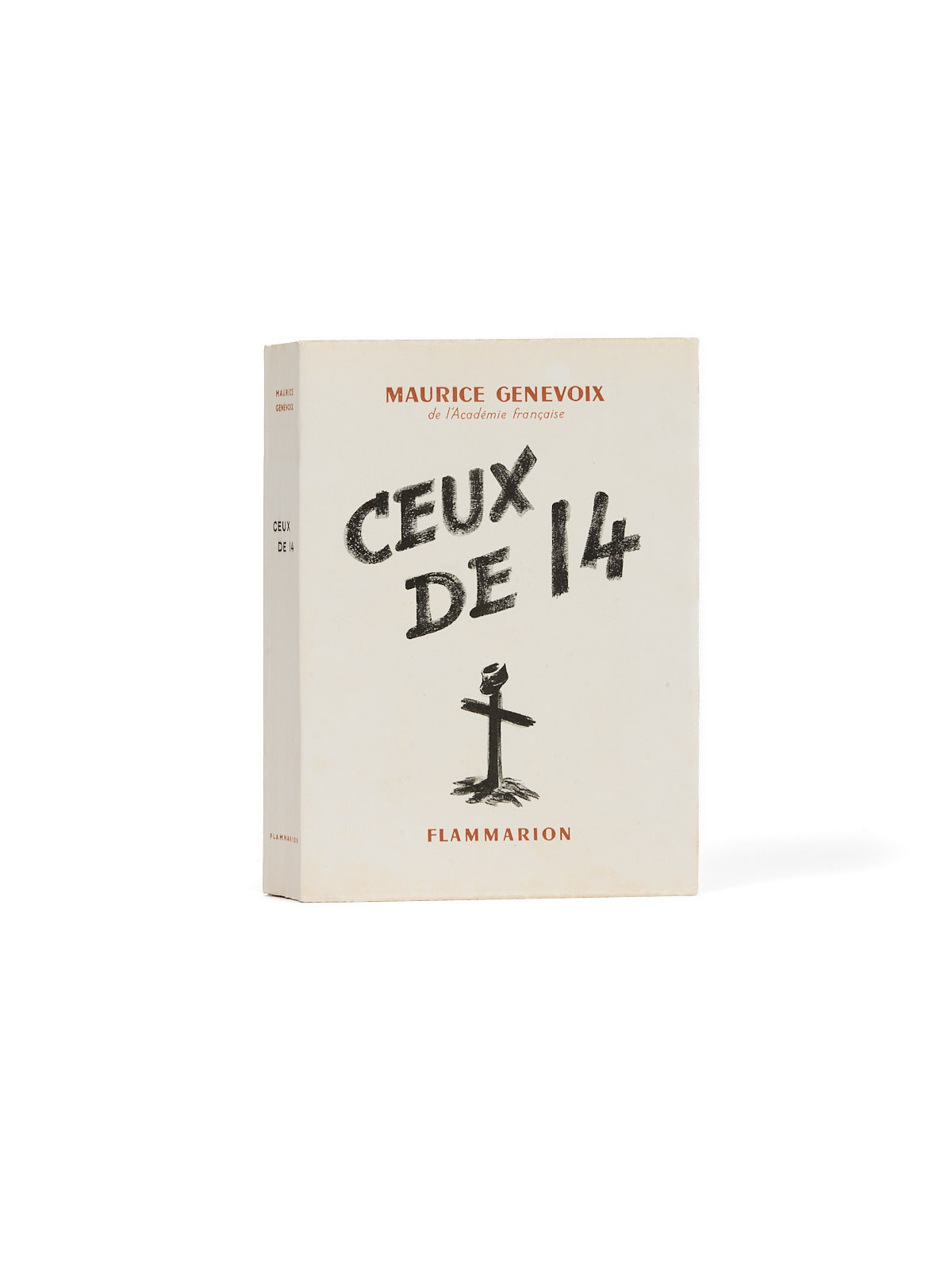
Ceux de 14
A young student at the École normale supérieure, Maurice Genevoix joined the 106th Infantry Regiment in September 1914 and fought in the Argonne, notably at the Tranchée de Calonne, where he was seriously wounded six months later, on 25 April 1915, by three bullets — two in the arm and one in the chest. After seven months of treatment, he returned to Paris, to the rue d’Ulm, and, encouraged by Paul Dupuy, the secretary general of the École normale supérieure with whom he had corresponded extensively during the fighting, agreed to write up his testimony, publishing Sous Verdun in April 1916. It was followed by Nuits de guerre in December, Au seuil des guitounes in September 1918, La Boue in February 1921, and finally Les Éparges in September 1921 — a body of work at once historical and literary, unquestionably ranking among the foremost testimonies published on the First World War.
Where other “great works” by war writers (Roland Dorgelès’s Les Croix de bois, Henri Barbusse’s Le Feu, Georges Duhamel’s Civilisation, to name the principal ones) can be criticized for lyrical excess or for narratives centered on the individual rather than the collective experience, Genevoix’s accounts are regarded as depicting the war, its madness, its cruelty, and its bodies torn apart by shells and bullets — as well as the camaraderie of the trenches — with a rarely matched authenticity, not to mention his political commentary. So much so that the first two accounts, judged too realistic, were cut by nearly 200 pages by French censorship at the time of their original publication in 1916. In the race for the Prix Goncourt, only Octave Mirbeau’s vote counted against Barbusse’s Le Feu. Les Éparges met the same fate: a truncated text and a delayed publication, since Genevoix leveled even more forceful criticism at a high command willing to sacrifice 10,000 men to take a ridge.
In 1949, Genevoix decided to gather these writings under the unifying, tributary title of Ceux de 14. He took the opportunity to rework the division of the narratives and made some adjustments to the original texts, reducing them from five accounts to four. The book was a critical and popular success, giving Genevoix an unrivaled authority on the subject. “Ceux de 14 is an absolute masterpiece that reads like a rise toward sacrifice and horror. Its summit is the battle of Les Éparges, the paroxysm of violence, one of the worst ordeals of 1914–18,” writes Michel Bernard, author of Pour Genevoix (La Table ronde, 2011).
The working manuscript of Ceux de 14 was donated by Maurice Genevoix’s grandchildren to the French state: it entered the collections of the Bibliothèque nationale de France on 4 November 2020. A week later, on 11 November, Maurice Genevoix entered the Panthéon, symbolically accompanied by Ceux de 14, thanks in part to the combined efforts of sub-prefect Michel Bernard and the economist and journalist Bernard Maris, who, with L’Homme dans la guerre, Maurice Genevoix face à Ernst Jünger (Grasset, 2013), had persistently reminded readers of the literary importance of the author of Raboliot. Bernard Maris, the last companion of Sylvie Genevoix and her successor as president of the association “Je me souviens de Ceux de 14” and of the “Société des amis du Mémorial de Verdun,” was killed by terrorists on 7 January 2015 and so did not live to see this national tribute.
In total, seventy-six men and seven women currently rest in the vaults of the republican temple by virtue of their personal merit, of whatever kind. Maurice Genevoix is one of seven writers so honored, the only one from the last century besides André Malraux.
“Ceux de 14 is a masterpiece too little read. Crowned with the Prix Goncourt in 1925, Raboliot surrounded Maurice Genevoix with an ambiguous prestige. The great memoirist was forgotten in favor of the impeccable craftsman of stories about hunters, fishermen and poachers. The mud of Les Éparges gave way to watercolor images of the Loire Valley. La Boîte à pêche (1926), Rroû (1931), Le Jardin dans l’île (1936), La Dernière Harde (1938), Eva Charlebois (1944) and Lorelei (1978): a perfect magician of French letters, Genevoix left behind an abundant body of work and an endless reservoir of dictations and grammar examples” (Sébastien Lapaque, “Maurice Genevoix, couvert de gloire et inconnu,” in Le Monde, 11 November 2020).
After the Panthéon, the Pléiade cannot be far behind!
A rare deluxe-paper printing, seldom encountered.
Of this text, Maurice Genevoix kept the original manuscript (now at the BnF), two working copies, and several copies of the first edition, which he kept in the library-study of “Les Vernelles,” his home on the banks of the Loire near Orléans.
This copy comes from there and bears the bookplate of the house.
Light scattered foxing.