

Céline au Danemark
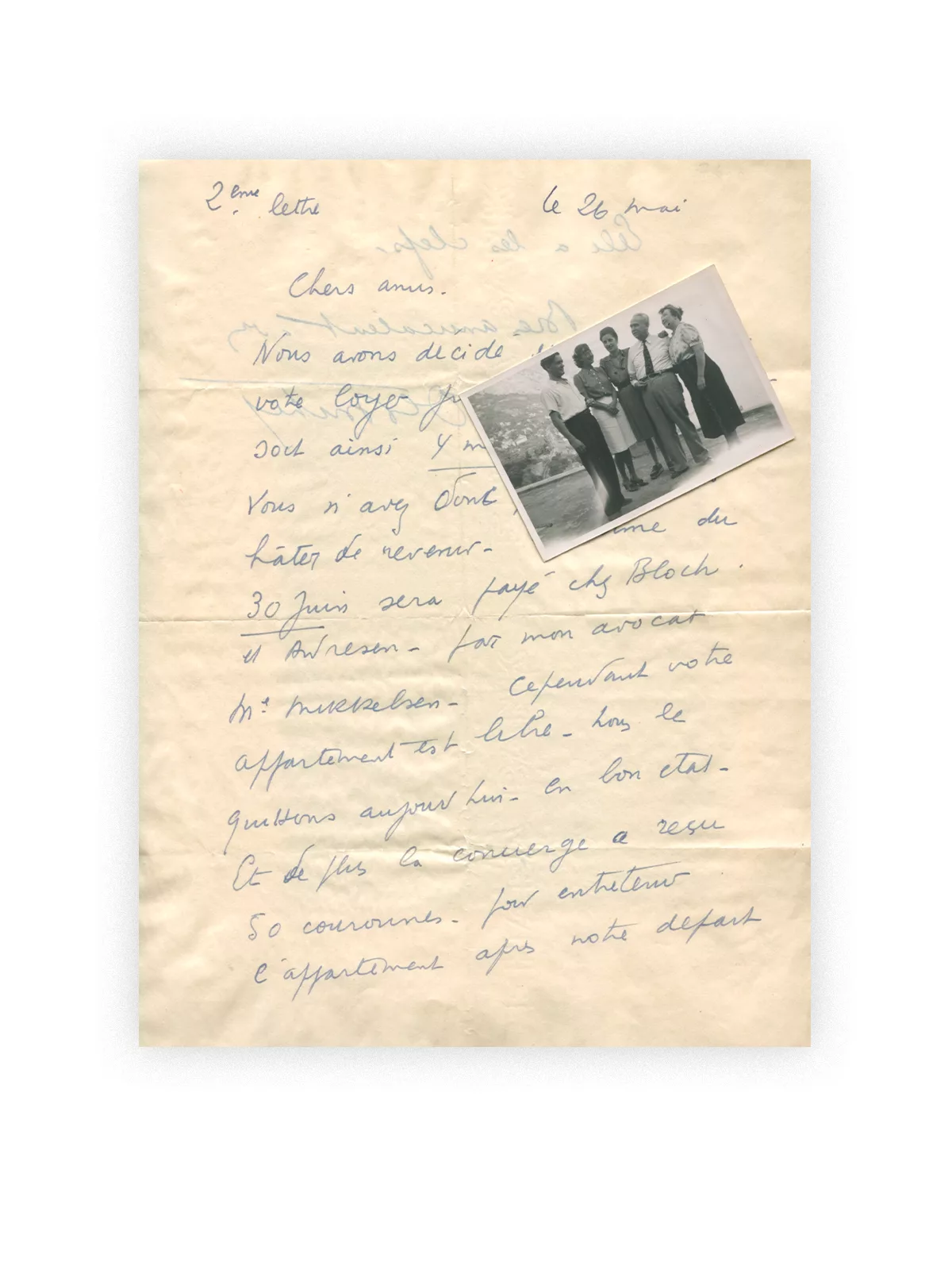
* An autograph letter signed (210 x 297 mm), recto-verso, on the yellow laid paper Céline used during his exile, in blue ink, in a very legible hand, dated Copenhagen, 26 May 1948, and signed “L.F. Destouches”: “Chers amis, Nous avons décidé de payer encore votre loyer jusqu’au 30 septembre soit ainsi 4 mois d’avance. Vous n’avez donc point à vous hâter de revenir […]. Cependant votre appartement est libre. Nous le quittons aujourd’hui” — a letter that raises a small chronological puzzle, since it is generally accepted that the Destouches couple settled in Korsør on 19 May 1948 (see Éric Mazet, “Repères chronologiques Avril-Mai 1948,” in Lettres à Antonio Zuloaga, p. 101). Else Jensen’s own testimony confirms that the apartment was returned in perfect condition, and that Céline was lavish in his gratitude to the Jensens for their hospitality.
* Two identity-card application receipts for Mr. and Mrs. Jensen, each bearing a photograph of either Else or Henning Jensen.
* A letter from Henning Jensen to the Danish consul general, written by and on behalf of Ercole Pirazzoli (the second husband of Lucette Destouches’s mother, previously divorced from Joseph Almansor). The text is a hagiographic account of “Monsieur Pirazzoli, Commander of the Crown of Italy, Knight of the Legion of Honor, a former industrialist, secretary for several years of the general delegation in France of the Italian Red Cross, and a board member for 22 years of the Italian Chamber of Commerce of Paris — a person of the highest honor and moral standing. He has never engaged in politics, and all who know him gladly attest to his great kindness, loyalty, and integrity,” intended to secure a visa allowing Lucette’s parents to visit her and Céline in Denmark. “If my wife and I were able to obtain permission to stay in France, we owe it to Monsieur and Madame Pirazzoli.”
* An original black-and-white photograph taken in Menton showing Mr. and Mrs. Jensen, Mr. and Mrs. Pirazzoli, and an unidentified friend.
Else and Henning Jensen were a couple of painters, and the first people in Denmark to help Céline and Lucette. At the time of Céline’s incarceration, Henning Jensen was also a prison guard at Vestre Fængsel, where he befriended Céline.
Céline had seen the Danish police arrive on 17 December 1945, following an extradition request from France. Lucette, released after a few days, urgently needed to find lodging. “A housing solution then arose thanks to this prison guard […] who dreamed of going to the south of France with his wife. We reached an agreement. My mother [Gabrielle Pirazzoli, known as Gaby] made a room available to him in Menton, leaving him a little money, while he, in turn, lent us his own lodgings for that time — a painter’s studio, a garret at 8 Kronprincessegade” (Vitoux, La Vie de Céline, p. 614). Lucette moved in that September. Céline himself would not be released until 24 June 1947. They remained there for nearly eleven months, until 19 May 1948, when they accepted the offer of their lawyer, Mikkelsen, to house them on his estate at Korsør.
A very fine group of documents, gathered in a binding created by Nobuko Kiyomiya.
The letter which raises a small chronological puzzle: see Éric Mazet, “Repères chronologiques Avril-Mai 1948,” in Lettres à Antonio Zuloaga, p. 101.