

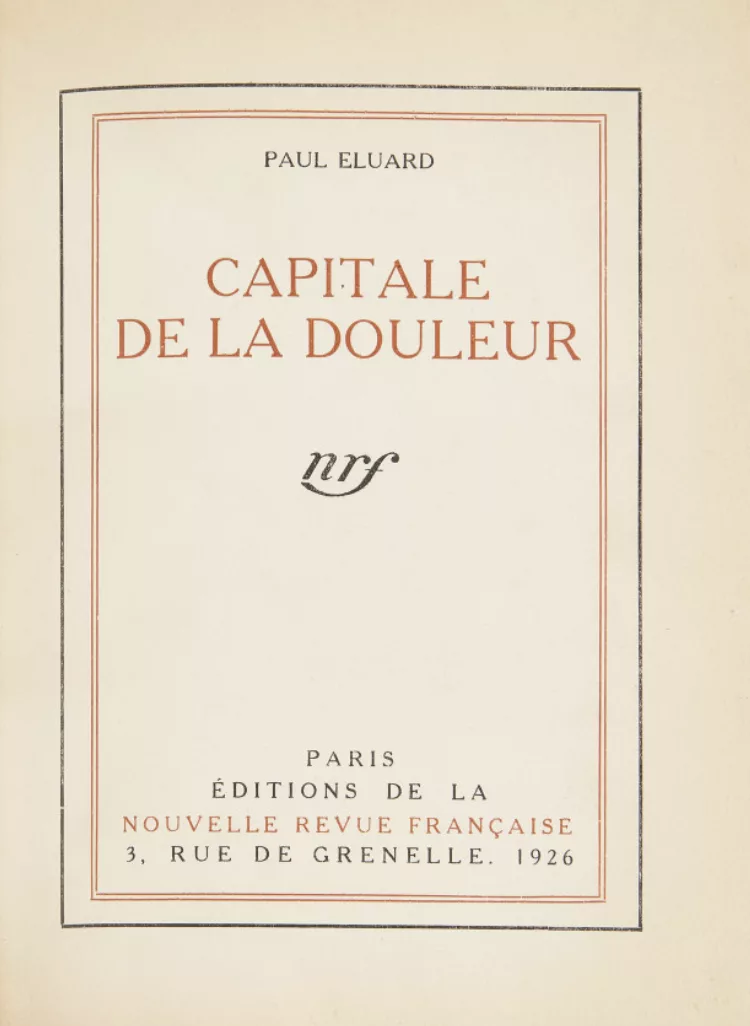
Capitale de la douleur
One of 109 deluxe réimposé copies in quarto Tellière format (no. V).
When Capitale de la douleur appeared in 1926, the poet who already signed himself Paul Éluard (Eugène Grindel had adopted the pseudonym in 1916) gathered together for the first time in a single volume two periods of his life and two phases of his work, under a title whose very ambiguity expresses the coherence of these two ways of seeing. Éluard, then thirty-one, assembled texts mostly already published in limited editions (setting aside those he had disowned, rejected or even destroyed): Répétitions, Mourir de ne pas mourir, extracts from Pour vivre ici, and texts from Au défaut du silence, originally published secretly in 1925 with anonymous illustrations by Max Ernst.
The first review of the book, published in L’Humanité on 31 October 1926, was written by a certain Maurice Parijanine, who prudently signed himself “P.” In a few lines he demolished Éluard’s verse, dragging his masters — Rimbaud, Lautréamont and Mallarmé — into the attack, comparing him to a fantaisiste like P.-J. Toulet, before concluding: “We pay him the tribute of recommending him to no one.” Outraged on more than one count, Éluard protested in a letter that the newspaper’s editors, despite the author’s request, naturally did not publish. Had Parijanine even read “La courbe de tes yeux fait le tour de mon cœur”?