

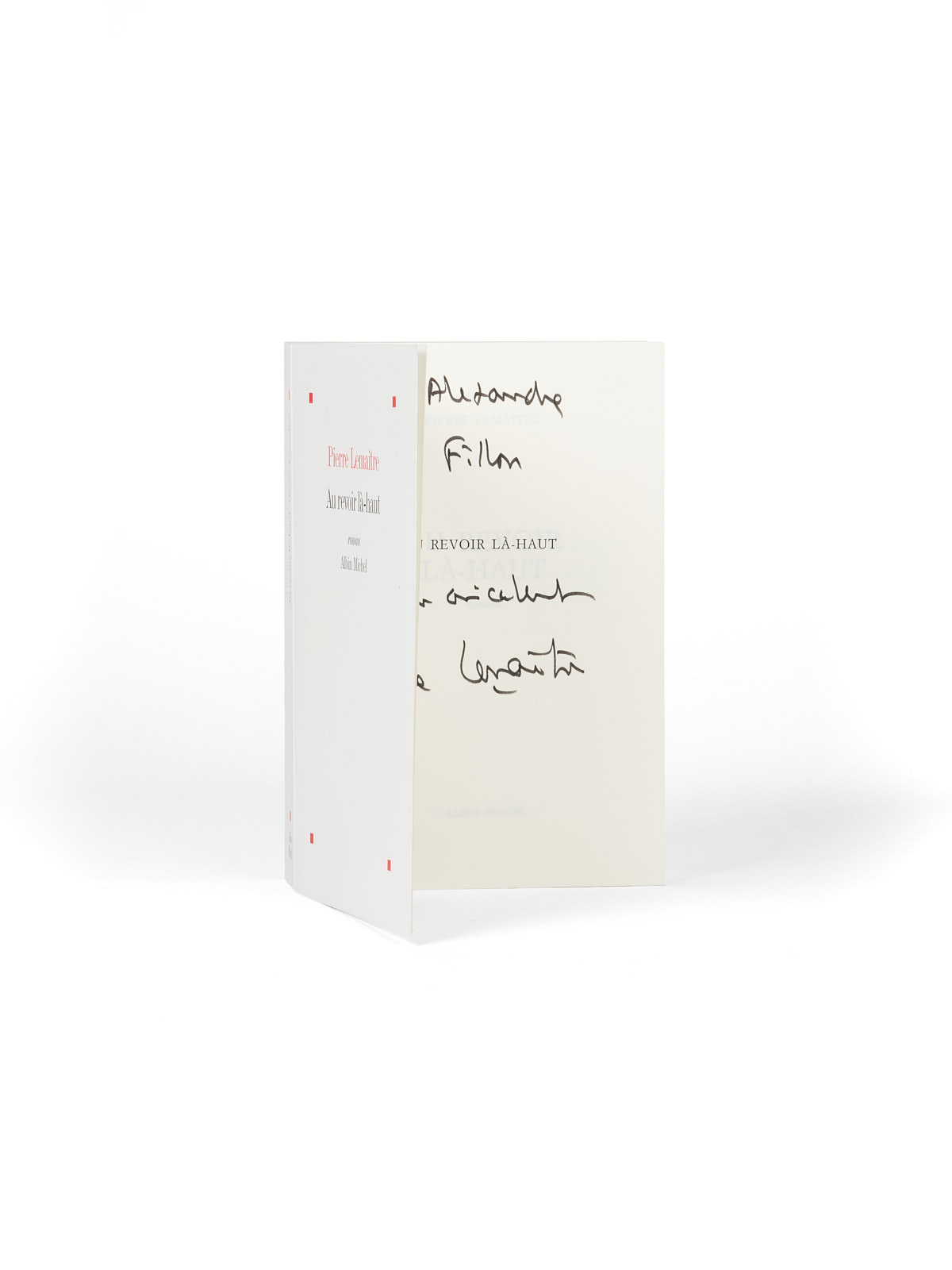
Au revoir là-haut
Signed presentation inscription: “Pour Alexandre Fillon. Bien amicalement, Pierre Lemaître.”
Rare first printing of one of the major Prix Goncourt winners of the 2010s, brilliantly adapted for film. The subject, however, is a well-worn one — even among Goncourt laureates: the Great War and its aftermath.
“We think we are dying for our country, but we are dying for industrialists,” Anatole France protested in July 1922. This is the central theme of Au revoir là-haut, which lifts the veil on the scandal of military exhumations, hushed up by the government in 1922. This fresco of rare cruelty, remarkable for its architecture and evocative power, had been in the author’s mind since he was seventeen: “Every time I thought about this war from a different angle, this war which never had an equivalent and never will again, I told myself: we were born of this war, it made us. As a teenager, I was pierced through by Roland Dorgelès’s Les Croix de bois. After that, I read the accounts of Henri Barbusse and Maurice Genevoix. What these great novels published after the war showed so well was how young the soldiers were. I quickly identified with those boys.” A promise kept, after a beneficial period of latency, thanks to family reading: “My parents, minor office clerks, held literature sacred. That is something that can inhibit you,” he sums up with modesty. From the founding of the Livre de poche imprint in 1953, his mother acquired every novel published in that small format which revolutionized publishing, from no. 1, Koenigsmark, by Pierre Benoit, to no. 400, Les Gros Sous, by Yves Gibeau. “I must be one of the only people able to recite the first hundred titles of the catalogue by heart. They made up the entirety of our library.”