

Au rendez-vous allemand
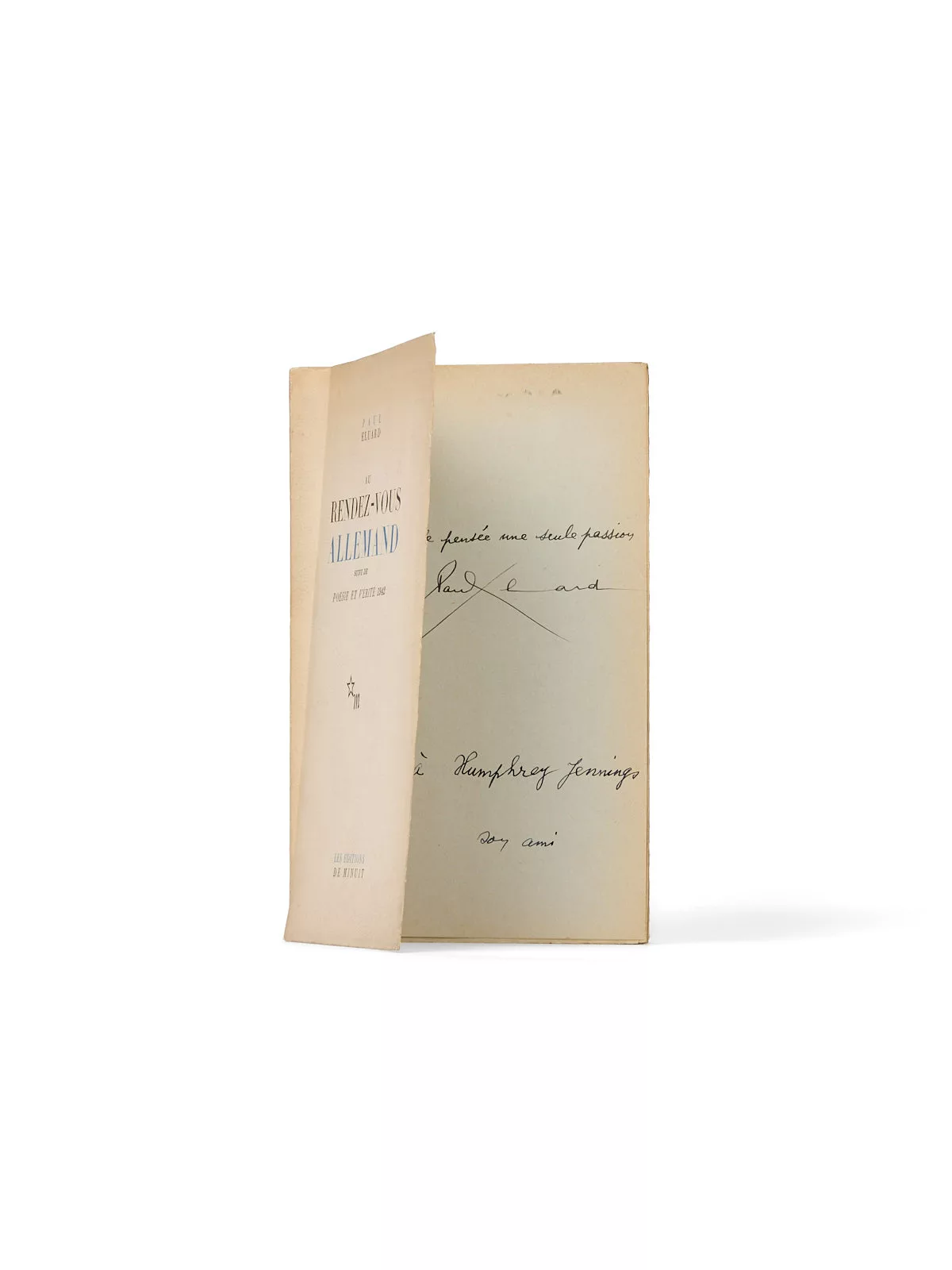
One of the copies printed on blue paper, not announced in the limitation.
Signed presentation inscription: “Une seule pensée une seule passion, Paul Éluard, à Humphrey Jennings, son ami.”
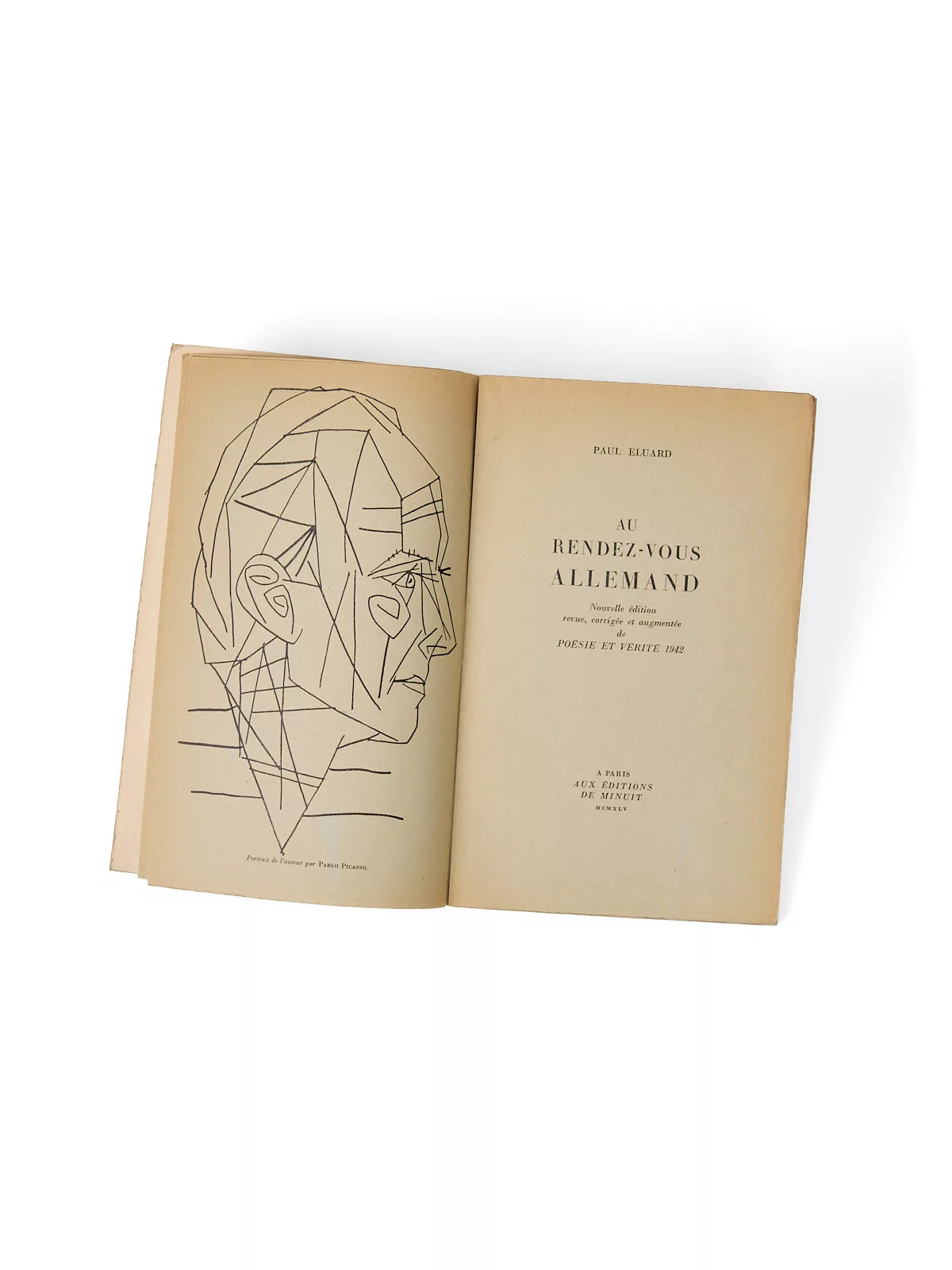
Long circulated clandestinely, Éluard’s Resistance cycle was gathered together at the Liberation by Éditions de Minuit: this new, revised, corrected and enlarged edition brings together Au rendez-vous allemand and Poésie et Vérité 1942 — the collection containing “Liberté” — and adds several previously unpublished texts, giving the volume the canonical form it would keep from the Occupation years onward.
Here, Minuit adopts its postwar emblem — the star designed by Vercors — carrying forward the continuity of its clandestine origins around Jean Bruller and Pierre de Lescure. The inscription to Humphrey Jennings gives this copy a fine provenance: a major poet-filmmaker of British documentary and close to the Surrealists, organizer in 1936 of the International Surrealist Exhibition in London, Jennings was one of Éluard’s earliest champions in Britain. Together with David Gascoyne, he produced the translations of Benjamin Péret (A Bunch of Carrots, then Remove Your Hat, with a note by Éluard and a frontispiece by Picasso), while Éluard dedicated to him a poem that became emblematic — “Le mouvement a des racines / L’immobile croît et fleurit,” written on the evening of the Munich Agreement and published in Donner à voir.
At the dawn of restored peace, Éluard did not forget his English friend, in a particularly telling inscription, since it echoes the original title of the poem “Liberté,” published in April 1942 in the journal Fontaine under the title “Une seule pensée.”
The portrait of Éluard by Picasso reproduced here differs from the one used for the 1944 edition; it reproduces a line drawing made on 6 October 1941, published in the first edition of Sur les pentes inférieures.
Henri Vignes, Bibliographie des Éditions de Minuit, 27.