

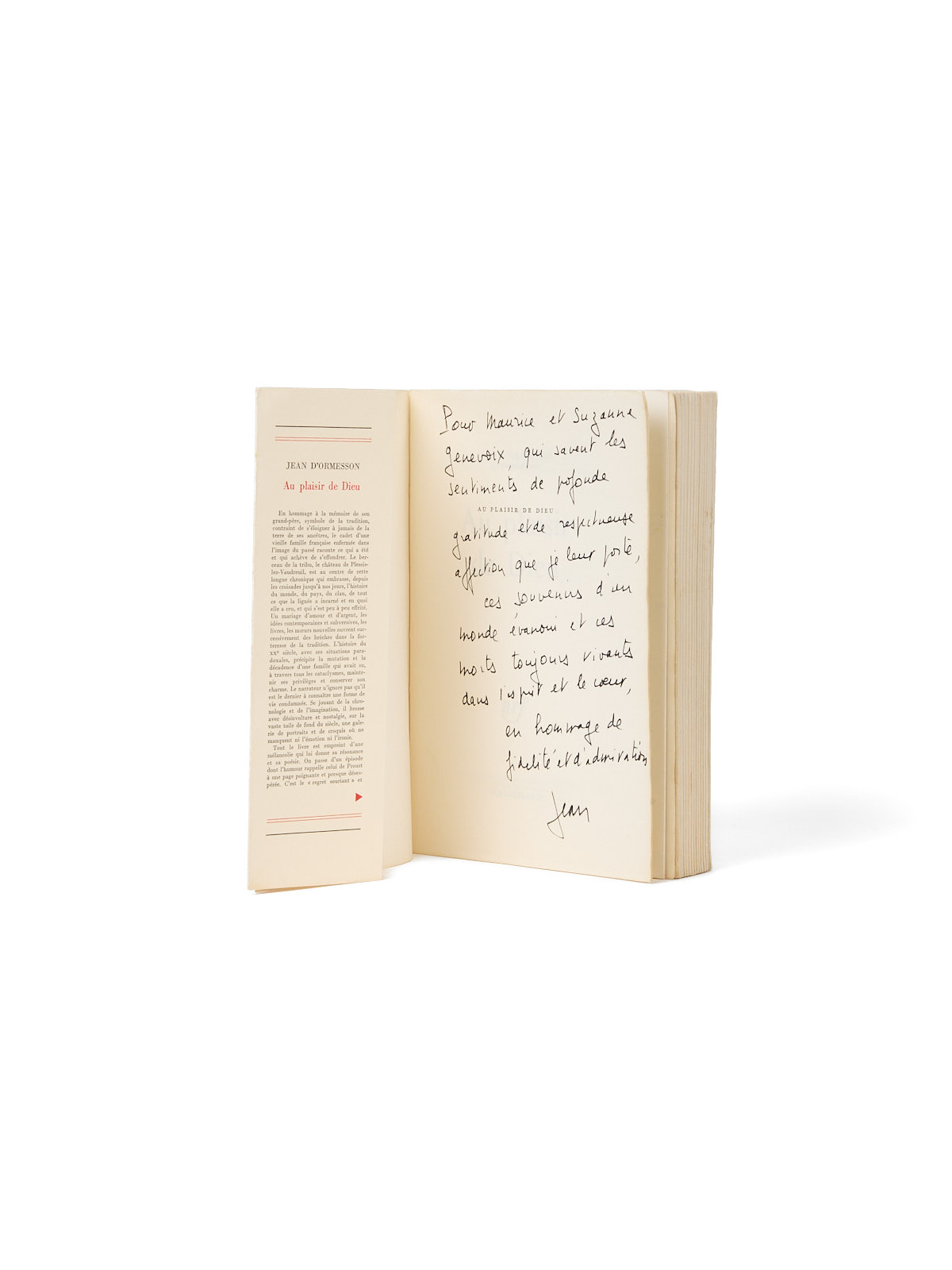
Au plaisir de Dieu
Signed presentation inscription: “Pour Maurice et Suzanne Genevoix qui savent les sentiments de profonde gratitude et de respectueuse affection que je leur porte, ce souvenirs d'un monde évanoui et ces morts toujours vivants dans l'esprit et le cœur, en hommage de fidélité et d'admiration, Jean.”
It was first with the uncle, Wladimir d’Ormesson, writer and diplomat, member of the Académie française from 1956 to 1973, that Maurice Genevoix formed a close friendship. The nephew, Jean d’Ormesson, would carry it on. He held immense and affectionate admiration for Maurice Genevoix, both as a writer and as a man; the day after Genevoix’s death in September 1980, he paid tribute to him, movingly recalling the happiness of having known him: “He knew his own worth: he was not proud. He could be sharp, incisive, but he was never unkind. He had tenderness for forests, animals, his native Loire, his Sologne, for those who suffer and die: men loved him in return. He knew everything: he was the opposite of a pedant. He understood everything. But he knew how to live. Every honor had passed over him without touching him. This man of the woods and this warrior was an intellectual. He had to bear witness to everything a generation of Frenchmen had known of sorrow and joy: the simple, happy life, love of the land, war and peace, memory.”
Au plaisir de Dieu is the first book d’Ormesson published after his election to the Académie française, on 18 October 1973, to the seat of Jules Romains, at a time when Genevoix was still its Secrétaire perpétuel. “The subject of the novel […] is the insertion of this old family society — not paternalistic but patriarchal — into a contemporary society whose structures tend to disappear.” With this work, built as an affectionate retrospective of a lived history, Jean d’Ormesson definitively established his reputation: a means for him to tell his own story and that of the Lefèvre d’Ormesson family, whose title of count he bears, and to recount his childhood spent at his mother’s château of Saint-Fargeau, which he was reluctantly forced to sell, an experience he lived as a “drama.”
A very fine provenance, enriched with a deferential inscription to the man who had just welcomed him beneath the dome of the Quai de Conti.