

Artine
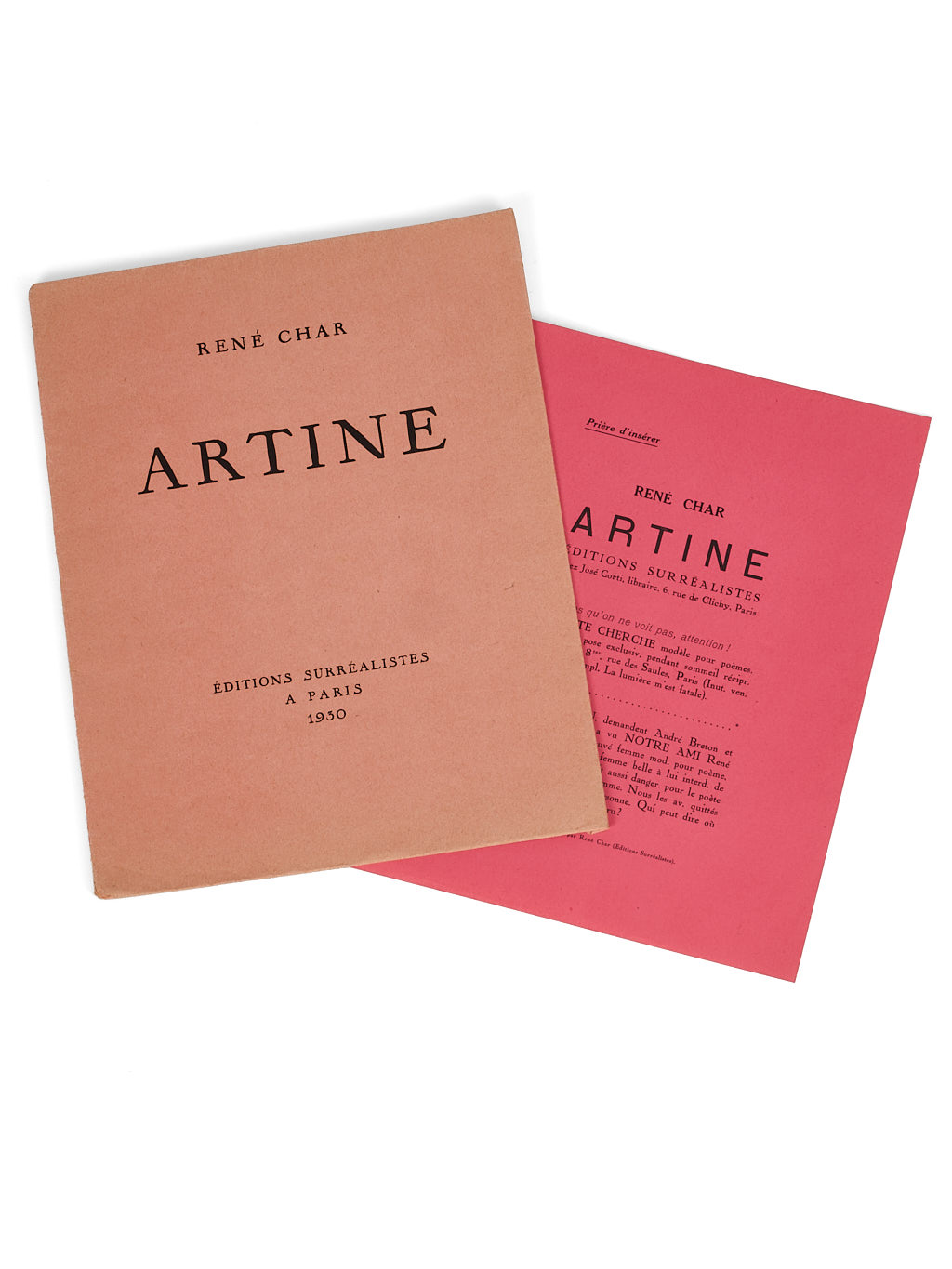
1/185 copies sur Ingres rose (n° 185).
First edition.
One of 185 copies on pink Ingres paper (no. 38).
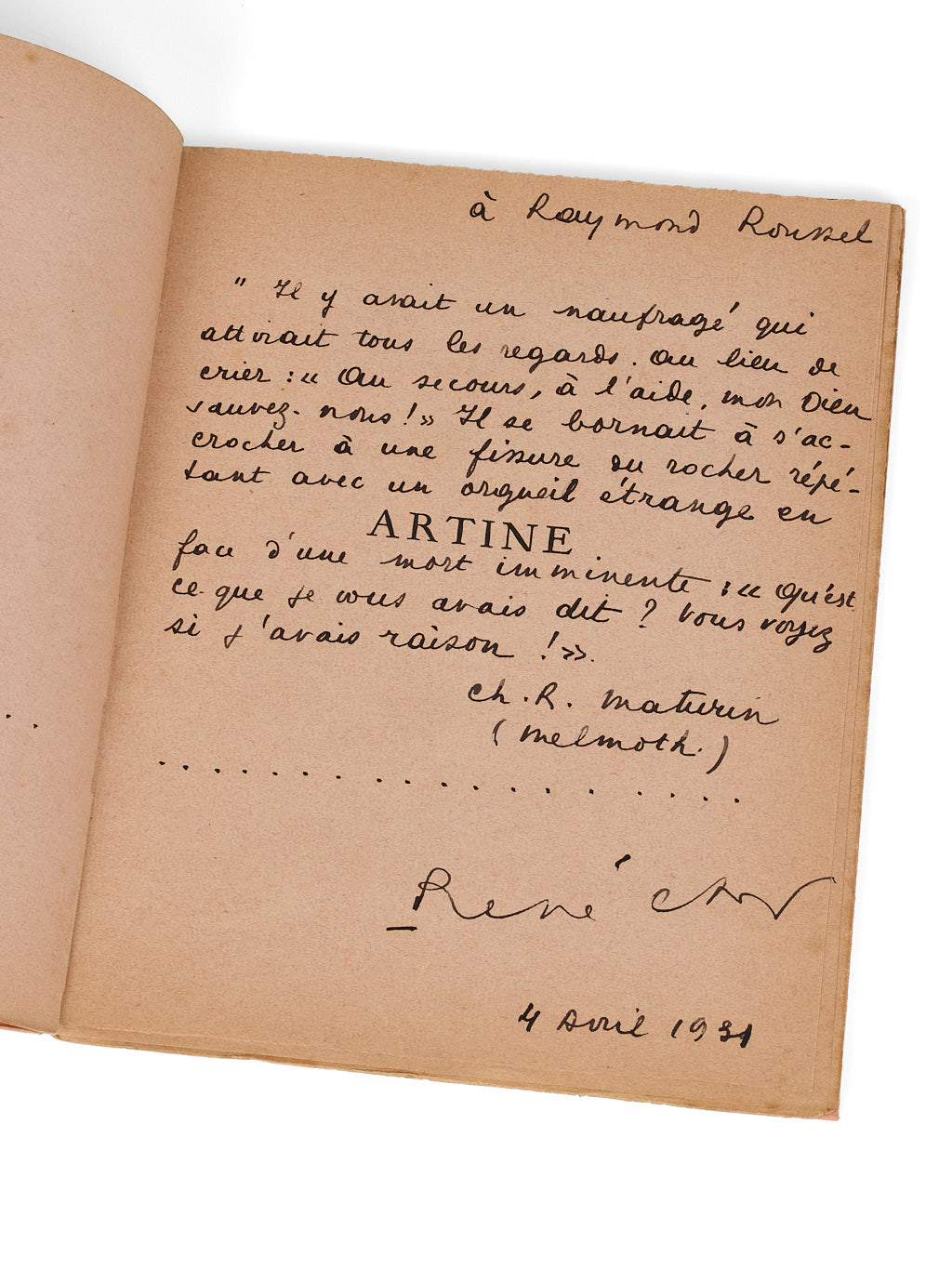
Signed presentation inscription to Raymond Roussel, followed by a quotation from Charles Robert Maturin’s Melmoth the Wanderer:
“à Raymond Roussel”
“There was a shipwrecked man who attracted everyone’s attention. Instead of crying: ‘Help! Help! My God, save us!’ he merely clung to a fissure in the rock, repeating with strange pride in the face of imminent death: ‘What did I tell you? You see that I was right!’ Ch. R. Maturin (Melmoth).”
Dated and signed: “René Char, 4 April 1931.”
Publisher’s insert preserved.
René Char and the Surrealists’ passionate admiration for Raymond Roussel is well documented. In his will, dated 20 January 1933, only a few months before his death, Roussel instructed that copies of his books be sent to a select group of writers and artists who had shown sympathy for his work. Among them were Robert Desnos, Paul Éluard, Tristan Tzara, Michel Leiris, André Breton, René Char, Salvador Dalí, André Gide, Philippe Soupault and Louis Aragon.
Artine appears to be the only book Char ever presented to Raymond Roussel. Char had previously published only three books — Les Cloches sur le cœur (1928), Arsenal (1929) and Le Tombeau des secrets (1930) — and no copy of any of them is known inscribed to Roussel.
Probably through his developing friendships with Éluard and Breton, Char met Roussel in early 1931 and presented him with his most recent book, adding this extraordinary quotation from Charles Maturin’s Gothic masterpiece Melmoth the Wanderer.
Published in 1820, Maturin’s labyrinthine novel reinvented the Faustian pact through the figure of a damned wanderer for whom ordinary time no longer exists. It exerted an extraordinary influence on nineteenth-century French literature. Nodier, Nerval, Balzac and Baudelaire admired it; Balzac wrote a sequel, Melmoth réconcilié, while Baudelaire repeatedly invoked Melmoth’s terrible, satanic laughter.
The novel would later become a touchstone for the Surrealists. André Breton championed it and was instrumental in the publication of a complete French version by Jean-Jacques Pauvert in 1954. In his preface, Breton traced the lineage from Maturin to Lautréamont, arguing that Maldoror had inherited “the very soul of Melmoth.”
Maturin was also Oscar Wilde’s great-uncle by marriage. After his release from prison, Wilde famously adopted the name Sebastian Melmoth, identifying himself with Maturin’s accursed wanderer.
The literary exchange between Char and Roussel was reciprocal. The following year, Roussel presented Char with a copy of his Nouvelles Impressions d’Afrique, warmly inscribed and dated December 1932.
That, in turn, appears to be the only known book inscribed by Roussel to René Char.
Char’s inscription here, written in the spring of 1931 and invoking a shipwrecked man confronting imminent death, acquires a hauntingly premonitory quality in light of Roussel’s death in a Palermo hotel on 14 July 1933.
A remarkable association copy linking two major figures of the Surrealist imagination.
Sebbag, Les Éditions surréalistes, 17; PAB, Bibliographie des Œuvres de René Char, no. 4, p. 15.