

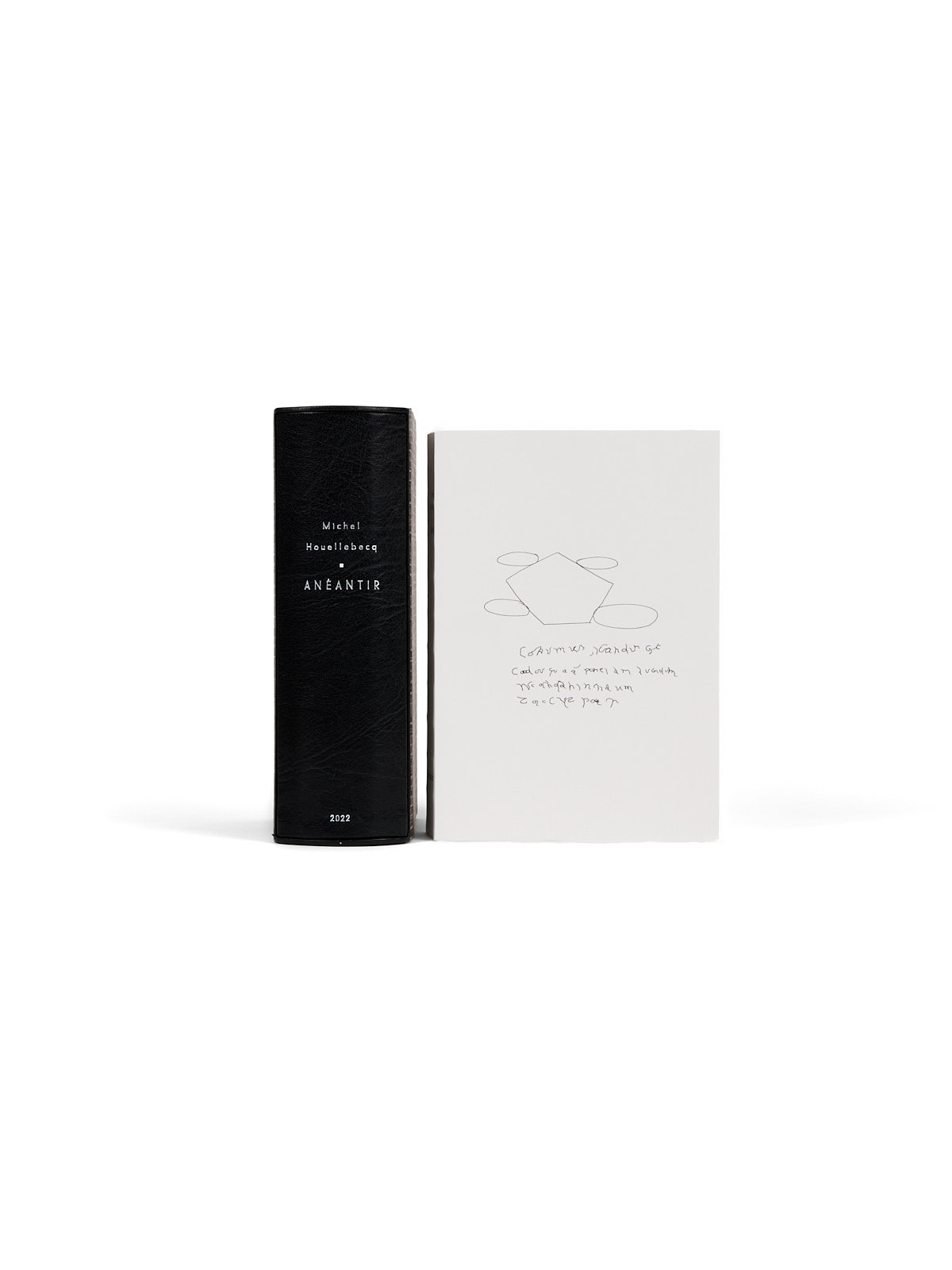
Anéantir
One of the first 200 copies on vélin Rivoli Arjowiggins (no. 77).
Anéantir carries the unsettling menace that Houellebecq reveals about our society, once again casting him as a writer of speculative fiction. His vision is unambiguous: our civilization has embarked on a generalized decay and will need no outside help to complete it. Slowly, methodically, heading straight into a wall, with no other way out.
“What is it about? Chinese solar panels, an election campaign, boomer psychology, technology transfers, Breivik, urban loneliness, fertility rates, eco-fascism, nihilism, strokes, inheritance law, the selfish gene, sexual misery, the Rassemblement National, Zemmour, the Beijing–Washington trade war, dreams, chaos, Islam, biotechnology, Sephardic dentists, Le Lambeau, euthanasia, dreams again, an election campaign, a lack of notoriety… (a non-exhaustive list) And then love, always, which he repeats is his main subject. But do we turn to literature to find the menu of the evening news on France 2? An atmosphere at times reminiscent of Baron noir, though the hope is quickly dashed, since it is far less cruel.” (Pierre Assouline). Anéantir is not a novel of twists or suspense. Assouline is right: “it wants to be a thriller, but on that score Grangé, Chattam, Minier and Thilliez have nothing to worry about.” Nor is Anéantir a compartmentalized novel, nor even, probably, a symbolic one, in which the main character understands little of what surrounds him, and barely more of what happens to him and to his own. His father is now mute — and this worsens over the last hundred pages, probably the most interesting in the novel.