

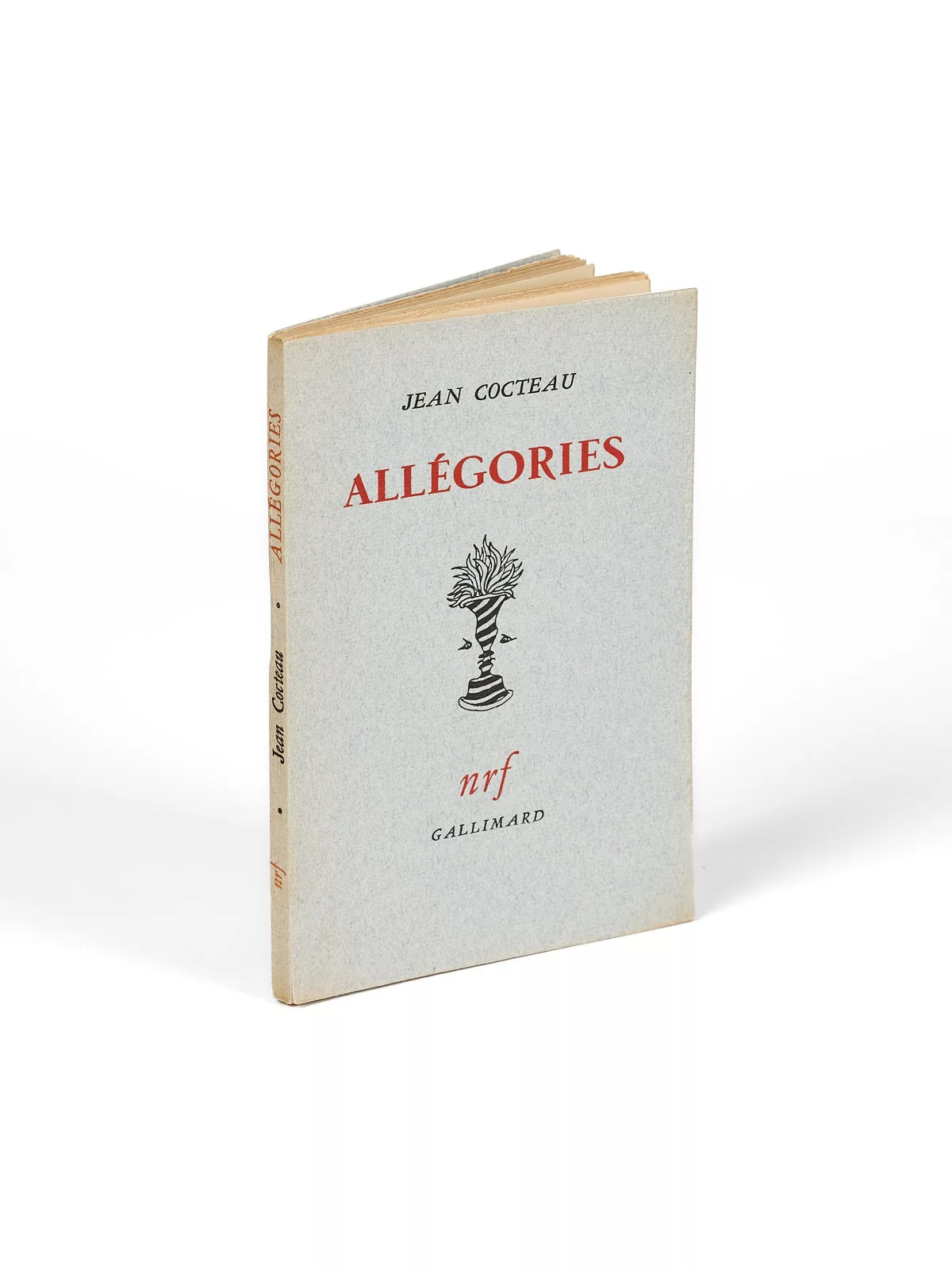
Allégories
One of 75 copies on alfax Navarre paper, this copy one of 10 hors commerce copies (no. XVIII).
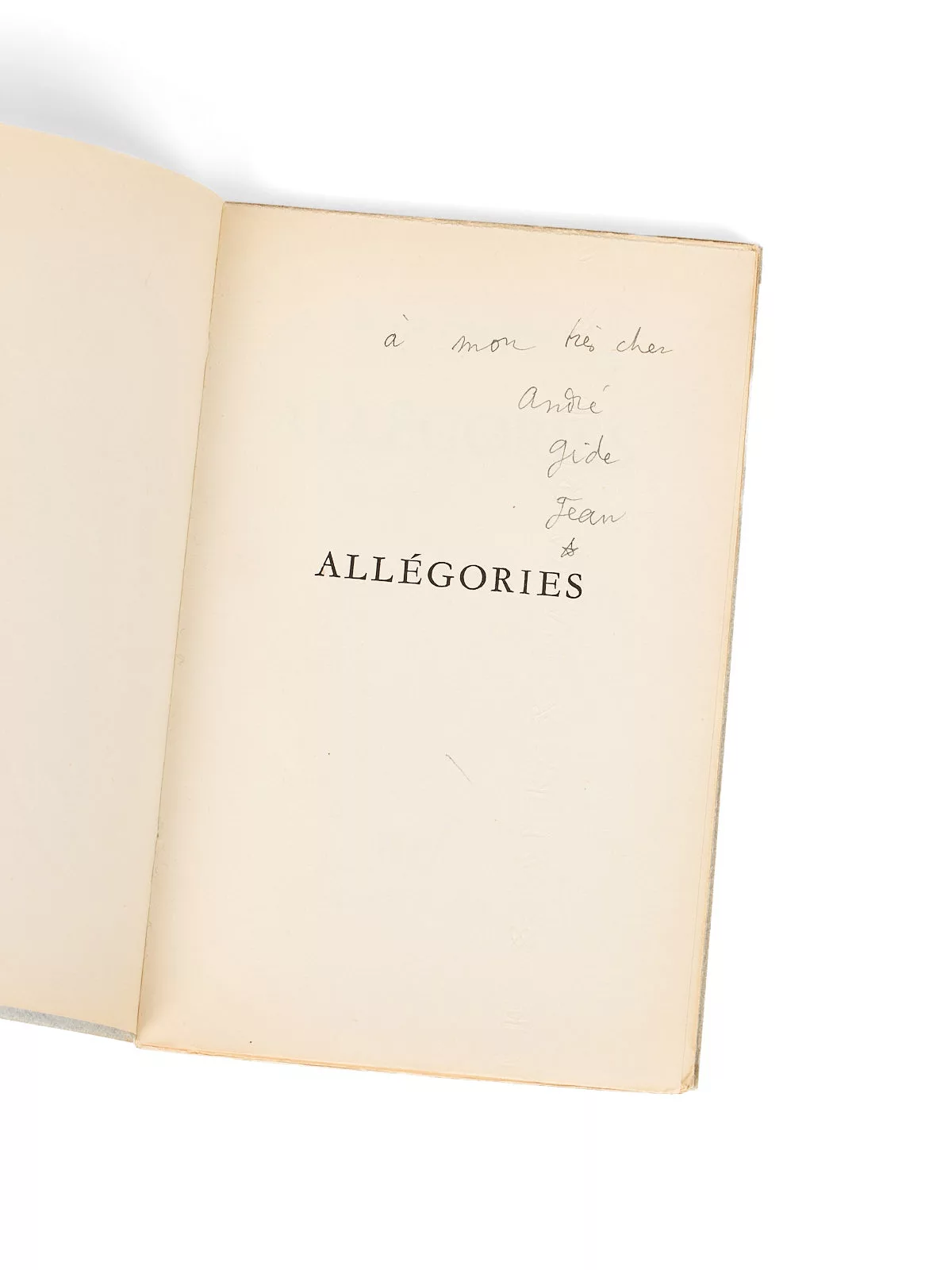
Signed presentation inscription: “à mon très cher André Gide, Jean.”
Relations between the two men had soured with the publication of Le Potomak in 1919, when Gide attacked the poems of Le Cap de Bonne-Espérance. Cocteau later recalled: “He summoned me like a schoolboy in trouble before the headmaster and read me an open letter he intended for me. […] In Gide’s letter, I appeared as a squirrel, and Gide as a bear at the foot of the tree.” Cocteau announced he intended to respond, but Jacques Rivière refused to publish his reply in La NRF, where Gide had published his own letter.
To this “Lettre ouverte à Jean Cocteau,” published in La NRF in June 1919, Cocteau retorted in Les Écrits nouveaux of June–July: “There is in you something of the pastor and something of the bacchante.” Gide answered again in the same review in October, reproaching him not so much for following as for pretending to lead.
The intellectual rivalry and guarded mutual esteem lasted throughout both men’s lives, during which they crossed paths at Gallimard and at society dinners, notably at the de Noailles’. Cocteau returned to the subject in his Journal d’un inconnu: “I loved Gide and he irritated me. I irritated him and he loved me. We are even. […] Towards the end of his life, he came to my country house with Herbart. He wanted me to direct a film he had adapted from Isabelle. […] Our relations remained pleasant until the end, until the letter in which Jean Paulhan described him to me as petrified on his deathbed.”
Gide, as early as August 1914, had kept his distance: “Jean Cocteau had arranged to meet me at an ‘English tea room’ […]. I took no pleasure in seeing him again, despite his great kindness; but he is incapable of gravity, and all his thoughts, his witticisms, his sensations, all that extraordinary brilliance of his habitual speech shocked me like a luxury item displayed in a time of famine and mourning. […] There is in him the carelessness of a Gavroche; it is beside him that I feel most clumsy, most heavy, most morose.”