

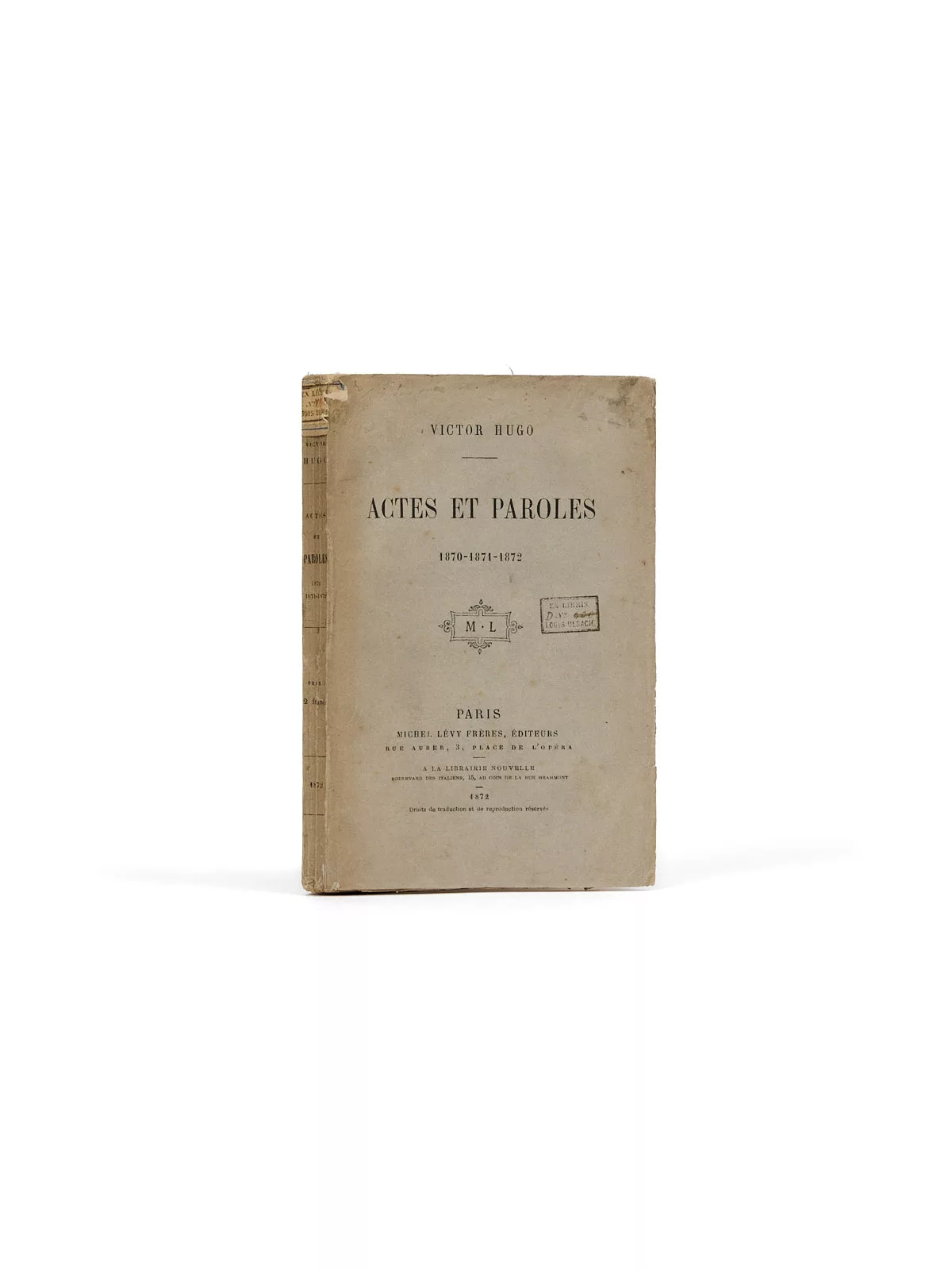
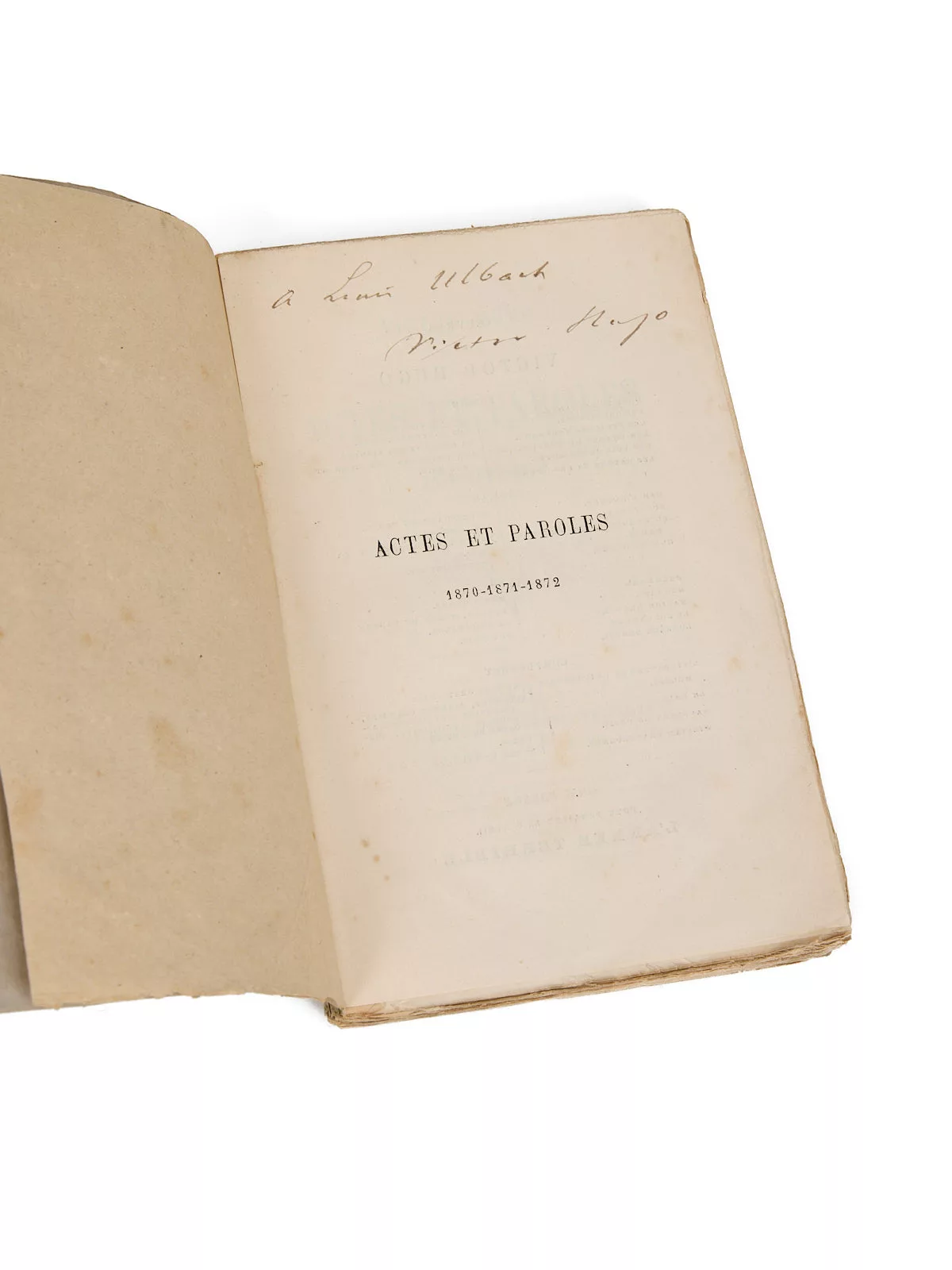
Signed presentation inscription: “à Louis Ulbach, Victor Hugo.”
Published in the aftermath of the Franco-Prussian War and the Commune, Actes et Paroles gathers Victor Hugo’s speeches, public interventions and political writings. The volume opens with the account of his return to Paris on 1 October 1871, after nineteen years of exile. Hugo was in Brussels when the Commune broke out. While he condemned certain excesses of the insurgents, he also called on the Versailles government not to answer violence with vengeance. One of the most celebrated texts in the volume, “Pas de représailles,” bears witness to this humanist stance, expressed at a time when the Versailles repression was leading to thousands of executions.
After the crushing of the Commune, Hugo made known that his door remained open to the proscribed. He paid tribute to the defeated, notably composing the poem “Viro Major,” dedicated to Louise Michel. This stance provoked fierce hostility: on the night of 27–28 May 1871, his house in Brussels at 3, Place des Barricades was stoned, and the Belgian government eventually decided to expel him. Taking refuge in Luxembourg, Hugo then wrote several texts that would later form L’Année terrible.
A fine copy presented to a longstanding companion, Louis Ulbach, with whom Hugo collaborated in 1867 on the edition of Paris-guide with Philippe Burty, for which Hugo wrote the preface.
A writer and journalist, and a feared critic, Ulbach worked for the Revue de Paris, which he directed before devoting himself there to literary criticism. Under his editorship, Madame Bovary was notably published. Ulbach was also one of the most active promoters of Hugo’s work, and at the famous “dîner d’Hernani” of 1877, he spoke on behalf of the Association littéraire internationale — of which he would become president in 1880 — in Hugo’s honor. On Hugo’s death, he wrote this speech:
“If I listened only to the grief of a friendship of more than forty years, and if I obeyed only the admiration of my whole life, I would remain silent before the formidable silence of this coffin. But I have received from the Association littéraire et artistique internationale, of which Victor Hugo was honorary president, a mandate that I am not permitted to decline (…) Victor Hugo is the French writer most admired outside France; not because we admire him, for foreigners sometimes reproach us for not admiring him enough, so overwhelmed are they by the powerful expansion of his genius (…). Let us keep our tears for tomorrow’s reflection, but today, let us not resist this surge of universal enthusiasm. It is our honor to yield to it.”
He would later publish an Almanach de Victor Hugo (1885) and then a Vie de Victor Hugo (1886).
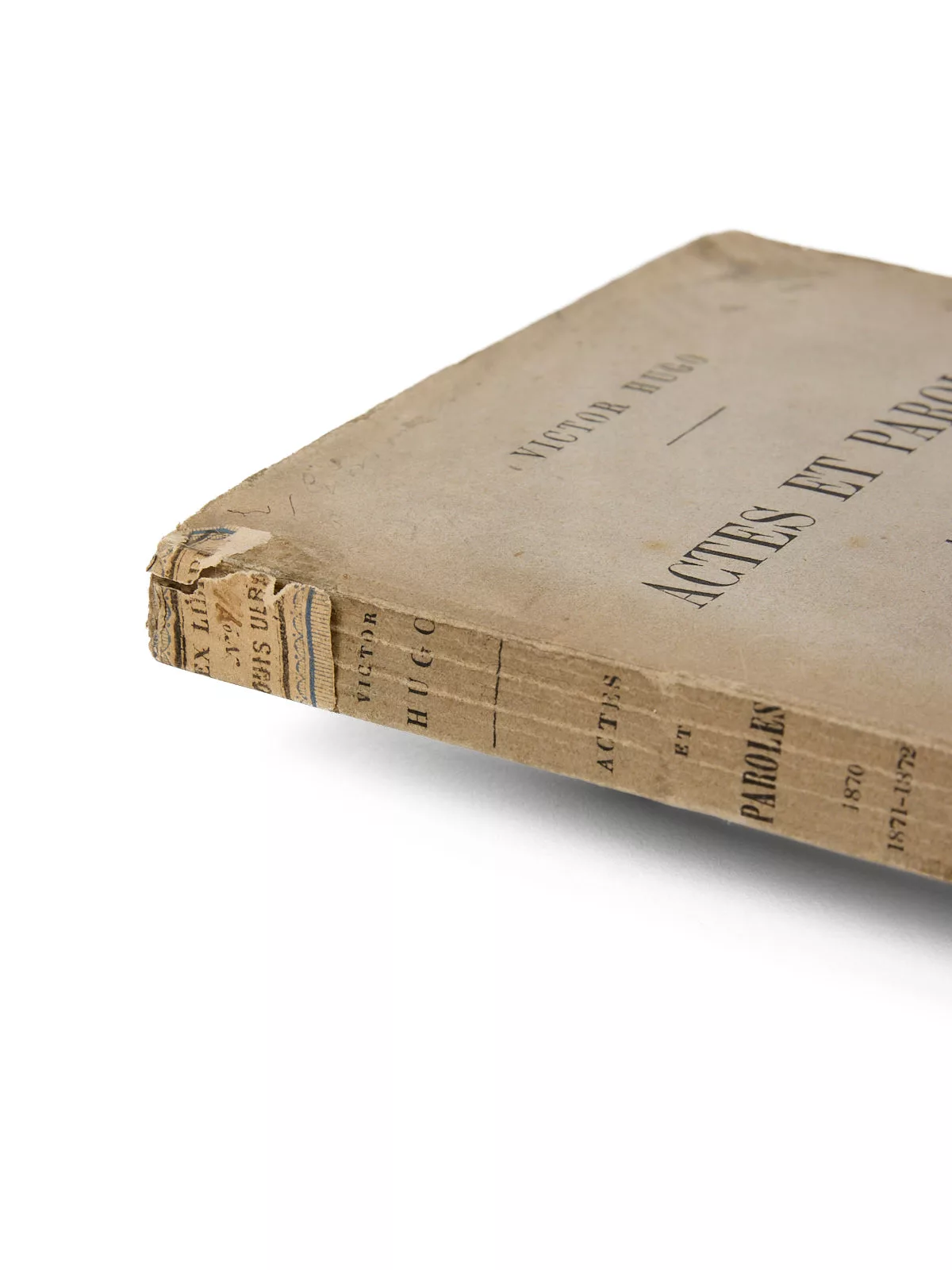
Louis Ulbach’s stamp on the wrapper, and his library label on the back.