

…à Guillaume Apollinaire
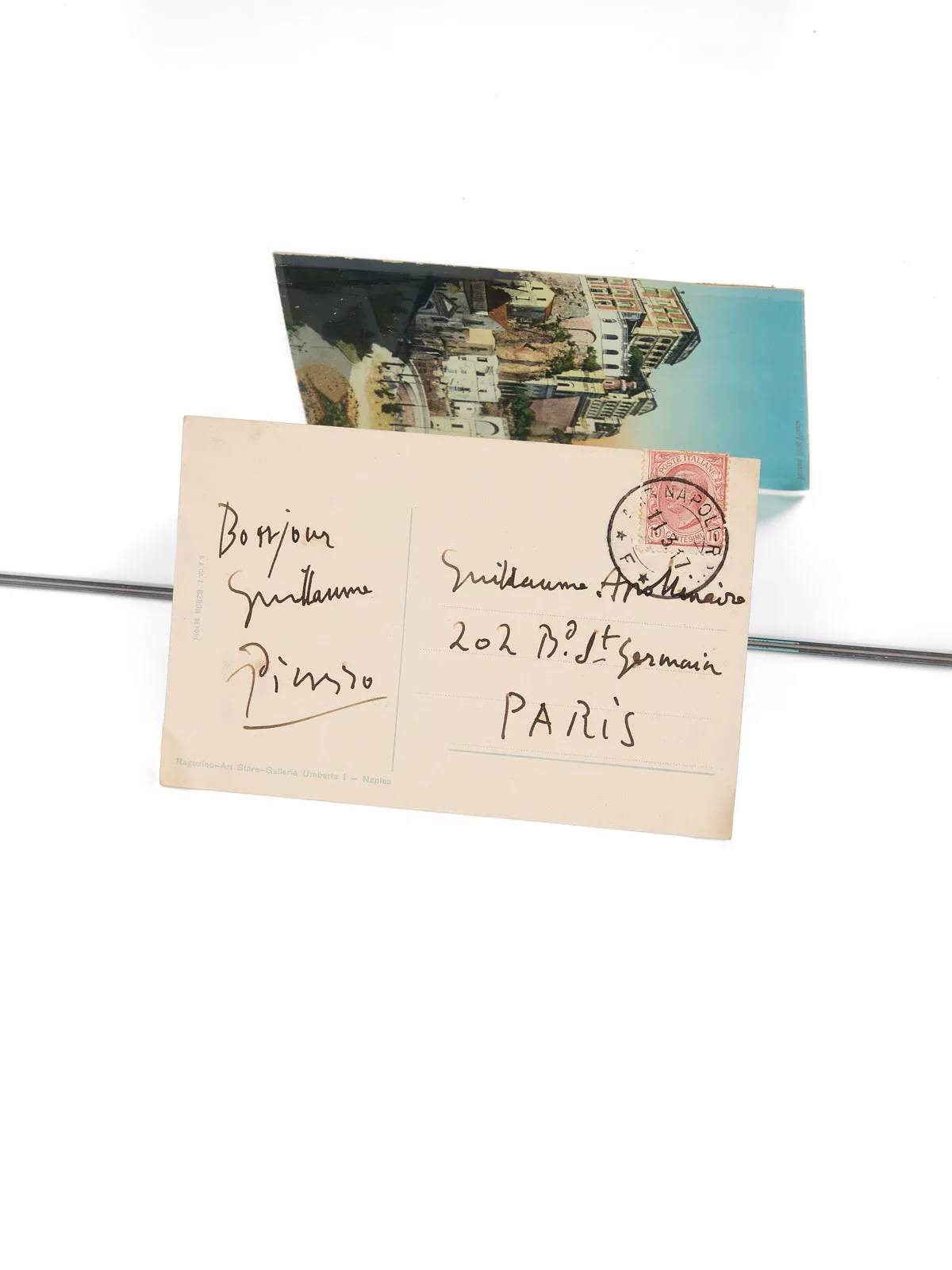
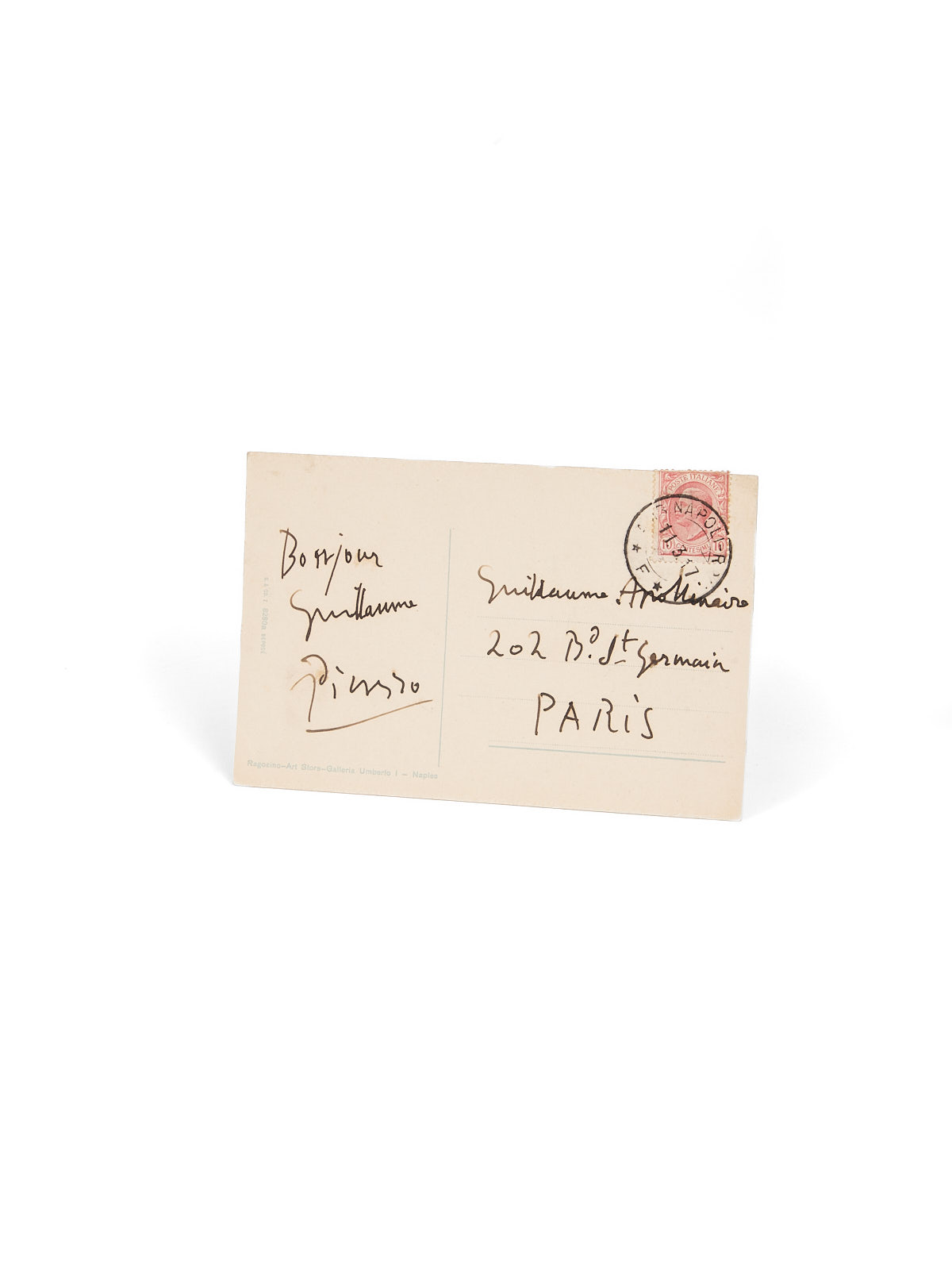
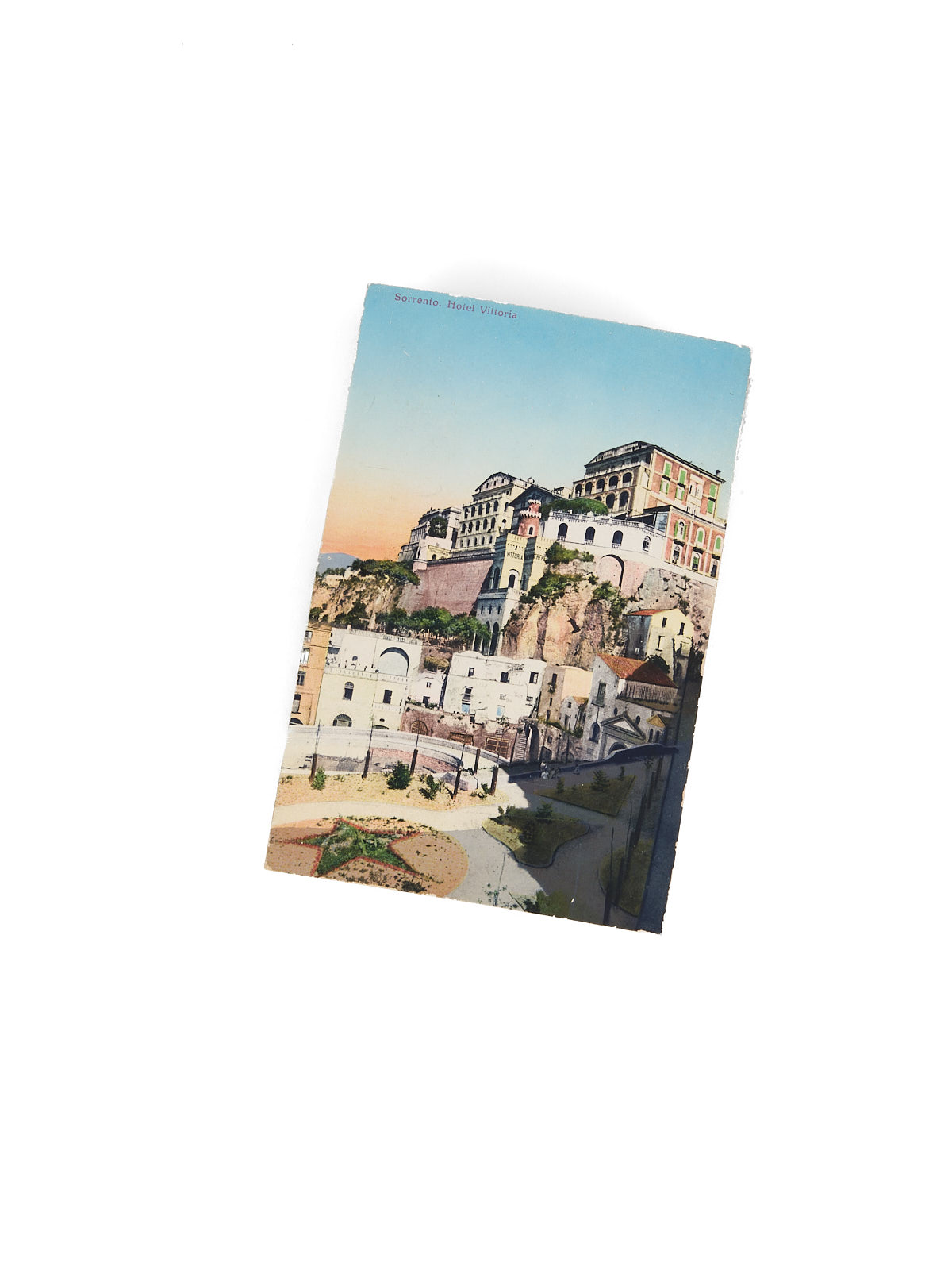
Written on the verso of a postcard showing a view of the Hôtel Vittoria (Naples), sent to the poet’s Paris address, “202 Bd St Germain.”
Picasso and Apollinaire first met in Paris in 1905, the beginning of an immense mutual admiration. Over thirteen years, their work engaged in constant dialogue, crossing and inspiring one another without ever merging into a single project. Picasso and Apollinaire dreamed of collaborating on a joint work, though this never came to fruition. History therefore remembers above all their friendship and the projects — real and imagined — that it generated.
They dedicated poems, drawings and paintings to each other, and exchanged views on art and life. Apollinaire introduced Picasso to erotic literature, which became something of a specialty of his; Picasso, for his part, features on the frontispieces of Alcools and Calligrammes.
Apollinaire, wounded by shrapnel to the right temple on 17 March 1916, was evacuated to Paris at the end of that month. He invited his friend to visit him: “Mon cher Pablo, viens me voir si tu peux aujourd’hui. Je suis au Val-de-Grâce, chambre no. 13. Tu demanderas le s/lieu[tenant] de Kostrowitzky.” Picasso came, and made a now-famous drawing of his friend with his head bandaged. Calligrammes was published, and on 31 December 1916 Picasso organized a banquet in honor of the poet, weakened but glowing with the prestige of his wound and the scar across his skull. Picasso then left for a journey to Italy.
His first stop was Rome, where he arrived on 17 February 1917. He accompanied Jean Cocteau on a two-month trip: the French playwright had asked the painter to take part in the production of Parade, a ballet inspired by one of his poems. For eight weeks Picasso, who until then had known only Spain and France, discovered a new world. Naples and Pompeii were his next destinations.
During this stay, Picasso met the dancer Olga Khokhlova, first seeing her at a performance of the ballet Les Sylphides on 9 April 1917 at the Teatro Costanzi (Rome Opera). A romance began, and Picasso followed his fiancée to Barcelona, where Parade was being performed. There he introduced her to his family and proposed marriage.
A year later, each man stood as witness at the other’s wedding: Picasso married Olga on 12 July 1918 in an Orthodox church on the rue Daru, following Russian tradition, with Guillaume Apollinaire, Max Jacob and Valerian Svetlov (a dance critic) as witnesses; two months earlier, in May, Apollinaire had married Jacqueline Ruby [Amelia Kolb], with Madame Lucien Descaves and Pablo Picasso as his witnesses.
The war, with its torments and interminable separation, brought the two men closer than ever. The last known card exchanged between them is this one, dated 5 September 1918 and sent from the Vallée d’Aspe. On 9 November, Guillaume Apollinaire died of the Spanish flu: Picasso had lost his dearest friend.
During his 1917 stay in Italy, Picasso visited the Naples Archaeological Museum twice. There he found an inspiration that encouraged him to produce works with antique influences. Of Naples and its ruins, some of them Pompeian, he said, “Antiquity swarms, all new, in this Arab Montmartre.”
Most of the surviving exchanges between Picasso and Apollinaire are now held at the Musée Picasso in Paris, which preserves the whole of the correspondence sent by the painter to his friend Guillaume — with the notable exception of this card. Terse indeed, but a witness to a friendship in which little needed to be said to be rekindled.