

L’action de la justice est éteinte
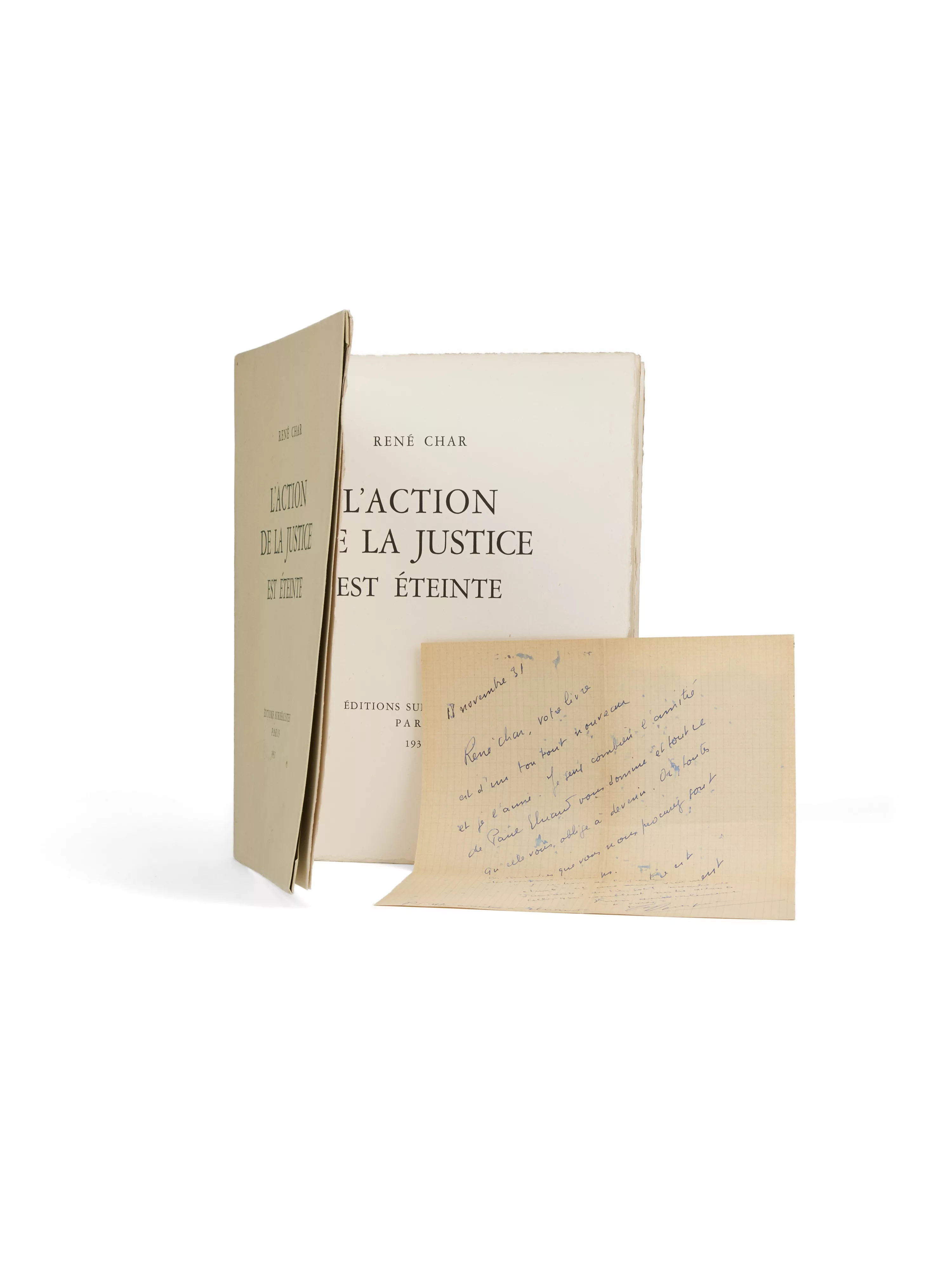
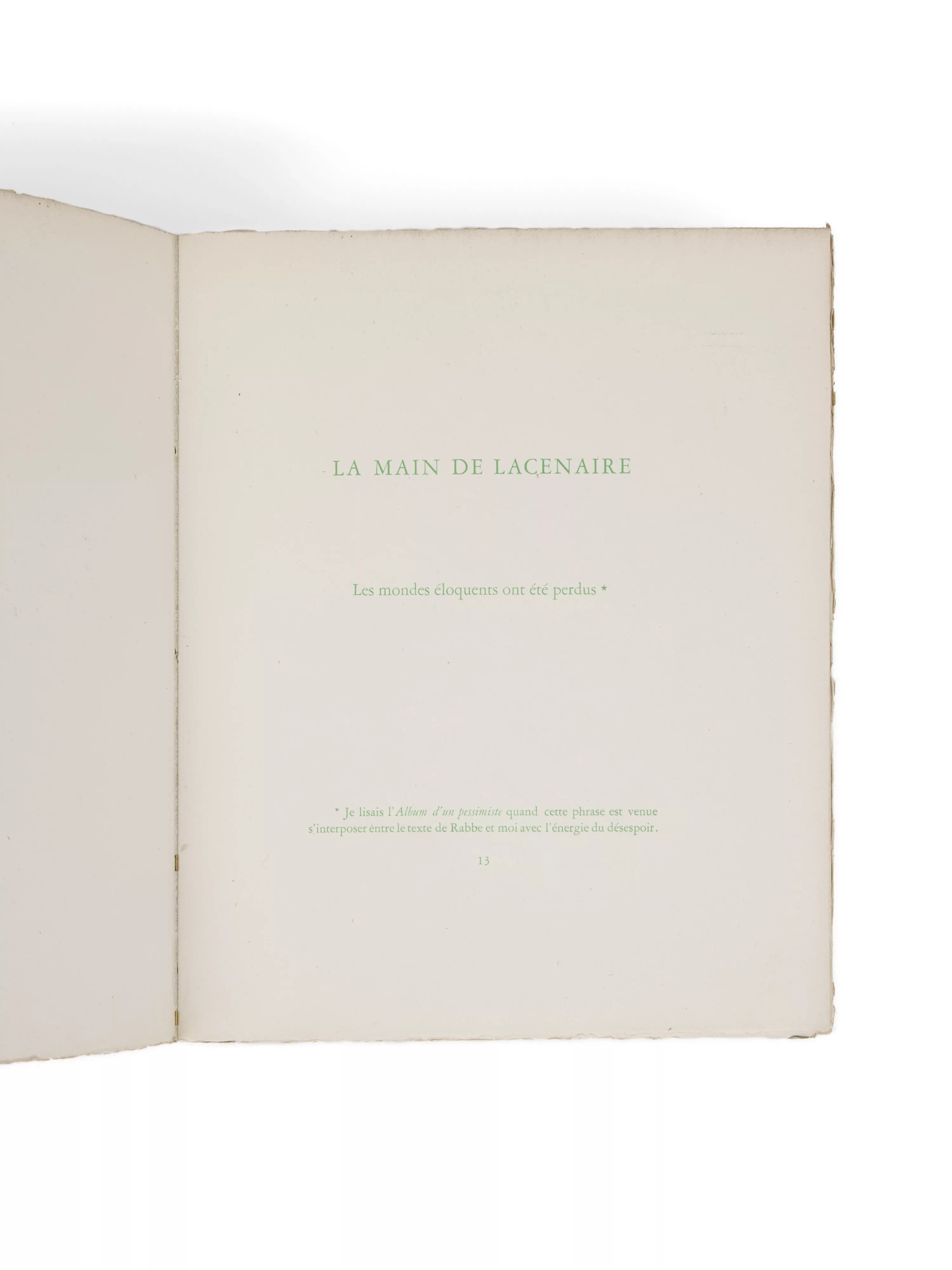
A precious trial copy with the central gathering printed in green, kept by René Char together with an autograph letter from Joë Bousquet, who had just read the collection and expressed his full admiration for it (1 p. on 1 leaf, addressed to Char's Paris address, 35 rue Marbeuf, envelope preserved).
This is the fourth collection published by the poet: it comprises twelve poems (“Poème,” “Sommeil fatal,” “Voyageur sans tunnel,” “La main de Lacenaire,” “Le Fantôme de Lola Abat,” “L’Artisanat,” “Poètes,” “L’Esprit poétique,” “Les Messagers délirants de la poésie frénétique,” “Les Soleils chanteurs,” “L’Instituteur révoqué” and “L’Amour”), printed in July 1931 by the printers Ducros and Colas for the Éditions surréalistes, directed by José Corti. It is dedicated to André Breton and takes its title from an incomplete sentence drawn from À Rimbaud (“L’action de la justice est éteinte là où brûle, où se tient la poésie, où s’est réchauffé quelques soirs le poète”). After Hommage à Sade (15 copies) and Arsenal (26, then 39 copies), it is the work with the most confidential print run identified in Pierre André Benoit’s bibliography published before 1950. The collection was reprinted, with a few corrections, in Le Marteau sans maître, again by Corti, in 1934, and later incorporated into Moulin premier.
The manuscript used for printing is unknown, and a slightly modified version was presented to Marcel Fourier (Bibliothèque Marcel Fourier, Librairie Faustroll, 2022, no. 71).
A rare trial copy, containing the central gathering printed in green (a feature found complete only in the five deluxe copies), which Char kept in his own library together with the letter Joë Bousquet sent him on 18 November 1931 from Carcassonne. Bousquet wrote to Char of the emotion these poems had given him: “René Char, votre livre est d’un ton tout nouveau et je l’aime. Je sens combien l’amitié de Paul Éluard vous domine et tout ce qu’elle vous oblige à devenir. Or toutes les surprises que vous nous procuez sont des surprises heureuses. L’Action de la justice est éteinte est une oeuvre vraiment surréaliste, du très petit nombre de celles qui comblent notre attente (…). P.S : mes amitiés à Eluard.” Éluard himself had received his copy printed in green at the end of September, acknowledging it to Char: “Mon cher René, quel beau livre, oui. Depuis que je le connais, depuis que je le relis, j’y suis plus attaché qu’à ma tête (…) J’aime ce livre, de beaucoup le plus étonnant que tu aies fait.”
Char and Bousquet probably met around 1929, through André Cayatte, at the time of the review Méridiens, which published poets from the South and to which Bousquet had considered entrusting the publication of his first book, Il ne fait pas assez noir. Their friendship remained constant from the outset. On the publication of Seuls demeurent and the reissue of Le Marteau sans maître in 1945, Bousquet wrote to Char of how indispensable his existence had been to him; a year later, in an article on Feuillets d’Hypnos in La Gazette des lettres, Bousquet wrote again: “Celui des hommes que j’estime le plus est aujourd’hui René Char.”
This fine letter and the copy are reproduced in L’Atelier du poète (p. 156).