

Monsieur Ouine
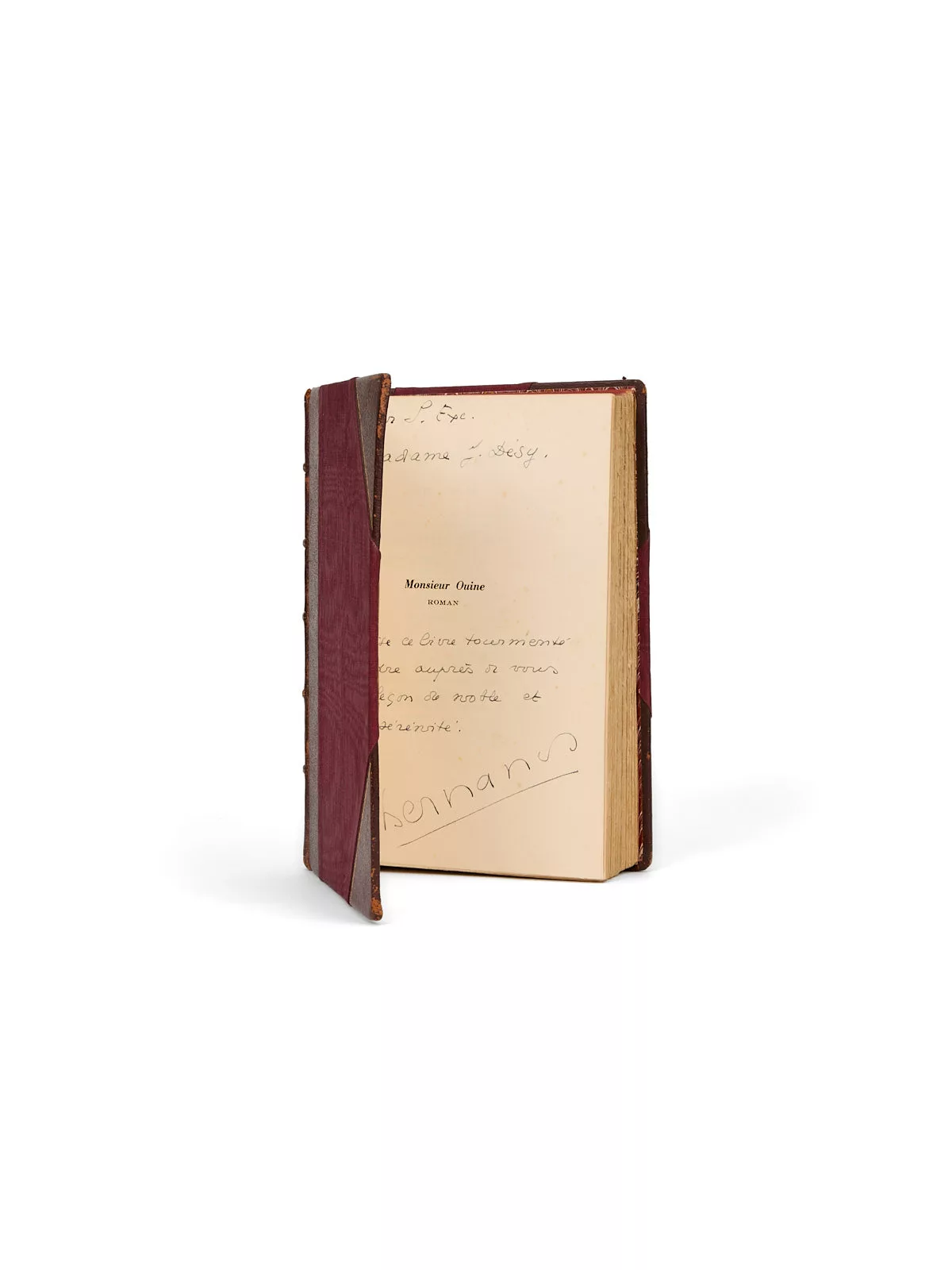
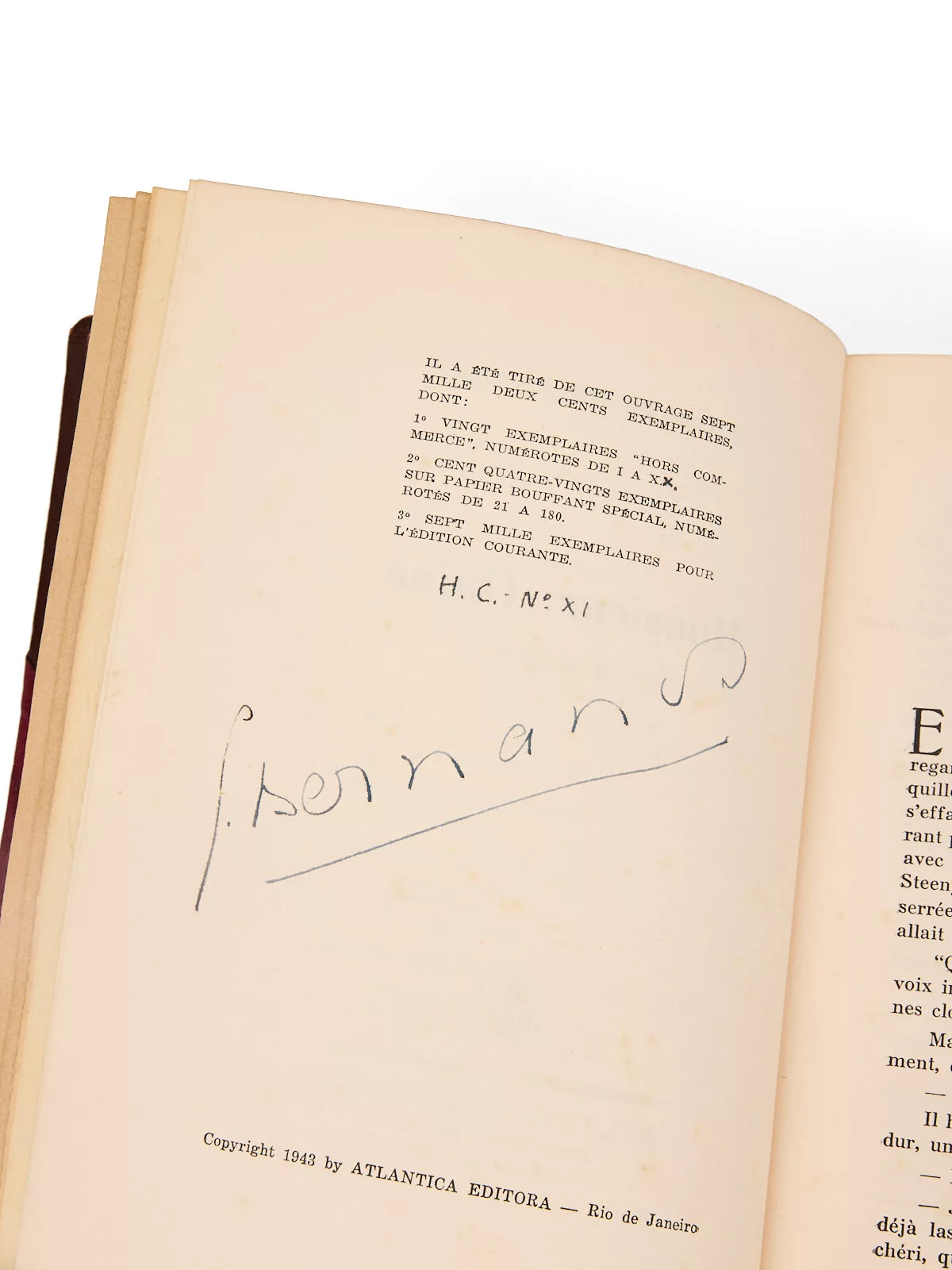
One of the first 20 hors commerce copies (no. XI), signed by Bernanos.
Presentation copy inscribed to “S. Exc. Madame J. Désy”: “puisse ce livre tourmenté prendre auprès de vous une leçon de noble et douce sérénité. Bernanos.”
The life of Monsieur Ouine was almost as unsettled and peripatetic as that of its author. Bernanos worked on it for nearly ten years, from February 1931 to May 1940, amid his constant travels and difficulties. Some twenty manuscript pages were even lost from his motorcycle bag between Aix and Marseille and had to be rewritten entirely.
The novel thus accompanied Bernanos for a decade: five chapters were written in 1931, eight more between December 1932 and December 1933, three in 1934, two in 1936, before the last was completed in early 1940. This exceptionally long gestation no doubt explains the special place the writer himself accorded the book. As early as December 1934, when the work was still far from finished, he wrote to Robert Vallery-Radot:
“Monsieur Ouine is the best and most complete thing I have written.”
Originally titled La Paroisse morte, the novel combines elements of the detective story, the metaphysical novel and the gallery of characters. Around the mysterious figure of Monsieur Ouine and a crime that seems to contaminate an entire community, Bernanos pushes his exploration of evil, spiritual emptiness and the dissolution of conscience to its furthest extreme.
When Bernanos completed the manuscript on 10 May 1940, he had been living in Brazil for two years, where he would remain throughout the war. From August 1940 he settled with his family on a small hillside property he named “Cruz das Almas” — the Cross of Souls. There he attempted, with little success, to raise livestock, while writing numerous articles, giving lectures and speaking out in favor of Free France.
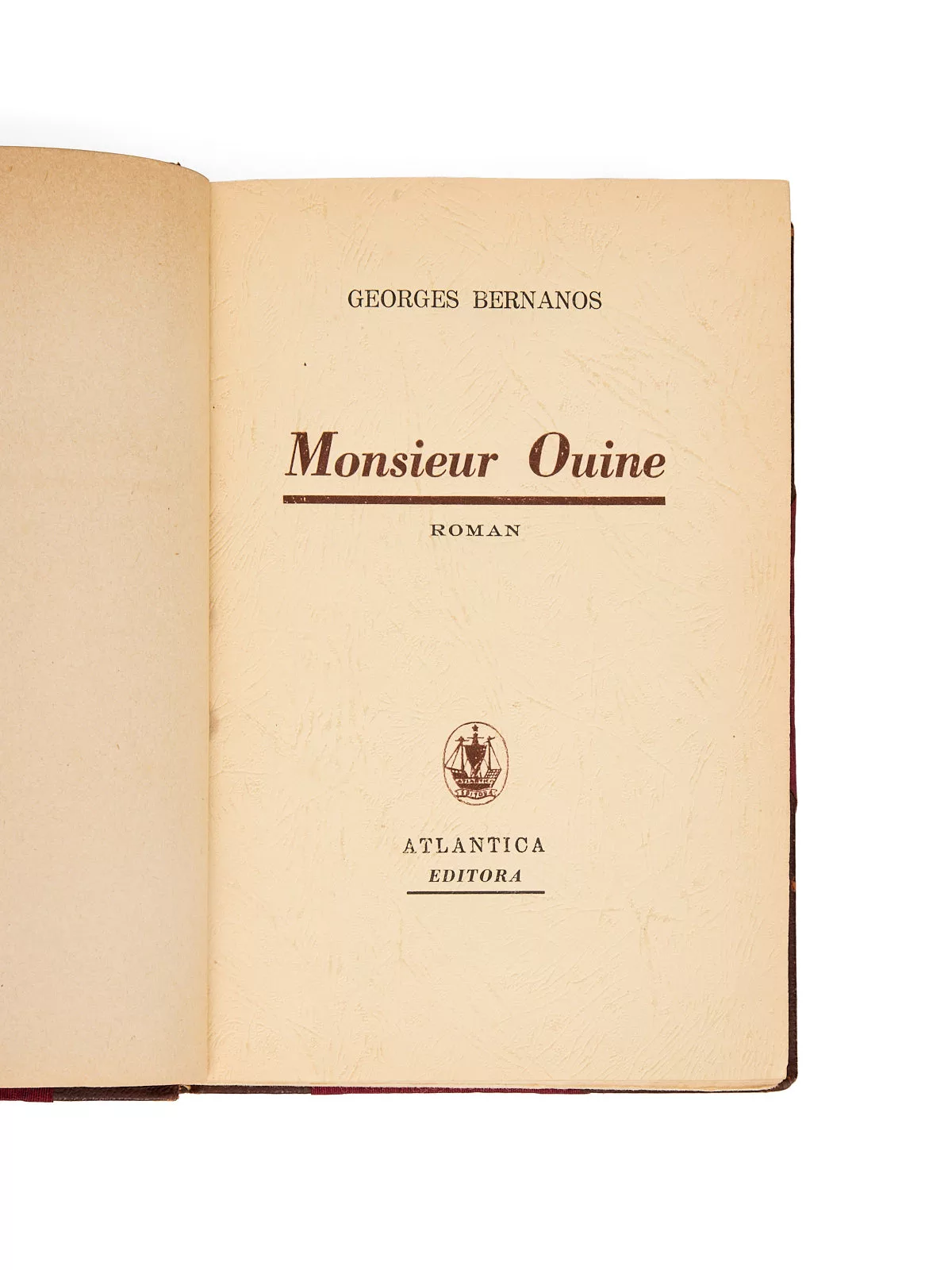
It was also in Brazil that he met the publisher Charles Höfer, a Swiss exile in Rio, a singular figure who was both a man of letters and an adventurer, then head of the powerful Atlantica Editora. It was precisely on 10 May 1940 that Bernanos told him he had just finished Monsieur Ouine. Atlantica published this first edition in 1943, one of Bernanos’s major Brazilian publications alongside Le Chemin de la Croix-des-âmes.
The history of this copy is intimately linked to these Brazilian years. Jean Désy (1893–1960) was one of the great figures of Canadian diplomacy. Canada’s first ambassador to the Netherlands, then to Belgium in 1939, he was posted there during the German invasion and organized the safe evacuation of his staff and their families. He subsequently became the first Canadian diplomat sent to Brazil. When the Canadian mission there was raised to the rank of embassy at the end of 1943, he naturally became ambassador. Bernanos became acquainted with him and his wife, Corine Désy, during his stay in Brazil. The diplomat and his wife were received at the Croix-des-âmes and maintained a relationship with the writer warm enough that Bernanos reserved copies of his Brazilian publications for them — the volumes of Le Chemin de la Croix-des-âmes bearing warm inscriptions to them are known, as is this copy of Monsieur Ouine, a “tormented book” that Bernanos contrasts with the “noble and gentle serenity” of its recipient.