

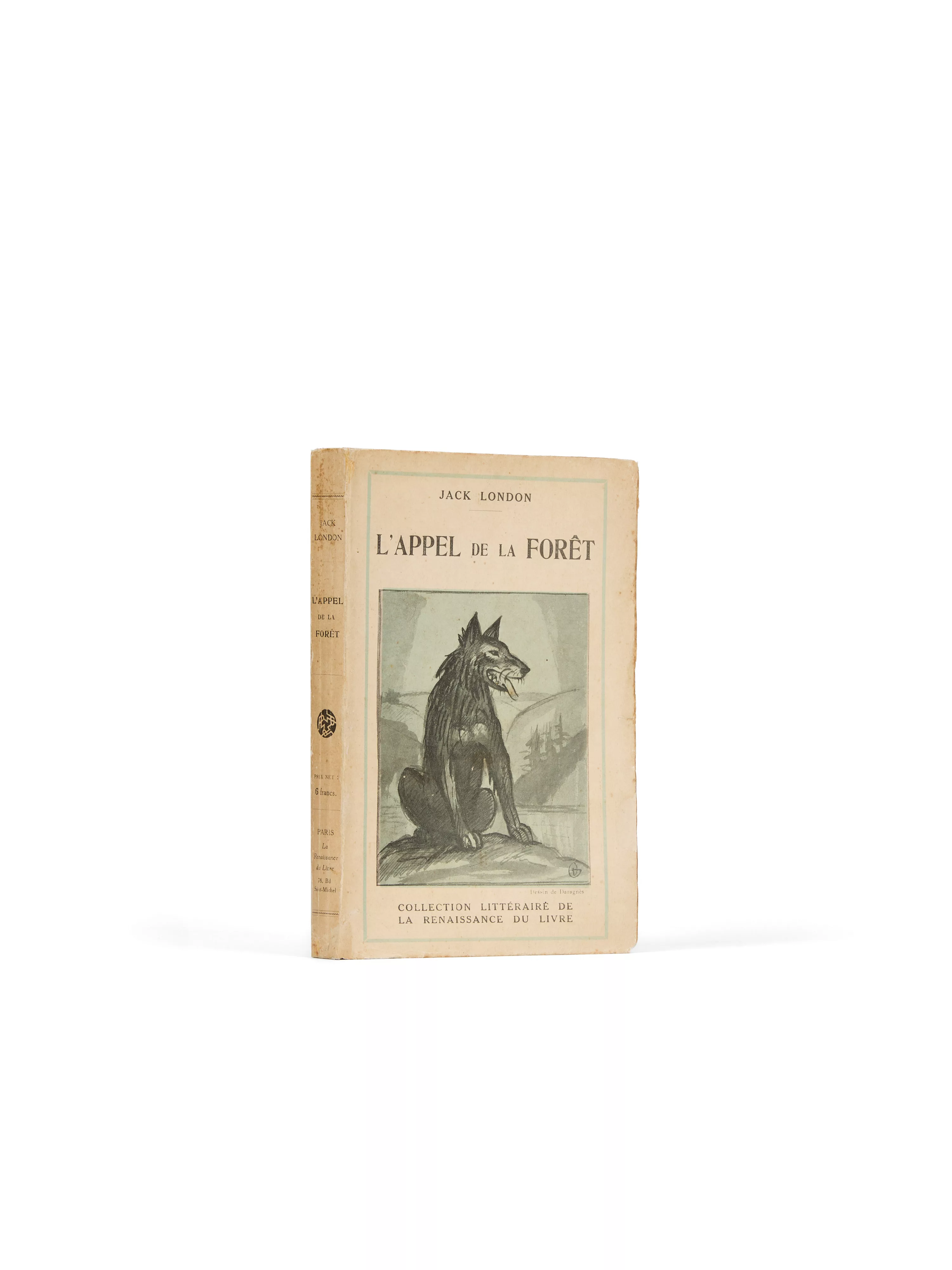
L’Appel de la forêt
Preface-letter by Paul Bourget.
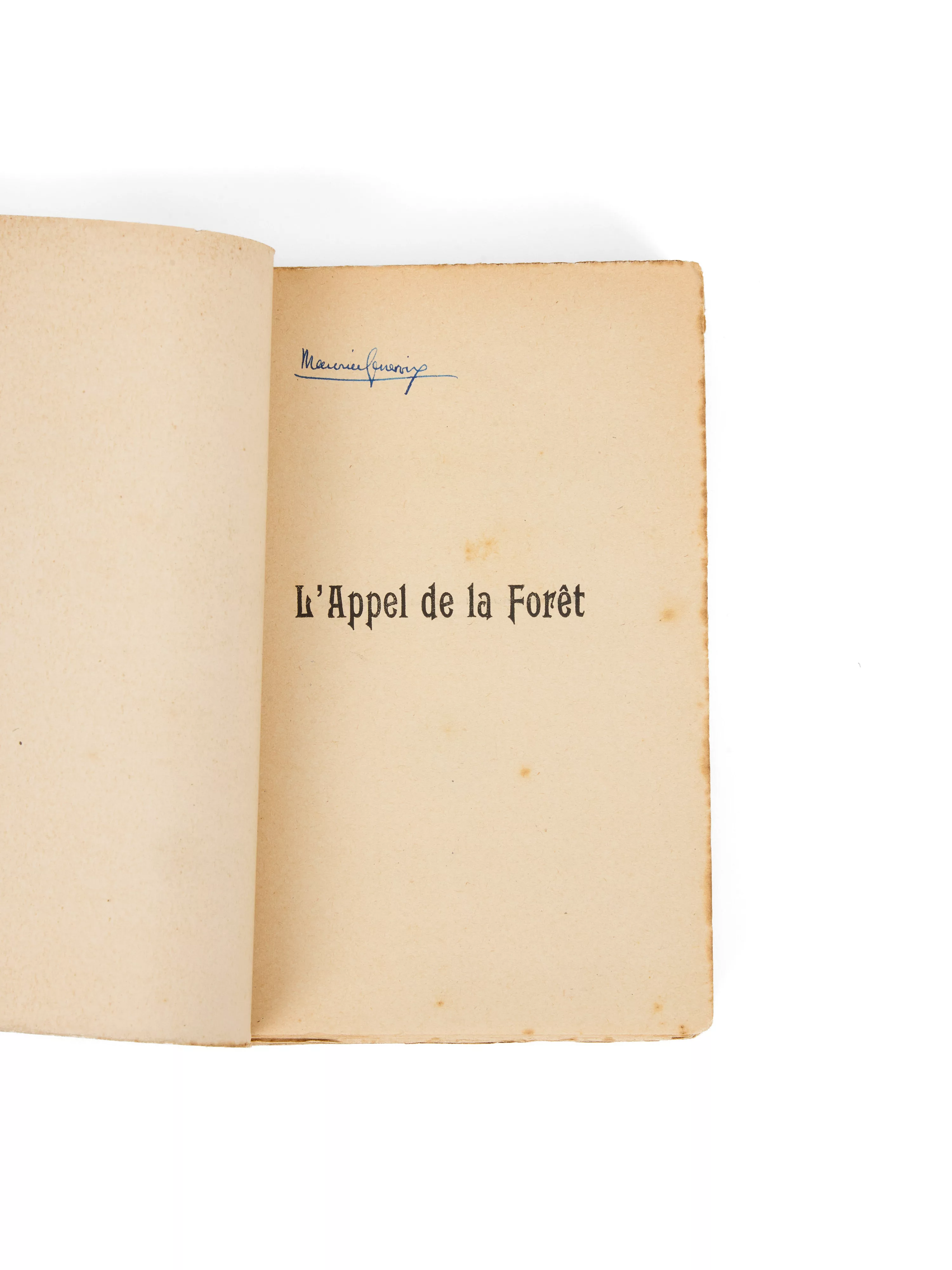
Maurice Genevoix's copy, with his manuscript ownership inscription.
A tale of initiation and a quest for freedom, The Call of the Wild is above all a story of return to origins, inspired by the theory of evolution that had marked the close of the nineteenth century: a novel of “unlearning,” a rediscovery of the wild instinct that the domesticated dog Buck gradually reclaims.
Jack London was still entirely unknown in France when the publisher Félix Juven, who had recently specialized in adventure literature for young readers, took an interest in his work. London, nicknamed the “Kipling of the cold,” could be admired as much for his exploits and travels as for his books. The translation was entrusted to Raymonde de Galard, a member of the highly aristocratic Société des bibliophiles français since 1903, who translated five of London’s titles between 1905 and 1906. Paul Bourget, of the Académie française, contributed the preface, which could only help the successful introduction of a still-unknown author. Raymonde de Galard appears here as “Mme la Comtesse de Galard,” her title of nobility no doubt lending credibility to her work at the time. The title page also carries the phrase “honoré d’une médaille d’argent de la société protectrice des animaux” (awarded a silver medal by the animal protection society), a mention that likely helped perpetuate a persistent misunderstanding about the book’s actual content.
The novel first appeared in installments, in Le Temps (3–16 December 1905), then in Le Journal des voyages (1 July–9 September 1906, illustrated by Joseph Beuzon). The cover of the subsequent Juven edition largely reproduces that of the original 1903 American edition.
This call to harmony and freedom could only have had a strong and positive impact on the young Maurice Genevoix, who devoutly kept this novel, read at sixteen, in his adult library. “For the first time, I saw myself given a number: no. 4. One might think of military life, if one had not also known, in the early years of this century, the life of a boarding pupil at a French provincial lycée. Everything the word ‘barracks’ evokes, I knew it there, at the age of ten, at the Lycée Pothier, rue Jeanne d’Arc… His consolation was a keen taste for comradeship, an aptitude for drawing, and the prodigious treasure of reading, which opened another universe to him. Jules Verne bored him; he was enthralled by Hector Malot’s Sans famille, before immersing himself in London and Kipling.” (in Maurice Genevoix, Chemins de mémoire). The following year he left for the preparatory class at Lakanal (Sceaux), where he would prepare for the entrance examination to the École Normale Supérieure, rue d’Ulm.
A remarkable copy of London’s first title translated and published in French. White Fang, also published in English in 1906, would not be translated until fifteen years later, in 1923.
From the library of Maurice Genevoix (bookplate).