

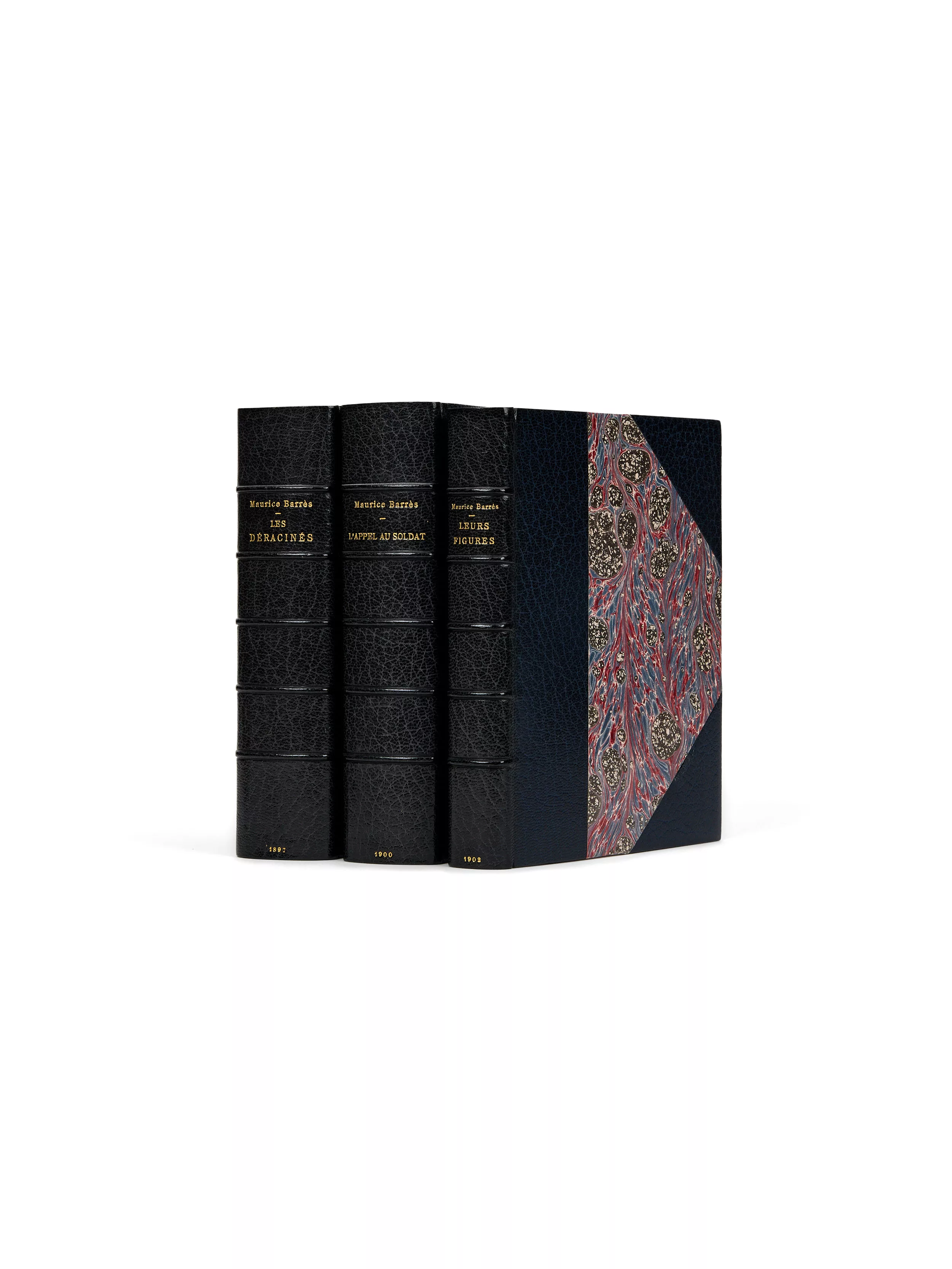
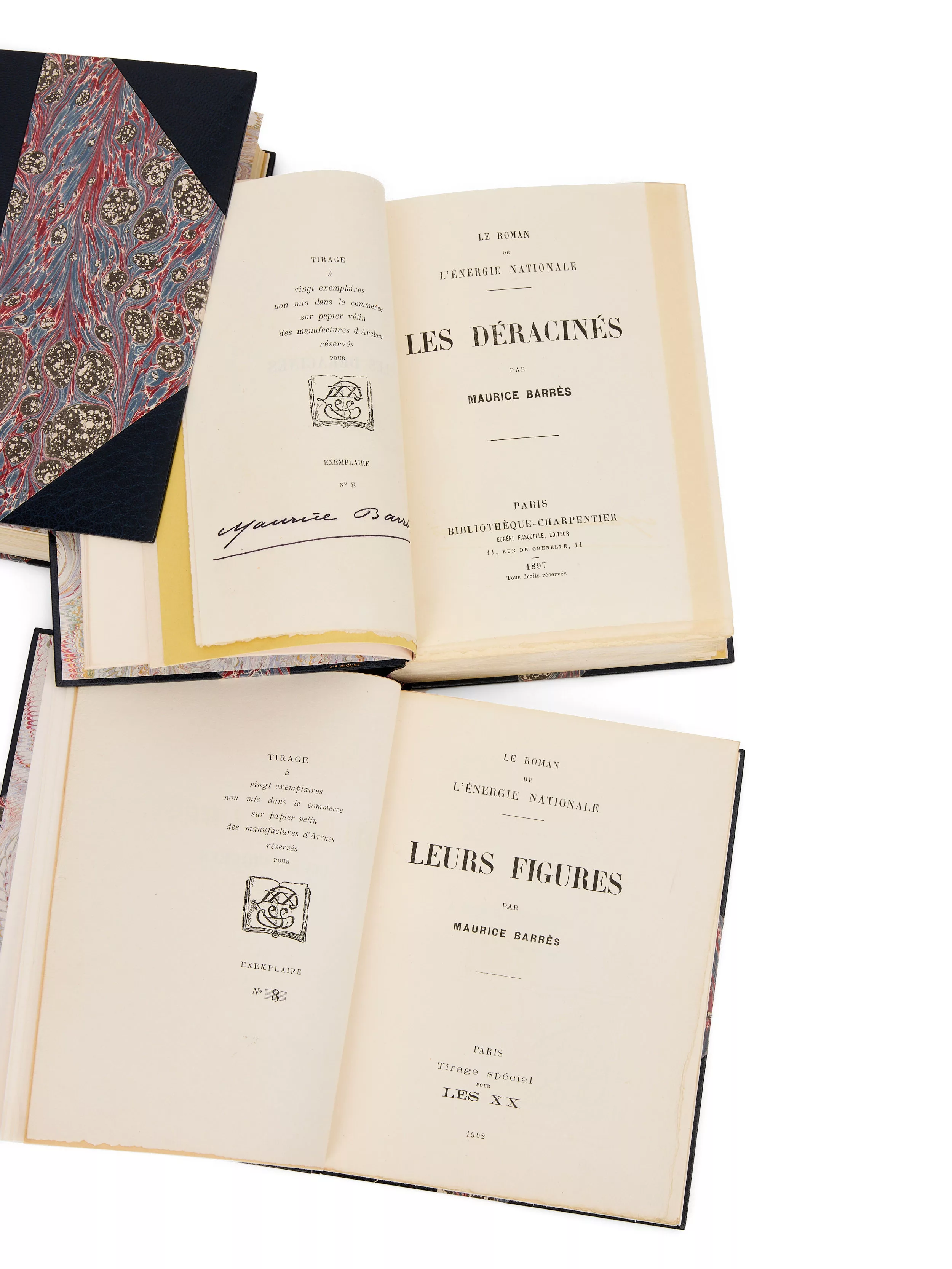
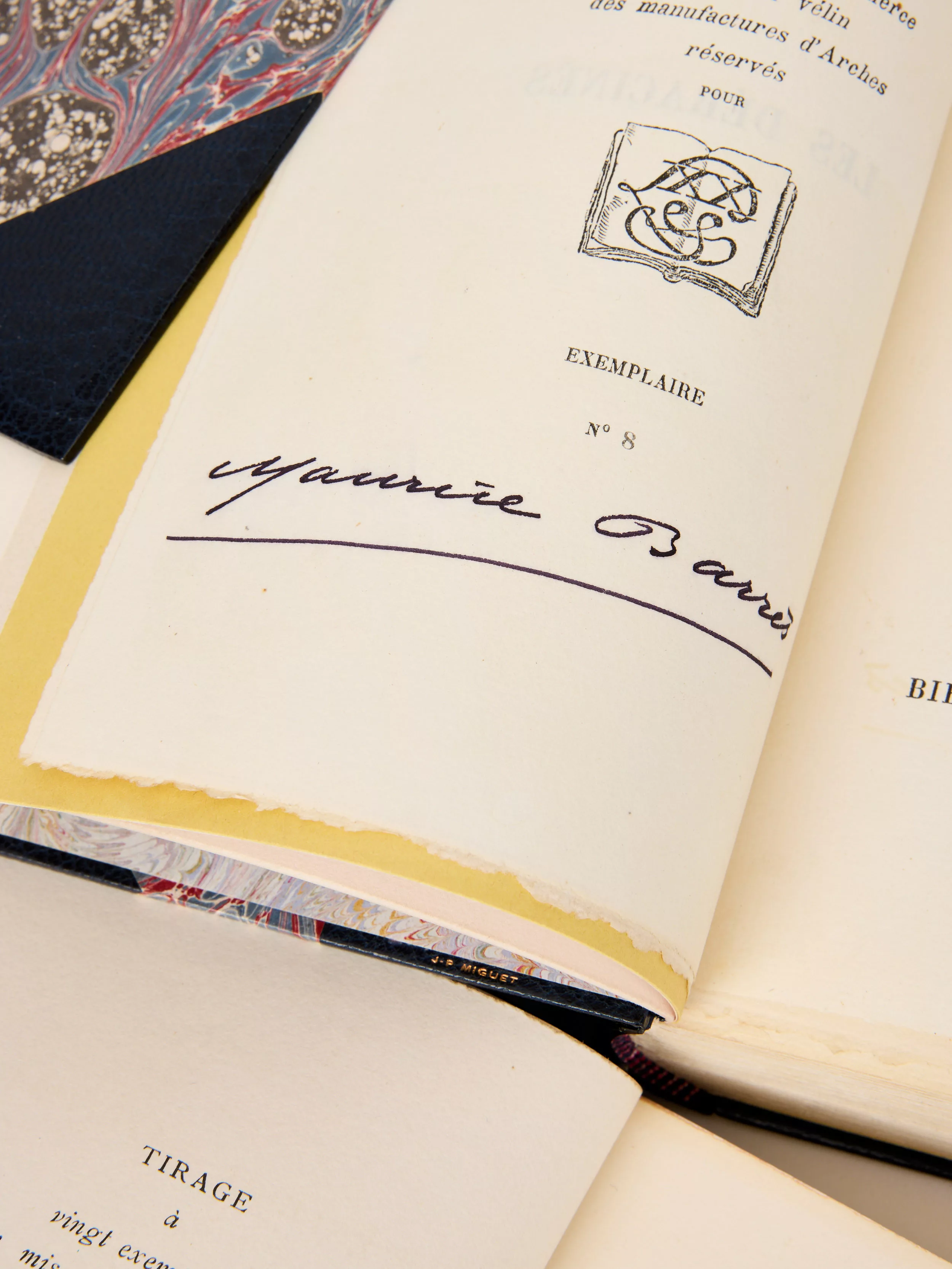
One of 20 numbered copies on vélin d'Arches reserved for the XX, for each of the three volumes.
These copies are not announced in the publisher's limitation statement and rank before the 25 copies on Hollande (after 10 copies on Japan).
The first volume is signed by Maurice Barrès in the limitation statement, in keeping with the practice of the “Société des XX” publications.
Le Roman de l’énergie nationale is arguably the most ambitious novelistic and ideological project of the man then known as the “princeps juventutis,” the prince of youth, as Barrès was called. Paul Bourget was the first, in 1888, in an article in the Journal des Débats, to draw attention to the then-unknown author of Sous l’œil des barbares. Following this, Barrès set out to compose a vast fresco comprising Les Déracinés, L’Appel au soldat and Leurs Figures: a “novel of national energy” in which he sought to capture the moral and political crisis of late nineteenth-century France, crystallized around the famous formula “the land and the dead.” The three volumes are dedicated respectively to Paul Bourget, Jules Lemaître and Édouard Drumont.
Published in 1897, Les Déracinés remains the most famous volume of the trilogy. Barrès follows seven young men from Lorraine who leave Nancy for Paris, drawn by the intellectual and social promises of the capital. But their uprooting from their native soil gradually becomes a loss of identity, moral dissolution and collective weakening: after various setbacks and disillusionments, two of them, Racadot and Mouchefrin, are driven to crime. While one escapes the guillotine through a friend’s complicity, “Racadot déraciné” is beheaded. Behind the individual trajectories of the characters lies a broader critique of a centralized France, “dissociated and decerebrated,” in which Barrès builds his novel on the idea that an individual cut off from his native milieu — his province, his traditions, his dead, his landscapes, his social language — becomes vulnerable and open to every moral or ideological dissolution: an anxiety that still resonates today and explains the enduring reference to Les Déracinés among intellectuals.
The importance of Les Déracinés in the intellectual life of the period was immediate. The novel sparked passionate debate, both political and literary. André Gide, in an article published in L’Ermitage in February 1898, responded ironically to the Barresian cult of rootedness: “Born in Paris, of an Uzès father and a Norman mother, where would you have me take root, Monsieur Barrès? I have therefore decided to travel.” Gide nonetheless admired the novel’s typological power, while criticizing Barrès for sacrificing the psychological individuality of his characters to ideological demonstration.
Barrès, who died in 1923, inspired several generations of writers: the tribute paid to him by the young Léon Blum in La Revue blanche has remained famous: “I know very well that Monsieur Zola is a great writer; I love his work, which is powerful and beautiful. But one could remove him from his time by an effort of thought, and his time would remain the same. Had Monsieur Barrès not lived, had he not written, his time would be different and we would be different. I know of no living man in France who has exercised, through literature, an equal or comparable influence.” Later, André Malraux would celebrate the writer while rejecting the politician: “He was a corporal in politics, whereas in literature he was a general.”
A rare edition, from the printing reserved for “Les XX”: this title inaugurated the collection of this society of bibliophiles, founded that year by Pierre Dauze. Two other titles appeared in 1897: La Canne de jaspe by Henri de Régnier, and an illustrated volume, Des chats, by Steinlen. The Société des XX continued until 1938, publishing 159 titles in an edition limited to the 20 members.
A very fine copy, magnificently bound by Miguet.