

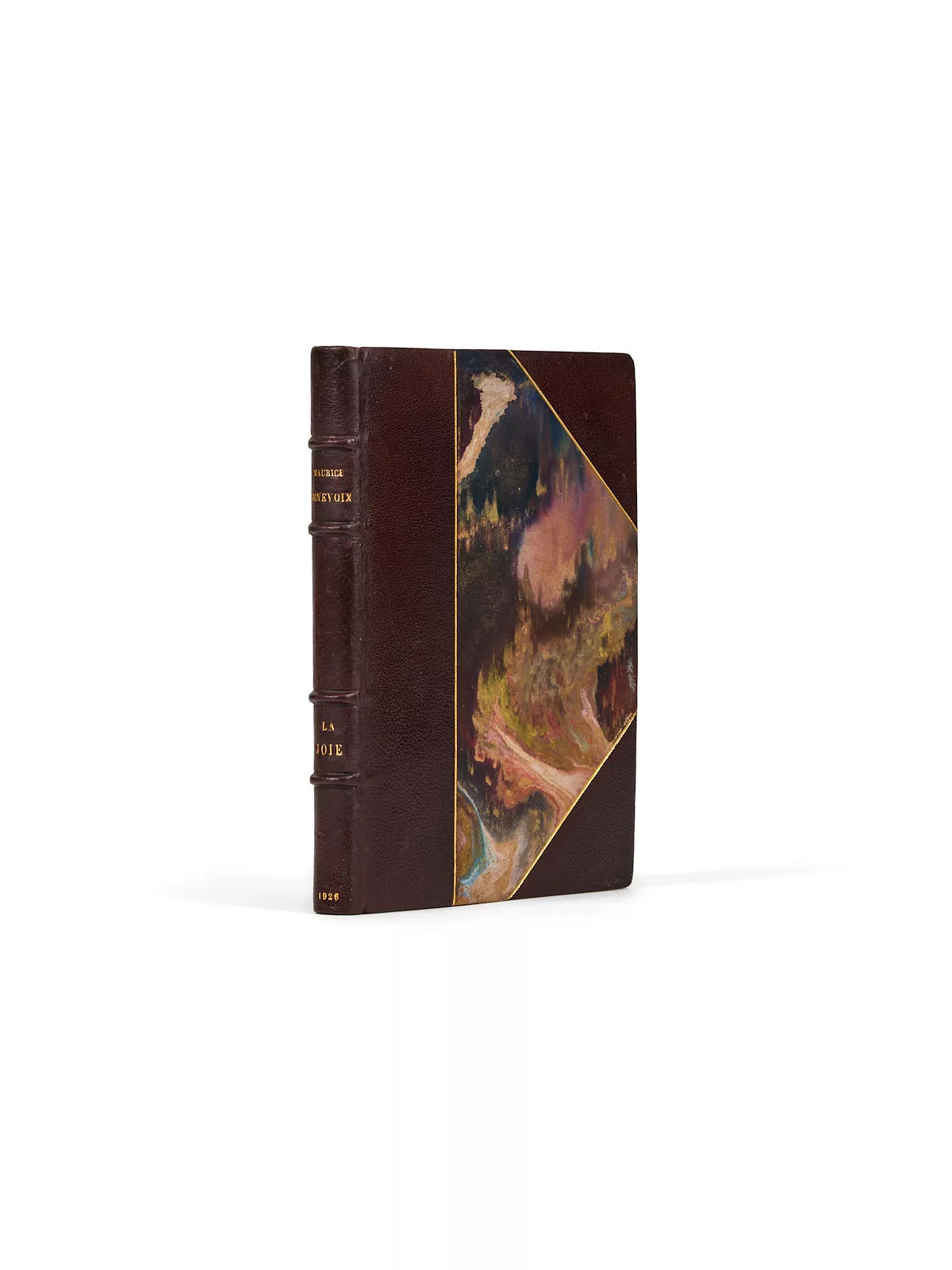
La Joie
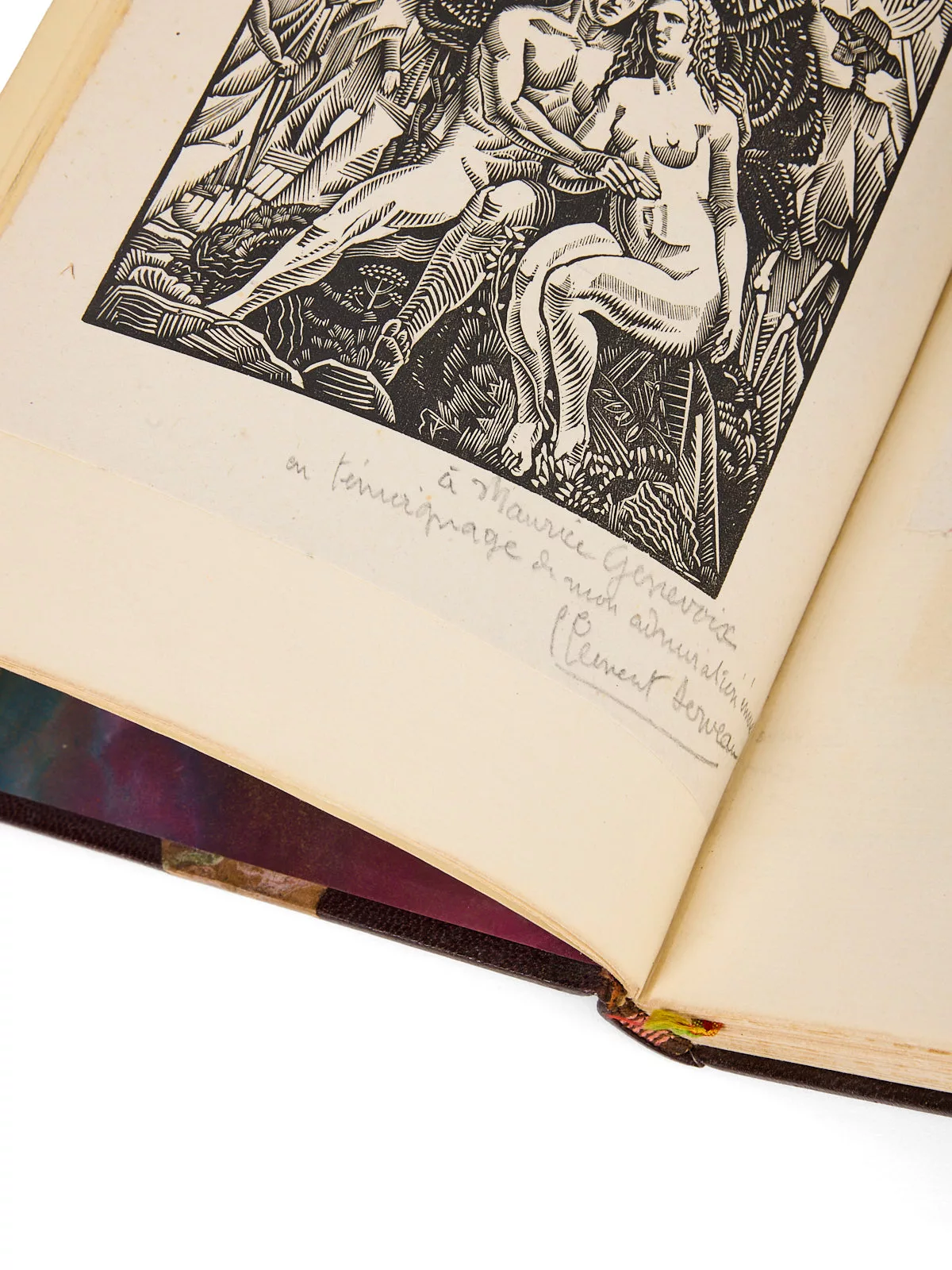
The author's own copy, with the suite on chine appliqué.
Signed presentation inscription [at the foot of the frontispiece printed on chine]: “à Maurice Genevoix, en témoignage de mon admiration émue. Clément Serveau.”
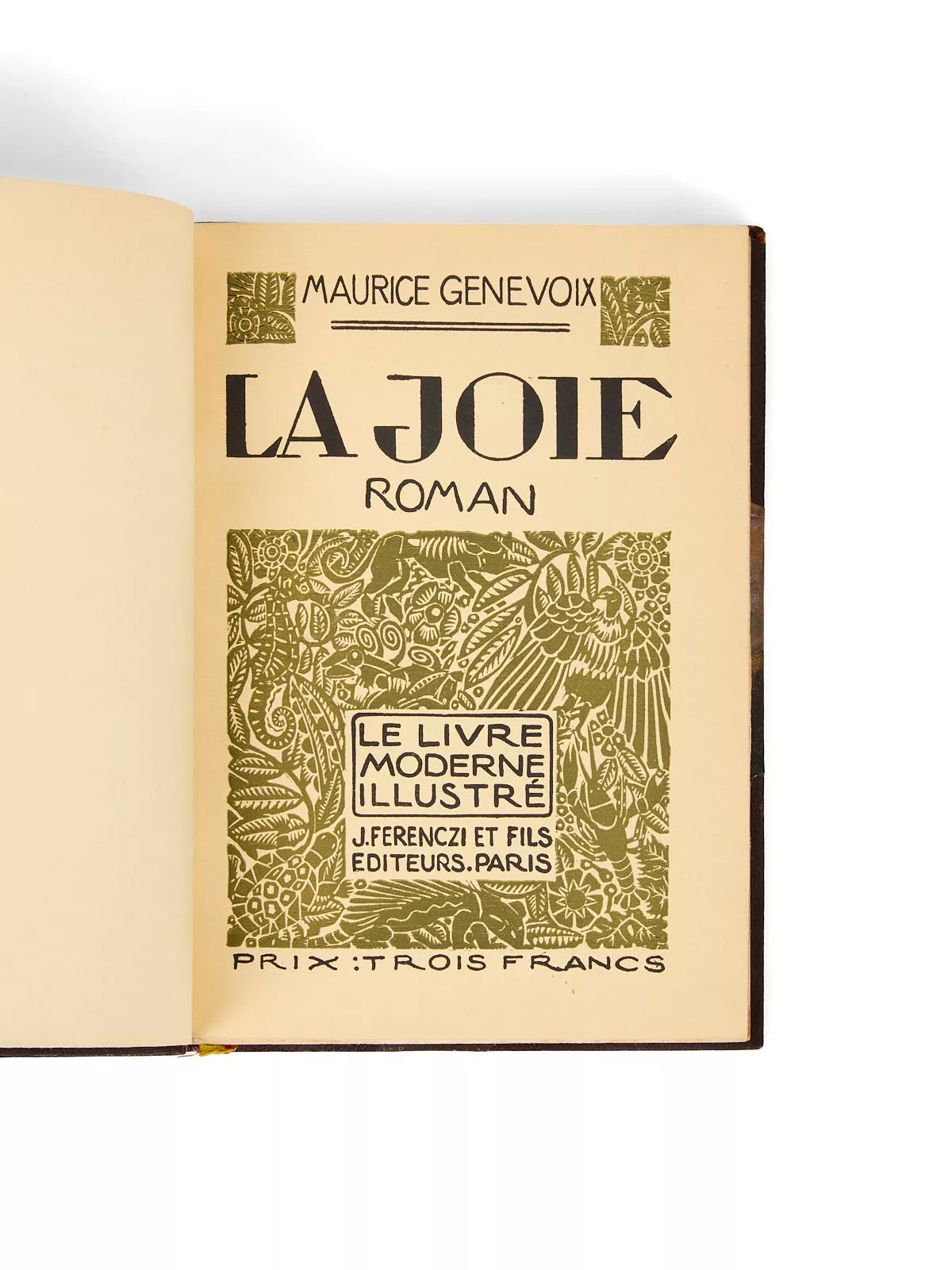
In the field of inexpensive illustrated literary editions, two rival publishers competed from 1923 onward: Fayard and Ferenczi. The former launched its “Le Livre de demain” series in February 1923, the latter its “Le Livre moderne illustré” in June of the same year. Both collections exemplify the revival of the wood-engraved illustrated book at a time when luxury publishing was becoming more widely accessible: “These two rival series popularized French literature for two or three generations… Their success at the time owed much to their illustrations, mostly wood engravings. This corpus of engravings is by far the largest, numerically, of any interwar production — some ten thousand original blocks, meaning designed and engraved by the same artist.” (Jean-Michel Galland, “Les gravures sur bois des collections Fayard et Ferenczi,” Nouvelles de l’estampe, no. 254).
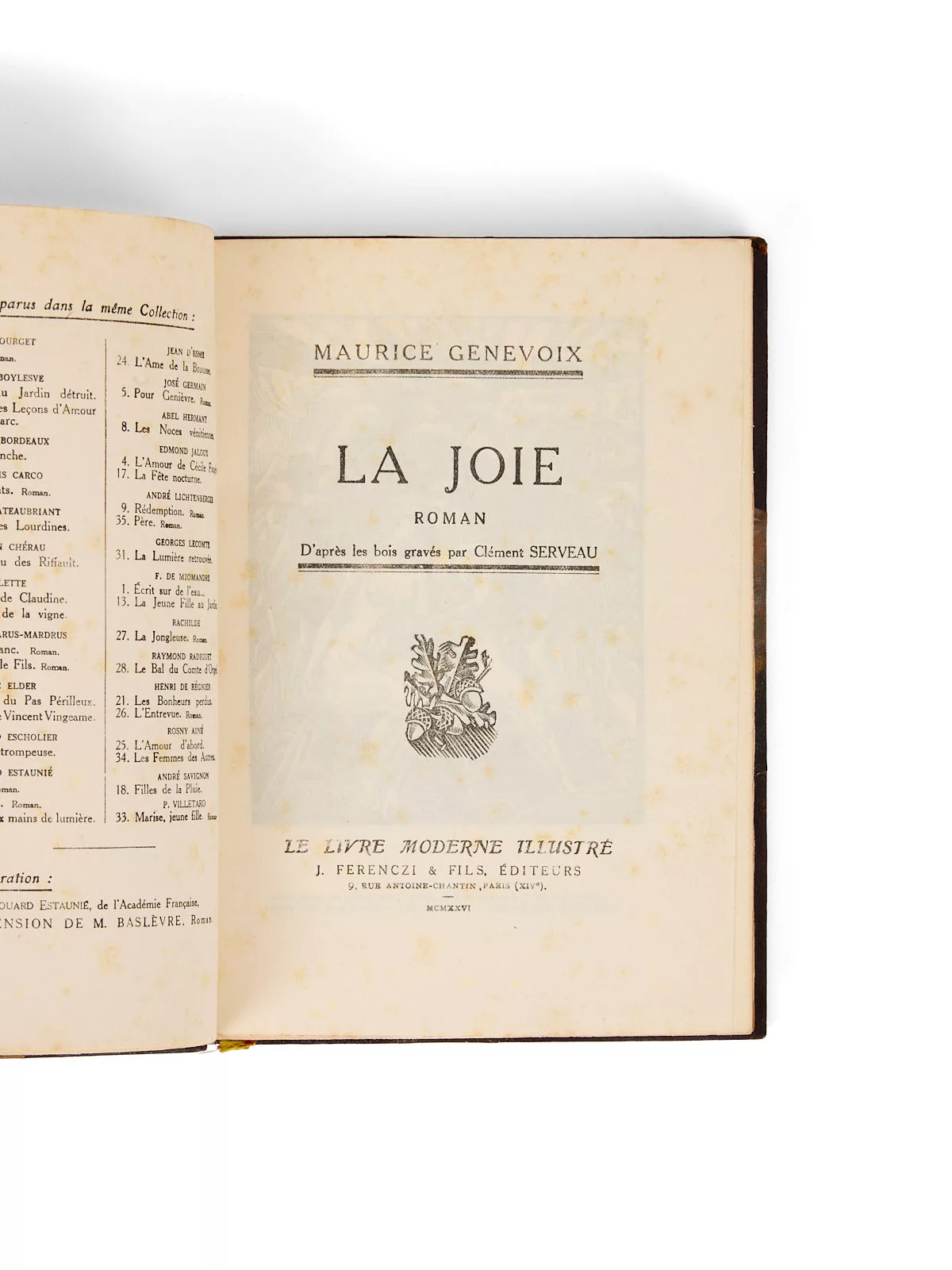
Ferenczi’s “Le Livre moderne illustré” ran until 1954, for a total of 366 titles. The texts were enriched with a series of interior illustrations, generally taken from original woodblocks. Its covers, well known to collectors and bibliophiles, are easily recognizable, featuring a monochrome-tinted wood-engraved illustration with “floral and animal” motifs in the Art Deco style, set within a design conceived by Clément Serveau. Serveau, who studied at the École nationale des arts décoratifs and then at the École nationale supérieure des beaux-arts in Paris from 1904 to 1914, became artistic director of Éditions Ferenczi in 1919. He illustrated, using wood engraving, seventy-eight titles in the series, whose literary direction Colette oversaw for several years.
The artists’ wood engravings were reproduced “through the valuable process of electrotyping, consisting of a copper cliché called a galvano, which reproduces the qualities of the original block with remarkable fidelity, allowing large print runs to be made without printing directly from the blocks themselves, which risked being worn or broken by excessive pressure.” (Carteret, Le Trésor du bibliophile: livres illustrés modernes).
Most French writers of the 1920s to 1940s had works published in this popular series: Francis Carco, André Malraux, Georges Duhamel, Colette, Francis de Miomandre, François Mauriac, Joseph Kessel, Raymond Radiguet, André Maurois, Irène Némirovsky, Blaise Cendrars and Paul Morand. Few foreign authors appear, though Stefan Zweig is a notable exception.
Maurice Genevoix entered the series in 1926 with La Joie. Raboliot followed in early 1927, as the 45th title in the series, a little over a year after winning the Prix Goncourt.