

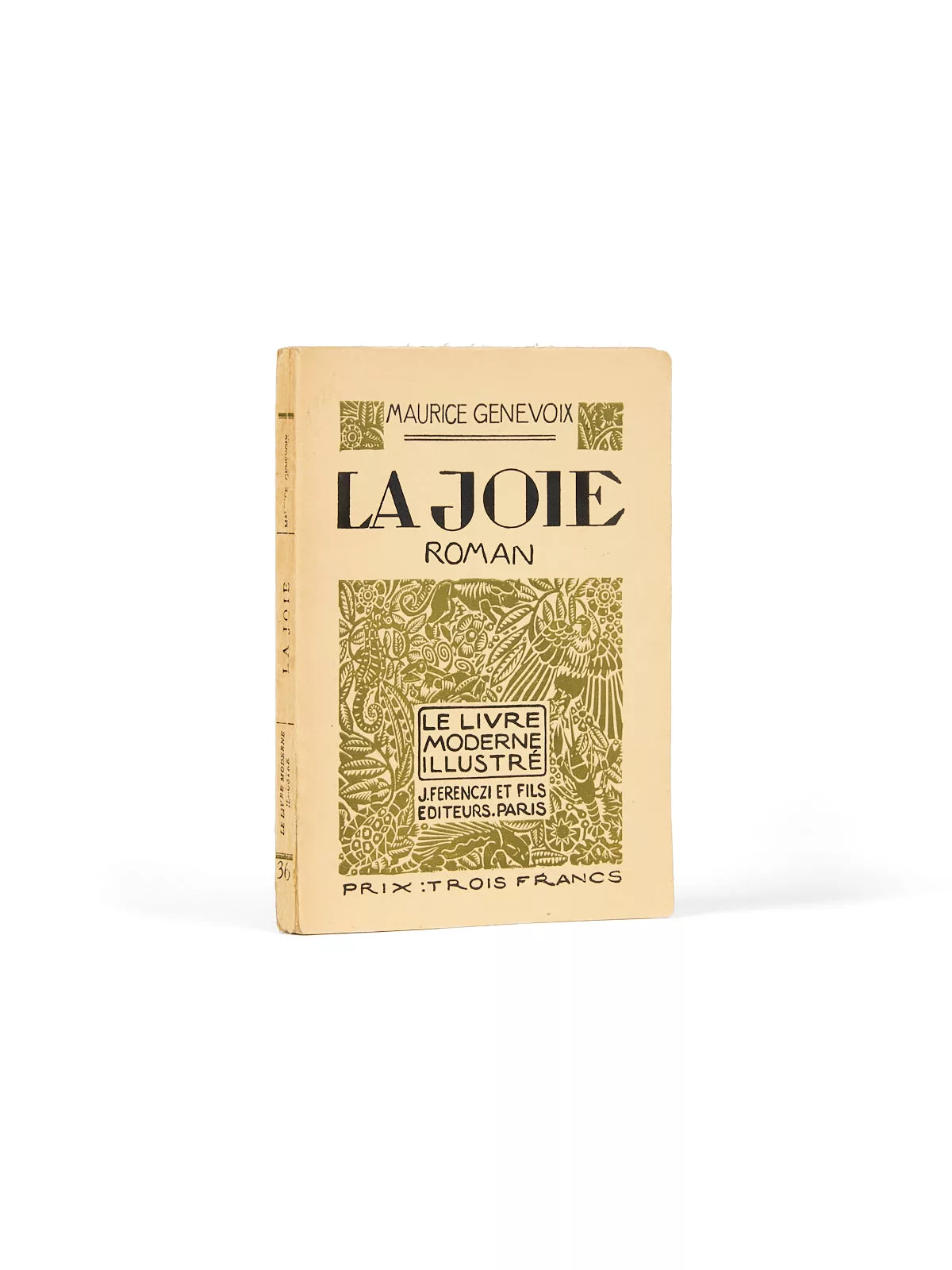
La Joie
Copy from the ordinary printing (no deluxe-paper copies announced).
The author's own copy, kept in wrappers in his library; it bears an autograph note in the margin of page 191: “à la fin de ma vie…relire ‘Vagabondages’ écrit à Javea. Le Chardonneret de Carel Fabritius.” This moving note, evoking the most famous work by the Dutch painter, a pupil of Rembrandt who died tragically during the “Delft thunderclap,” invites Genevoix, “at the end of [his] life,” to return to a short text he had written in Jávea, in the province of Alicante in Spain: a late text, perhaps even one of the last Genevoix wrote, which would not be published until September 1980, in the poetry review Vagabondages, in its September issue.
In the field of affordable literary editions, two rival publishers competed from 1923 onward for the market in illustrated editions: the houses of Fayard and Ferenczi. The former with its collection “Le Livre de demain,” launched in February 1923, the latter, in June, with “Le Livre moderne illustré.” Both were emblematic of the revival of wood-engraved illustrated books in the context of the democratization of the luxury book: “These two rival collections popularized French literature for two or three generations… Their success at the time stemmed largely from their illustrations, mostly wood engravings. This corpus of engravings is by far the largest, numerically, of any interwar production — on the order of ten thousand original blocks, that is, designed and engraved by the same artist” (Jean-Michel Galland, “Les gravures sur bois des collections Fayard et Ferenczi,” Nouvelles de l’estampe, no. 254, 2016, 38–56).
The “Le Livre moderne illustré” collection launched by Ferenczi ran until 1954, with a total of 366 titles. The texts were enriched with a series of interior illustrations, generally taken from original woodblocks and usually including a frontispiece, decorative initials and tailpieces. Its covers, well known to collectors and bibliophiles, are easily recognizable, featuring a principal woodcut with “floral and animal” motifs in a monochrome-tinted Art Deco style, designed by Clément Serveau. Serveau, after studying at the École nationale des arts décoratifs and then the École nationale supérieure des beaux-arts in Paris from 1904 to 1914, became artistic director of Éditions Ferenczi in 1919. Using the woodcut technique, he illustrated seventy-eight of the collection’s titles, whose literary direction Colette oversaw for several years.
The artists’ woodcuts were reproduced “thanks to the valuable process of electrotyping, consisting of copper plating known as a galvano, which reproduces the qualities of the original woodblock to perfection, allowing large print runs without printing directly from the blocks themselves, which risked being worn out or broken by excessive pressure.” (Carteret, Le Trésor du bibliophile: livres illustrés modernes, p. 271).
Most French writers of the 1920s to 1940s had works published in this popular collection: Francis Carco, André Malraux, Georges Duhamel, Colette, Francis de Miomandre, François Mauriac, Joseph Kessel, Raymond Radiguet, André Maurois, Irène Némirovsky, Blaise Cendrars and Paul Morand. Few foreign authors appear in it, but Stefan Zweig is notably among them.
Maurice Genevoix entered the collection in 1926, with La Joie.
From the library of Maurice Genevoix (bookplate).