


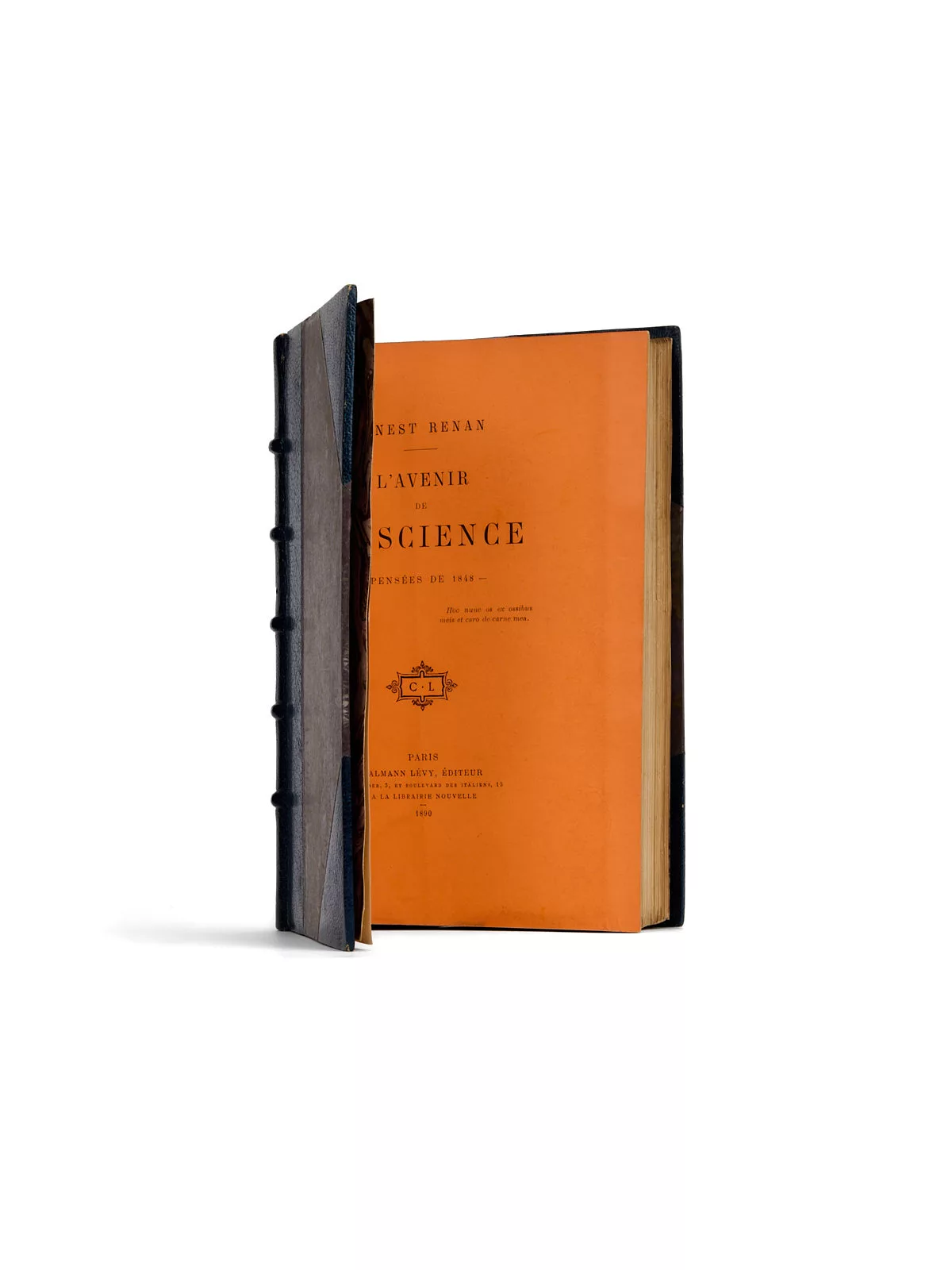
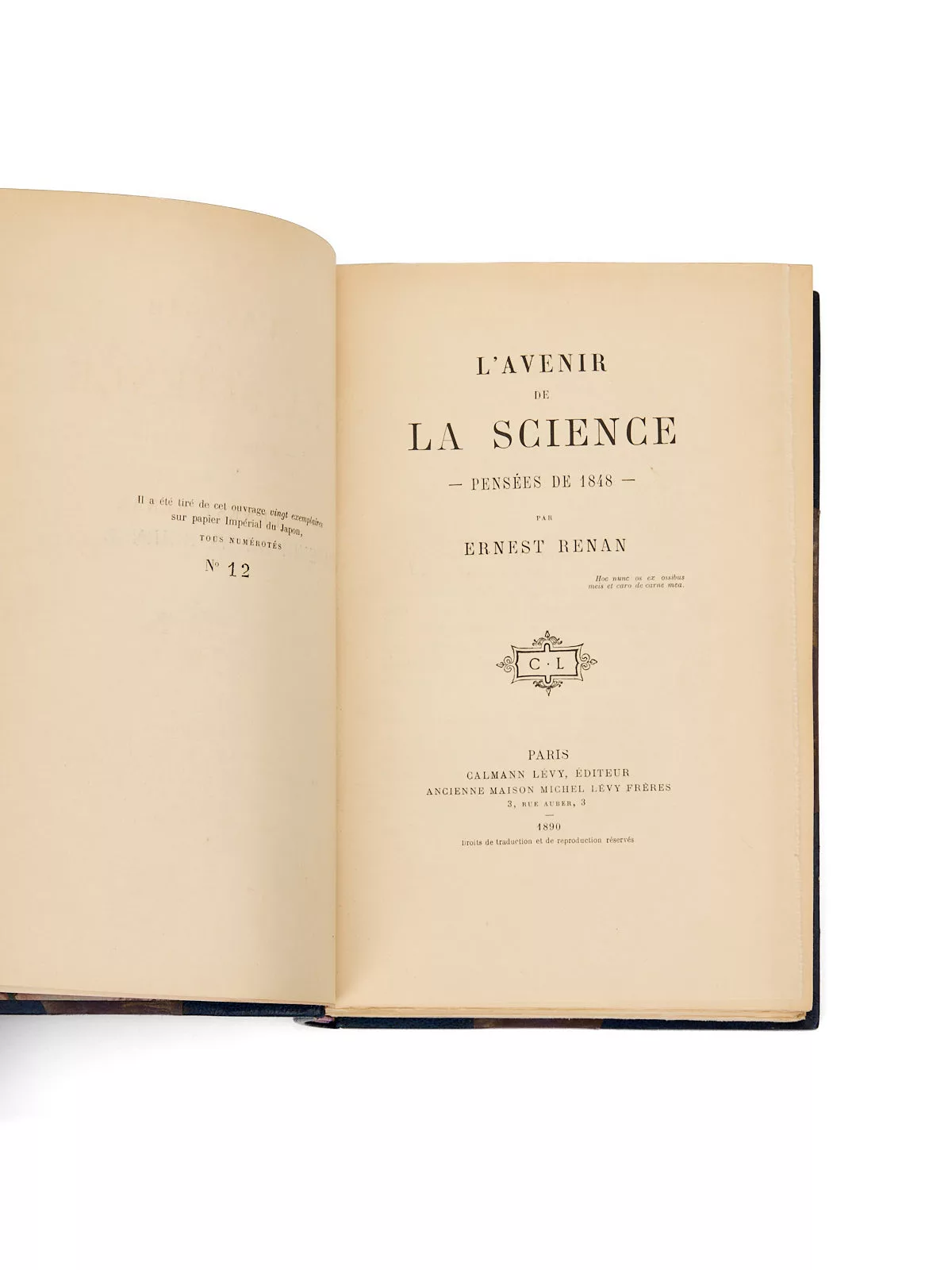
One of 20 copies on Japanese paper (no. 12).
L’Avenir de la science (The Future of Science) is one of Renan’s most singular books: a work of youth published on the threshold of old age, it is the deferred testament of a twenty-five-year-old man, offered to the public by an already celebrated writer. Written in the intellectual ferment of 1848 and completed the following year, the book was not published until 1890, forty years after its composition and only two years before the author’s death. Between these two dates, Renan had become the great historian of religions, the philologist of Vie de Jésus, the thinker behind Qu’est-ce qu’une nation?, a member of the Collège de France and the Académie française.
The subtitle, Pensées de 1848, is essential: it situates the book within a year of revolution, political utopias and intellectual renewal. For Renan, the future of humanity should no longer be entrusted to dogma but should proceed through science, understood in the broadest sense — not only the natural sciences but also the human sciences: philology, history, textual criticism, and the study of religions, languages and works of art. Renan dreamed of a “science of the human mind”: the replacement of theology by critical history, confidence in the philological method, and the ambition to apply the rigor of the positive sciences to matters of the mind — not a substitute belief, but a discipline of the true, the good and the beautiful.
The 1890 preface adds further interest to the volume. The aging Renan looks back on the enthusiasm of his younger self, not quite disavowing it, but still recognizing in it the founding impulse of his intellectual life.
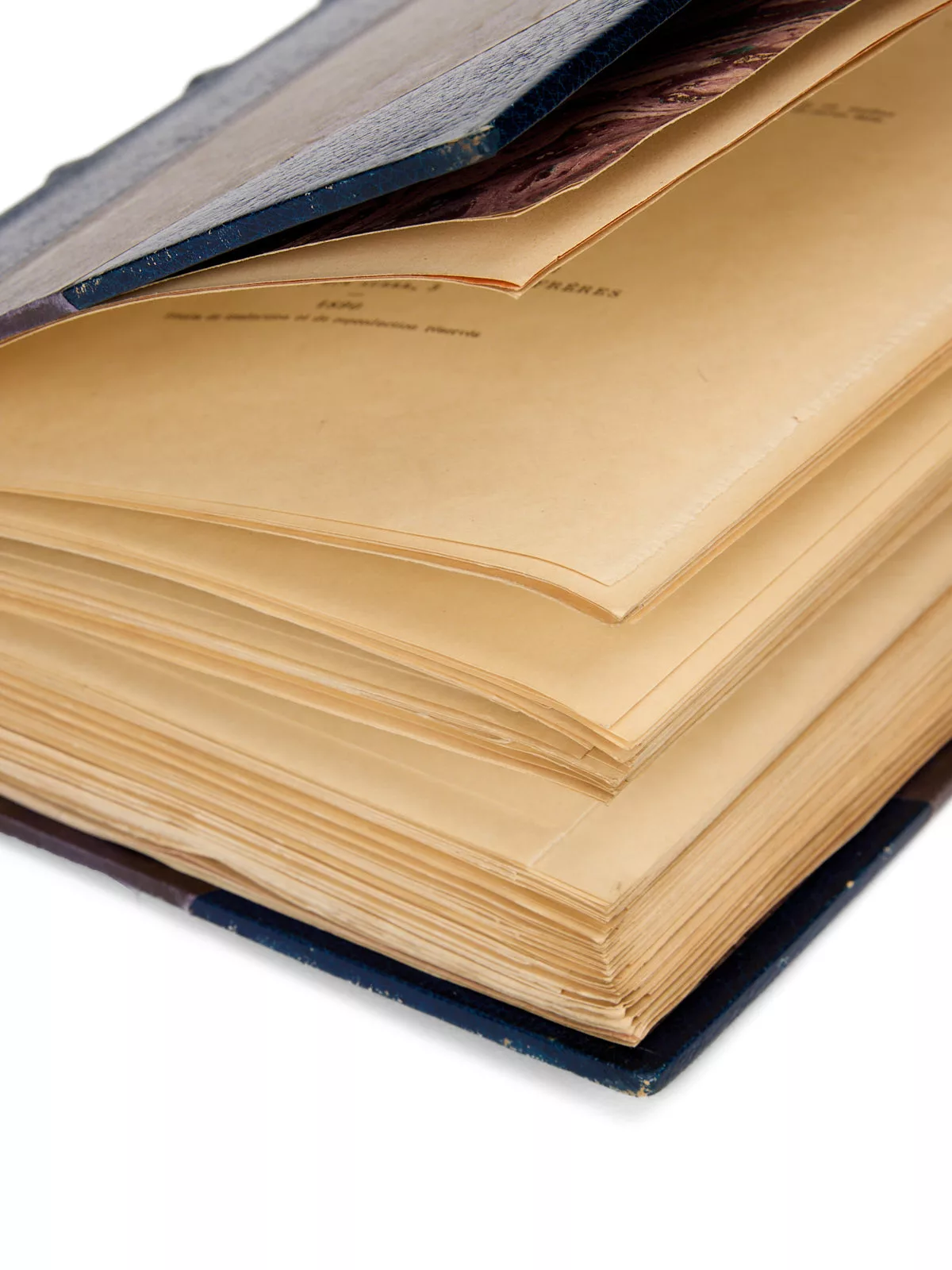
A rare deluxe copy, beautifully bound by David: one of the earliest bindings by Salvador David, successor to his father Bernard David from 1890 until 1927. He was one of the principal binders for Descamps-Scrive.
Vicaire, VI, 1035; Clouzot (who records only 30 deluxe copies on Hollande paper).