


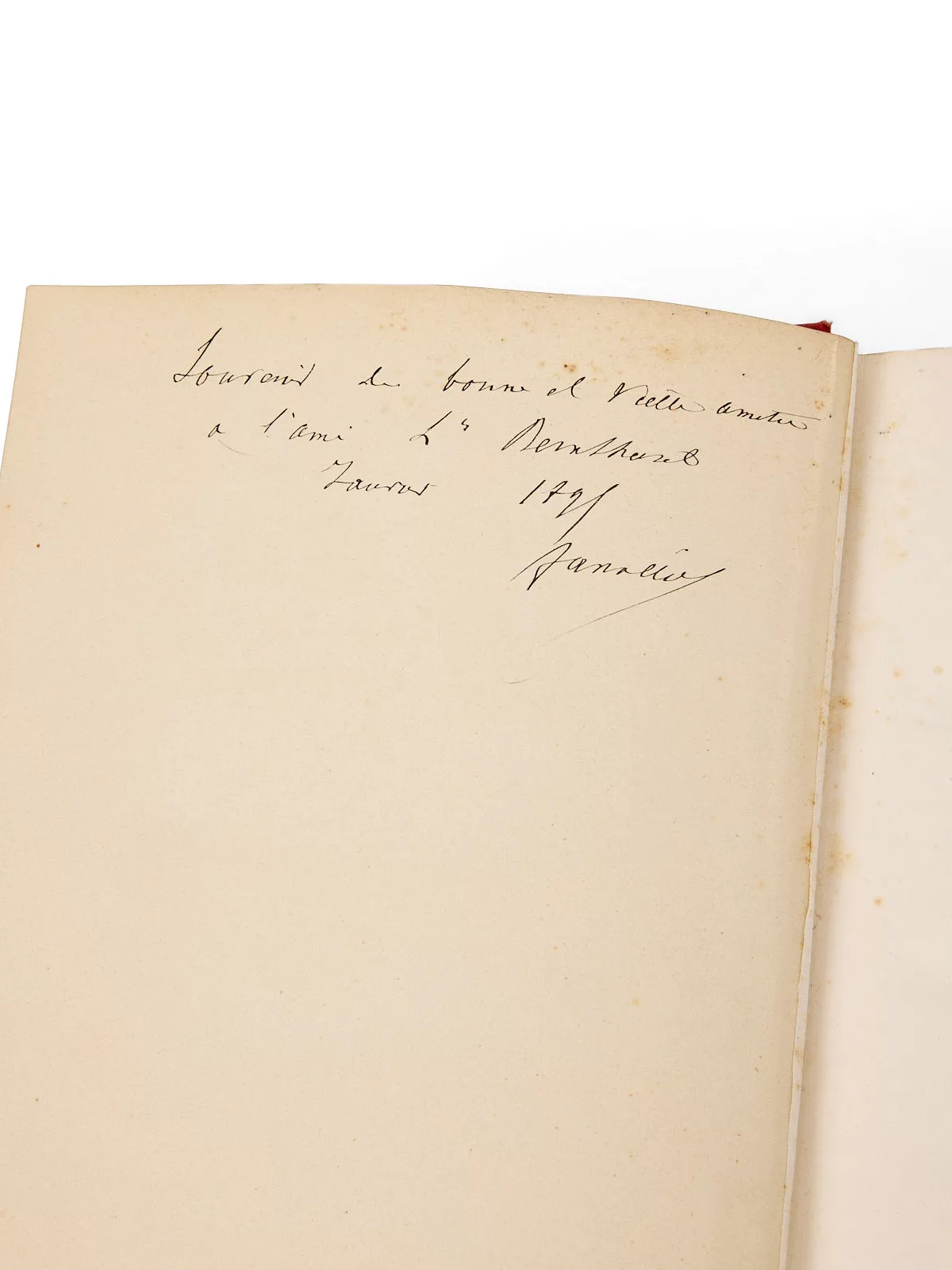

Mirifiques aventures de maître Antifer
Mirifiques aventures de maître Antifer deserves to be examined above all in the context of astronomical navigation. As Jules Verne himself told a journalist, “it is the story of a treasure hunter and discoverer, and the plot turns on a very curious geometrical problem” (Robert Sherard, 1894, in Entretiens avec Jules Verne, 1873–1905), the solution of which would reveal a treasure supposedly hidden at the pole of a spherical cap whose base circle is determined by the positions of three islets, visited successively by the characters of the novel. The ultimate goal of the voyage is Julia Island, a volcanic islet that disappears beneath the waves just as the heroes reach it.
As so often, Jules Verne draws on reality: Julia Island did indeed exist, described by Pierre Larousse in his Grand dictionnaire universel du XIXe siècle as “a small floating island which appeared in 1831, in the Mediterranean, between Sicily and the island of Pantelleria; it measured 700 meters in circumference and 70 meters above sea level. After a month, it sank beneath the waves. In 1851, it was observed to be rising again.” The island is also mentioned in other novels by Jules Verne: Les Enfants du capitaine Grant, Le Chancellor and Mathias Sandorf.
Fine publisher’s boards, back cover type F, second cover type N, with HF catalogue, 1894–95.
Minor defects at foot, some foxing.
Bottin, 302–303.