

Civilisation
In mid-December 1914, Georges Duhamel, still working as a physician, wrote to his wife: “I shall owe it to the war that I emerged from my usual rut and saw an enormous collection of men that nothing could have led me to imagine.” These first impressions gave rise to Vie des martyrs, published in April 1917 — a book praised by Maurice Genevoix in L’Europe nouvelle in January 1918. A year later, Duhamel followed it with Civilisation, a more ambitious and more novelistic work, in which he broadened his subject through several different narrators. It is no longer only a matter of bearing witness, but of reflecting on what war does to humanity. The physician’s compassion is joined by a moral disillusionment, even despair, in these texts written from the ambulances of the rear front.
On 11 December 1918, Civilisation was awarded the Prix Goncourt, beating Pierre Benoît’s Koenigsmark, Maurois’s Les Silences du colonel Bramble and Giraudoux’s Simon le pathétique. Duhamel abandoned medicine for good following this literary recognition. It should be noted that the volume was published under the pseudonym Denis Thévenin, for reasons that have never been fully established — Duhamel having signed most of the press copies under his real name.
Jean Norton Cru, in Témoins, expressed reservations about the book, doubting the veracity of certain episodes and accusing the author of a form of aestheticization: “Did the author not play too insistently on the string of pity, for literary purposes, with the intention of producing crowd-pleasing set pieces?” Nevertheless, Civilisation remains one of the most important texts to emerge from the lived experience of a physician during the Great War.
In August 1940, Civilisation was banned and placed on the Bernhard list, before Duhamel’s entire body of work was placed on the Otto list. At the Liberation, Duhamel joined the Comité National des Écrivains, from which he resigned in 1946, disapproving of the excesses of the Épuration.
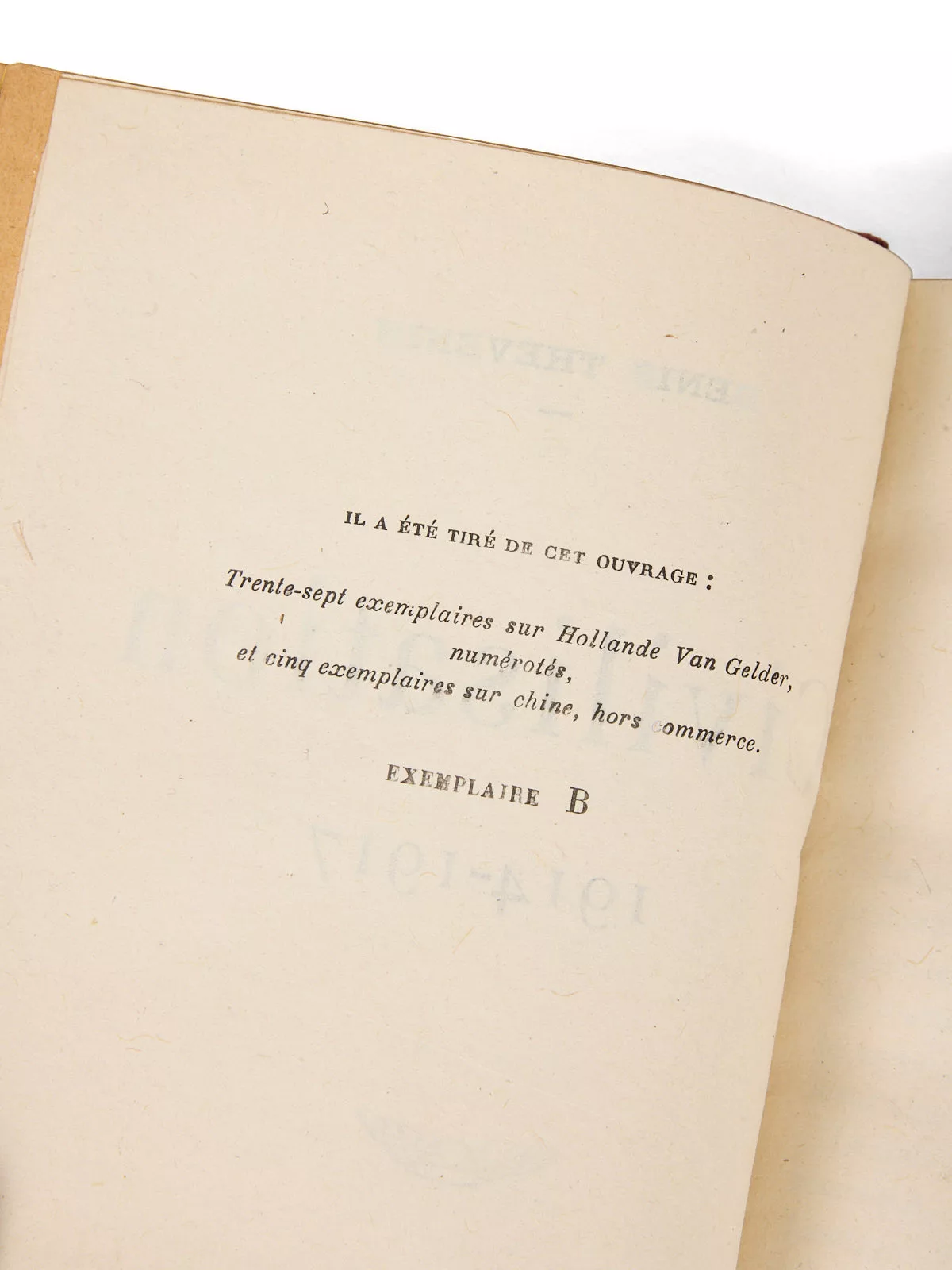
The present copy belongs to the extremely rare printing on China paper, limited to five hors commerce copies. A typographical error appears to be specific to this printing: the date printed on the half-title reads 1916, suggesting that typesetting predated the commercial printing, in which the date was of course corrected to the correct year of 1918 — the rest of the printing otherwise being strictly identical.
No other copy on China paper has been located to date (public sales, bibliographies, institutions and major collections on the subject).
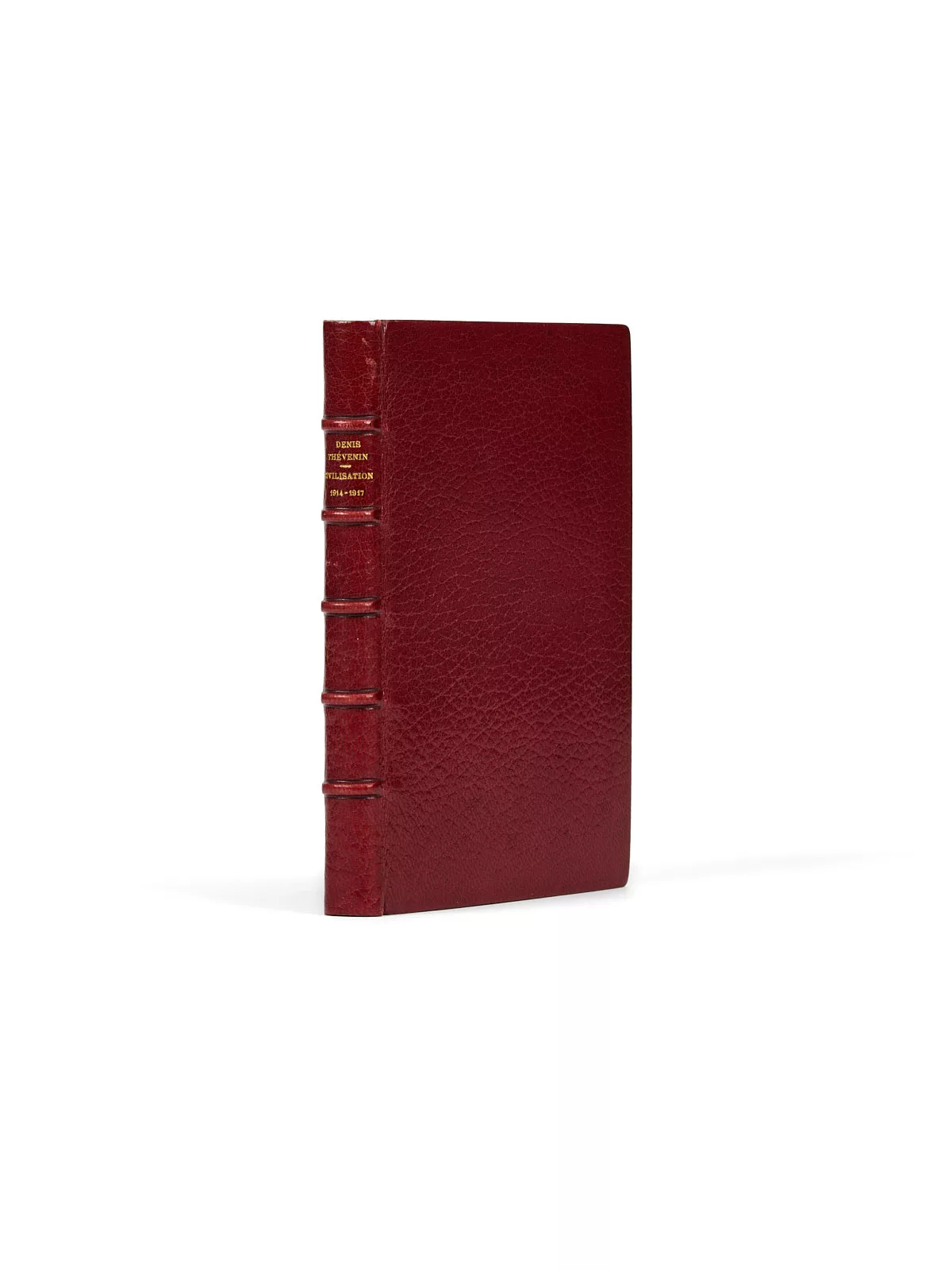
A beautifully and early bound copy by Paul Affolter. A Parisian bookbinder active from 1880, first established at 10 rue Richer, then at 50 rue Laborde, his workshop, known for careful execution and classical taste, worked closely with the Librairie Fontaine, run by his brother Jules Affolter (formerly of the Auguste Picard firm, then a partner of Auguste Fontaine and likewise established on rue Laborde). This bookseller-binder partnership allowed a bibliophile clientele — notably collectors of the small-format Lemerre editions — to have their volumes bound “to order” in a tasteful spirit that made the workshop’s reputation at the turn of the century. In the commercial context of 1900–1925, older fine editions became scarcer while modern publishing developed (Crès, Hachette, Grasset, Gallimard, Plon, etc.): Affolter kept pace with this shift, offering high-quality bindings for contemporary texts as well as for classics, clothing them in elegant Jansenist morocco. Upon his sudden death on 18 March 1929, the workshop was taken over by Jean Augoyat, ensuring the continuity of an address well known to bibliophiles.
A very fine copy, in a full contemporary binding. Accompanied by the author’s “pseudonymous” visiting card, bearing his real address at 28 rue Vauquelin.