

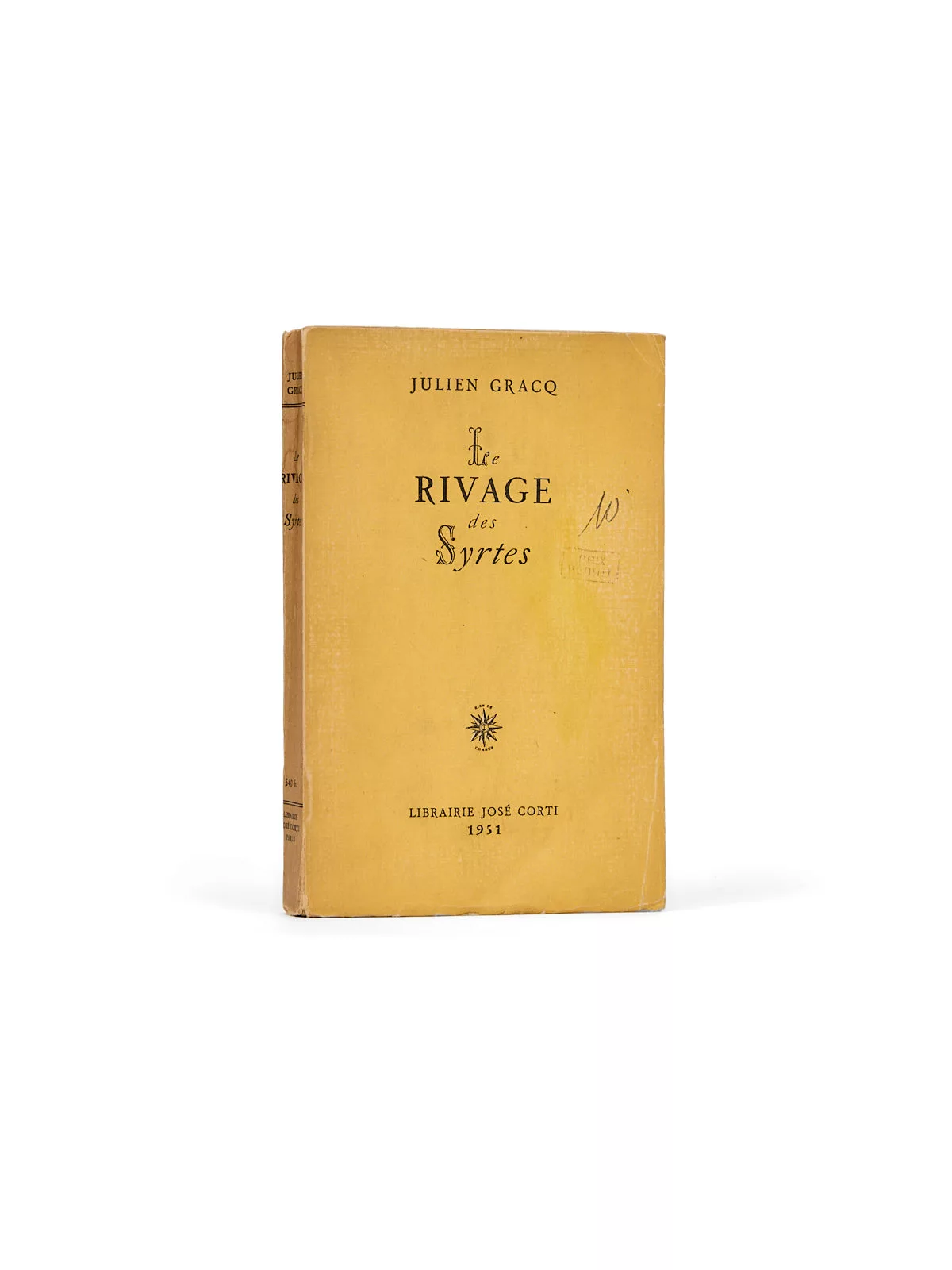
Le Rivage des Syrtes
First printing — without statement.
A sumptuous, allegorical novel, Le Rivage des Syrtes transports the reader into an imaginary world of silent lagoons, dormant cities and uncertain borderlands. Gracq, trained as a geographer, deploys a precise, poetic vocabulary to describe isthmuses, promontories, islands and shorelines, turning landscape itself into a true protagonist.
By the time of publication, Julien Gracq had already set himself apart from the literary establishment, notably through his pamphlet La Littérature à l’estomac (1950), denouncing media collusion and the obsession with literary prizes. True to this stance, he famously refused the Prix Goncourt in 1951. The refusal caused a considerable scandal and, paradoxically, a surge of publicity: Corti’s print run rose from 7,000 copies in September to 127,000 by December. It became the author’s greatest commercial success, a world away from the 130 copies sold of his first novel, Au Château d’Argol (1938).
Critical reception was marked by Antoine Blondin’s memorable phrase, who wittily described the book as an “imprécis d’histoire et de géographie” (in Rivarol, 6 December 1951). This ambiguity, between a dreamed world and historical resonance, gives the novel its singular character.
Gracq never wavered in his distance from official honors. The only “corridors of power” he agreed to frequent were those of Georges Pompidou, his fellow student at the École normale supérieure between 1930 and 1934, who tried in vain to have him awarded the Légion d’honneur. François Mitterrand received three polite refusals to his invitations.
The working manuscripts and fair copy of Le Rivage des Syrtes are now held at the Bibliothèque nationale de France (Legs Julien Gracq, 2008).
From the “Prix Goncourt” library of Gérard Pouguet, with bookplate.