

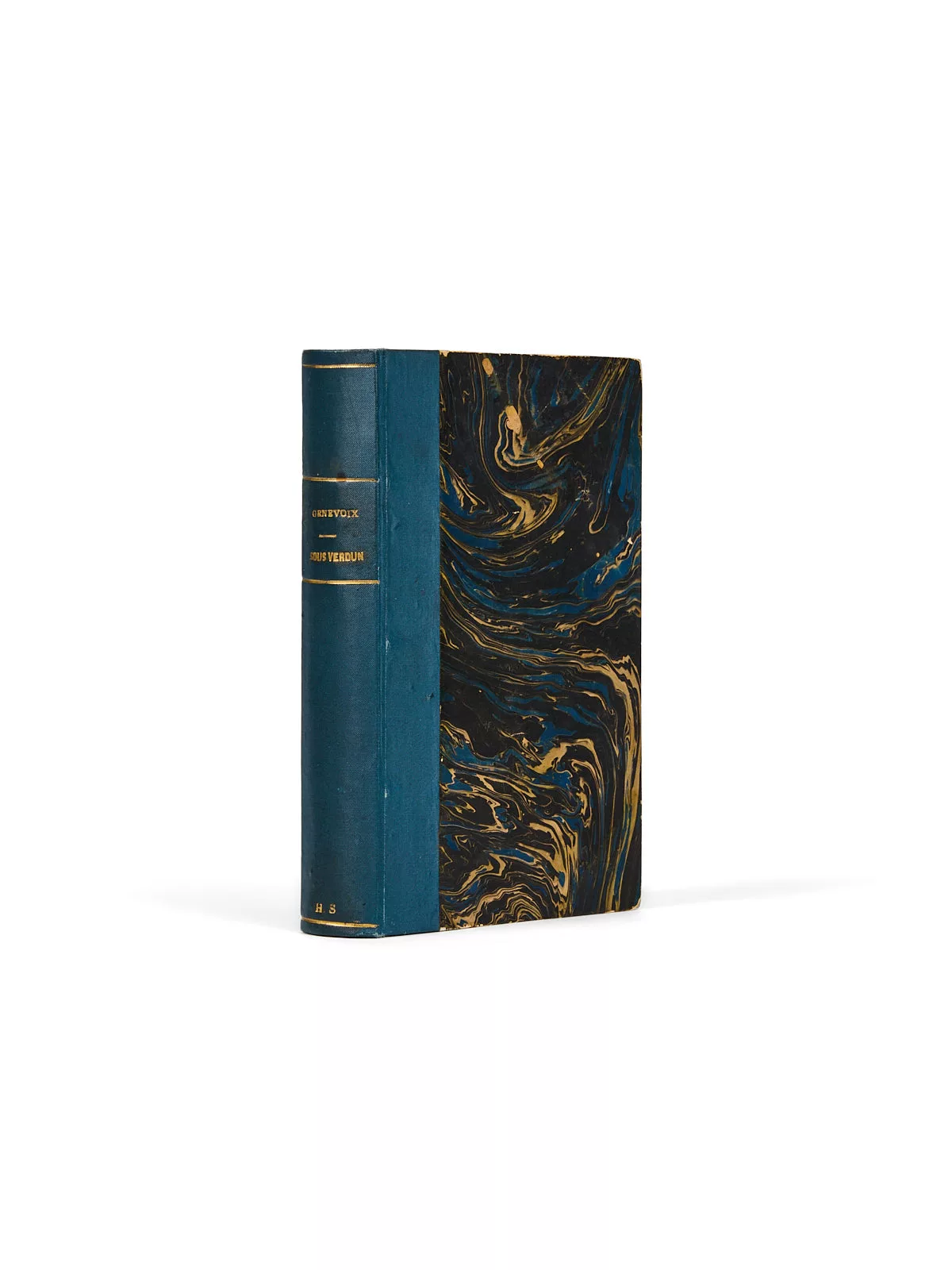
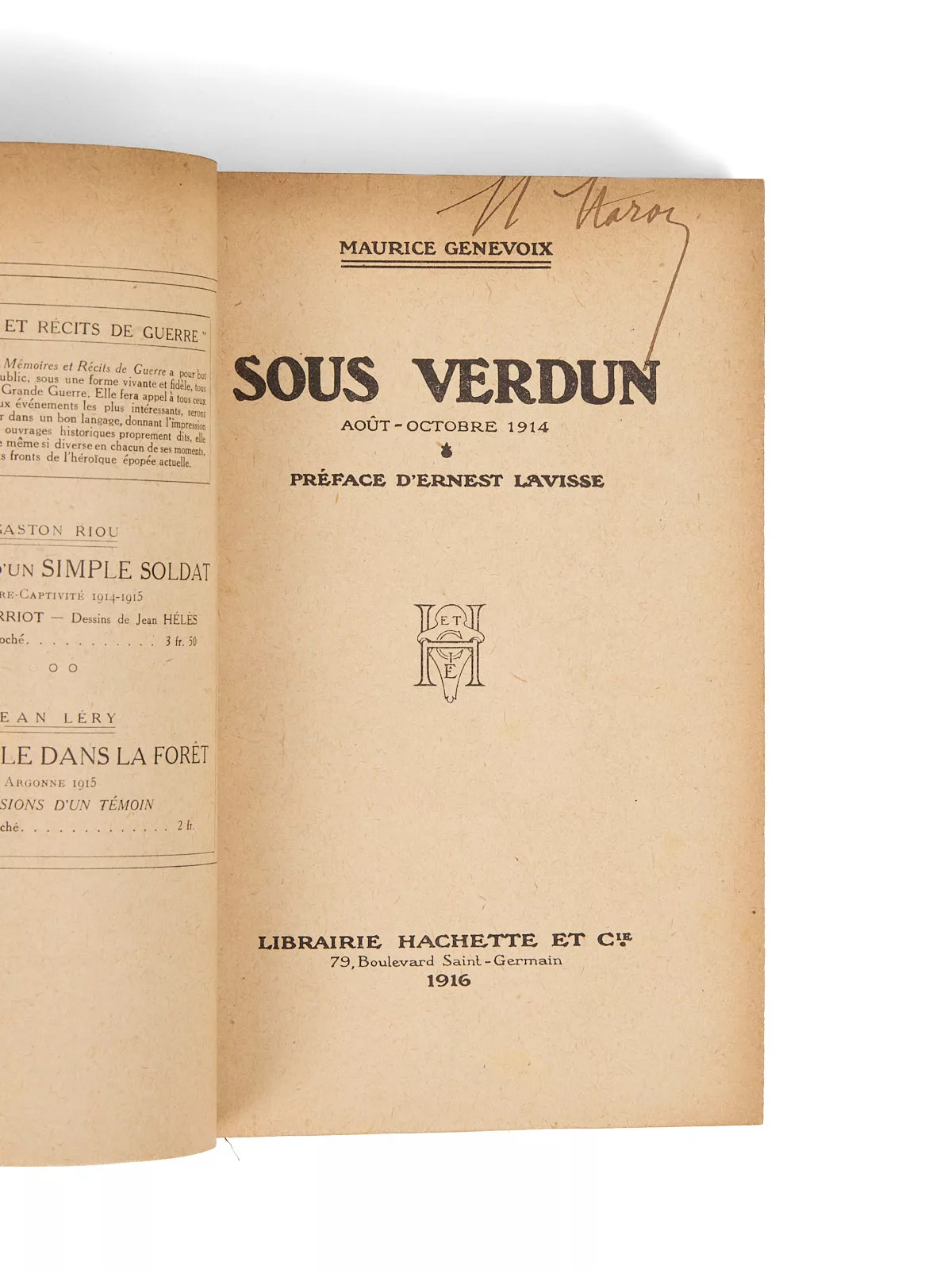
Copy of the first printing, identifiable by the announcement leaf facing the title page, which lists only the single title by Riou already published.
Mounted facing the half-title, a three-quarter-view drawing of the face of a French soldier (poilu), dated 1917, signed “Maurice” (not Genevoix).
A young student at the École normale supérieure, Maurice Genevoix joined the 106th Infantry Regiment in September 1914 and went to fight in the Argonne, notably at the Tranchée de Calonne, where he was severely wounded six months later, on 25 April 1915, by three bullets — two in the arm and one in the chest. After seven months of treatment, he returned to Paris, to the rue d’Ulm, and, encouraged by Paul Dupuy, secretary-general of the École normale supérieure, with whom he had corresponded extensively throughout that ordeal, he agreed to recount his experience at the front and published Sous Verdun in April 1916. It was followed by Nuits de guerre in May 1917, Au seuil des guitounes in September 1918, La Boue in February 1921, and finally Les Éparges in September 1923: a body of work at once historical and literary, among the most striking ever produced on the First World War.
Where other “great works” by war writers (Roland Dorgelès with Les Croix de bois, Henri Barbusse with Le Feu, Georges Duhamel with Civilisation, to name only the principal ones) were sometimes criticized for excessive lyricism or for individual rather than collective accounts, Genevoix’s narratives describe with rarely equaled authenticity the camaraderie of the trenches and, above all, the horror, the madness and the cruelty of war, as well as the paradoxes and sometimes absurd decisions of the high command. So much so that Sous Verdun and La Boue were cut by censorship upon their publication.
Genevoix reconstructed his days at the front from an eight-month field diary (25 August 1914 to 25 April 1915); the first two volumes, Sous Verdun and Nuits de guerre, omit no day. Jean Norton Cru, presenting Genevoix’s five narratives in his 1929 book Témoins, wrote that among the authors of the war, Genevoix stood unquestionably first, and that his work was incomparable. To compose them, Genevoix also drew on letters sent to his family, his father, his brother René, and above all those sent to Paul Dupuy at the rue d’Ulm: “What I had to keep silent from my own, I confided freely in these letters, wishing to be truthful, to share without reserve,” he wrote in Jeux de glaces (1960).
Sous Verdun was praised by critics: Le Journal des débats enthused that it was “Maupassant [to whom the writer had devoted a dissertation while at the École normale supérieure] from behind the trenches,” adding that “one sees the war, in all its horror and truth, utterly vivid.” It was a critical success for Genevoix, whose book approached 10,000 copies and who was considered a contender for the Prix Goncourt, before the publication of Barbusse’s Le Feu changed the situation within a matter of weeks.
In December, two Goncourt prizes were to be awarded: the one for 1914 (not previously awarded) and the one for 1916. The 1916 prize went to Barbusse, eight votes to two, and the 1914 prize to Adrien Bertrand, nine votes to one — the sole dissenting vote, cast for Genevoix, coming from Octave Mirbeau. To justify the outcome, it was disingenuously argued against Genevoix that his title, Sous Verdun, misleadingly suggested he would be writing about the great battle of 1916, whereas his book in fact recounted the fighting in the Meuse from August to October 1914. The April favorite had been overtaken by a shooting star and a dying man (Jean-Yves Le Naour, La Gloire et l’Oubli. Maurice Genevoix et Henri Barbusse, témoins de la Grande Guerre, Michalon, “Histoire,” 2020).
A fine copy of the first printing, without edition statement and with the correct publisher’s announcement leaf at the front.