

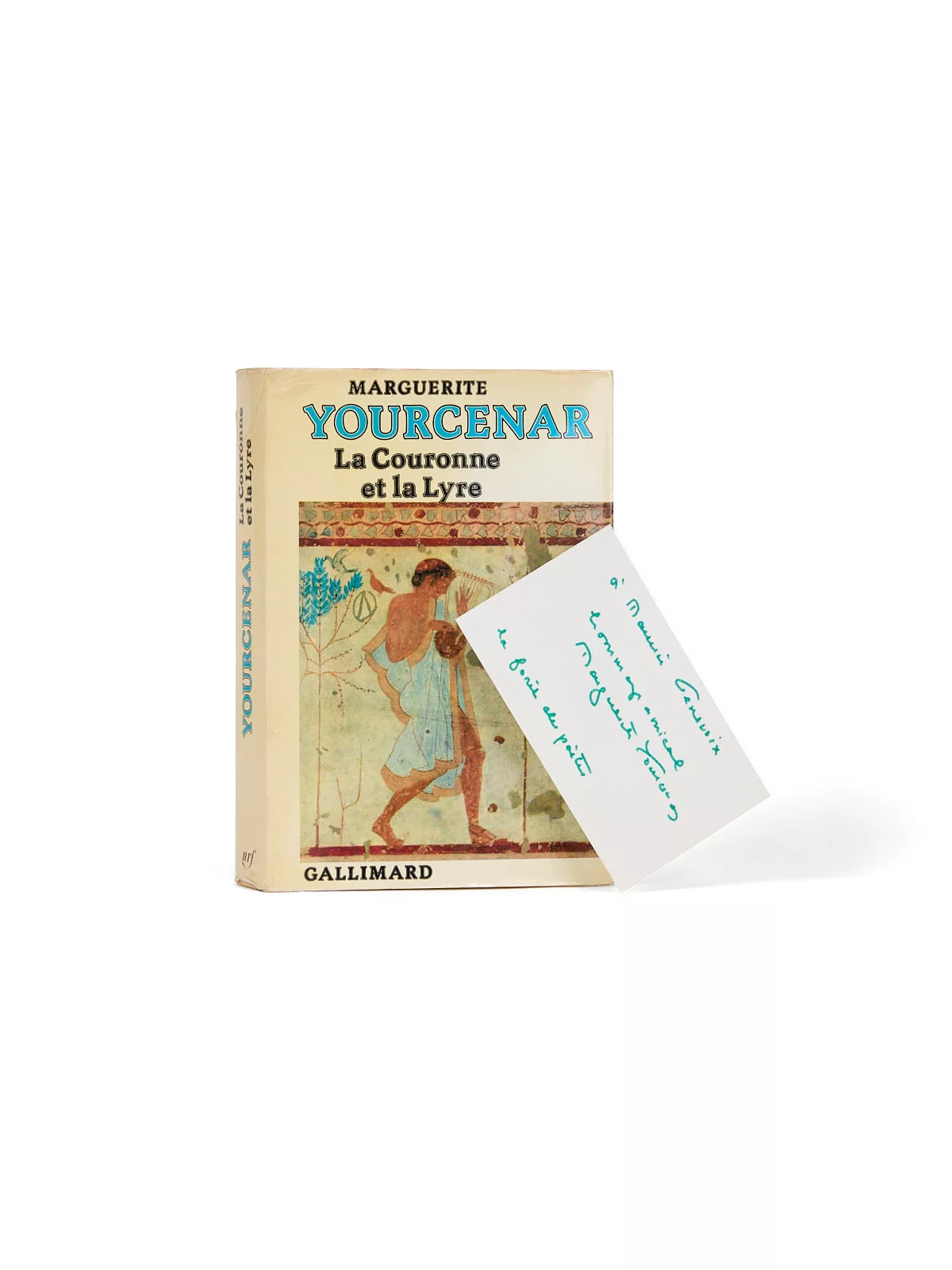
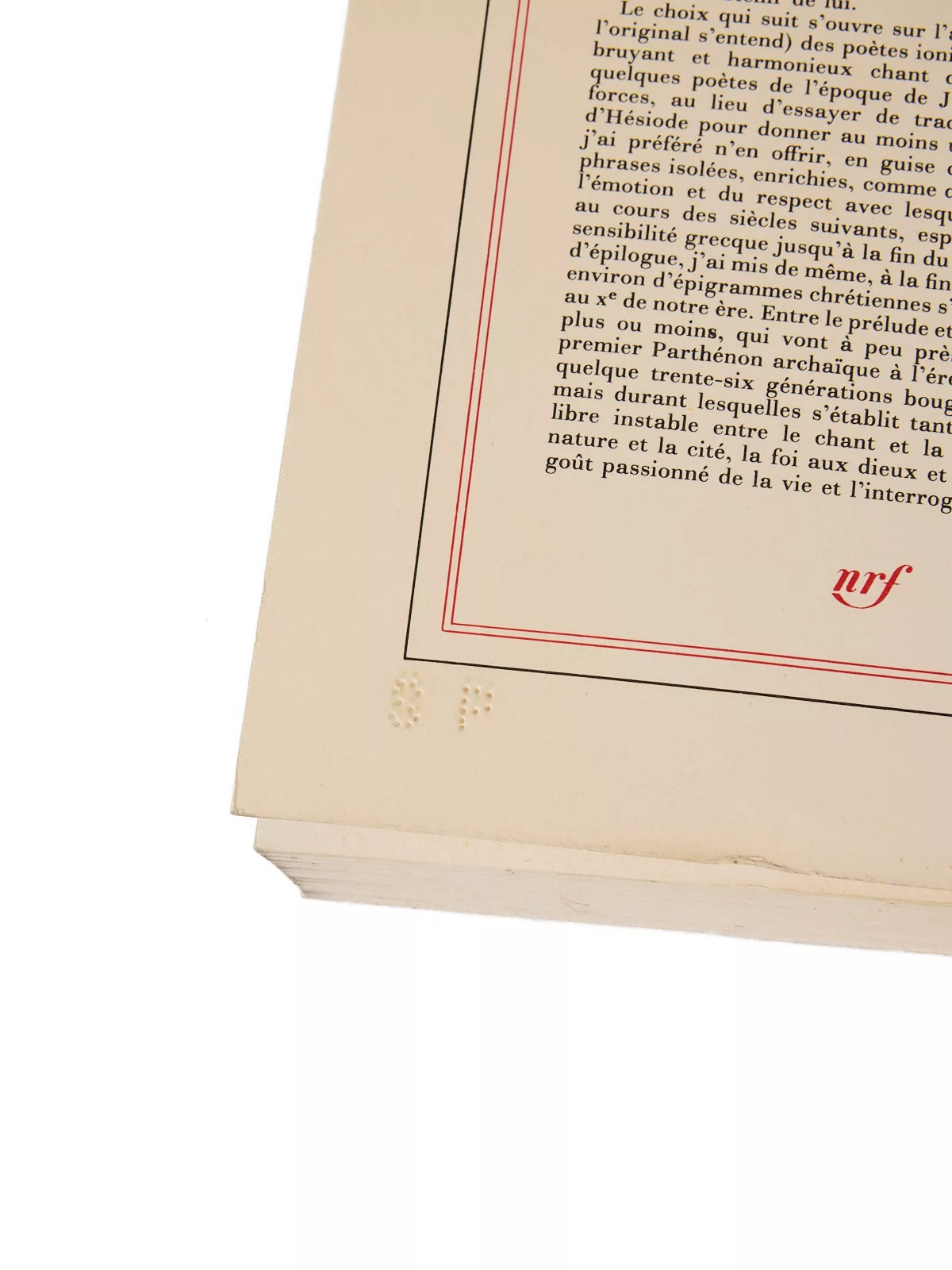
Press copy, stamped as such.
Presentation inscribed on an autograph card, signed: “à Maurice Genevoix, hommage amical, Marguerite Yourcenar, la forêt des poètes.”
La Couronne et la Lyre is one of Marguerite Yourcenar’s major late books, and one of those in which her relationship to Greece is most directly expressed. It is not a simple anthology, but a personal selection, presentation and translation of the ancient Greek poets — a subject that had occupied her from the beginning of her career, since as early as 1932 she had published a Pindare with Grasset. This fidelity would run through her entire œuvre, from Électre ou la chute des masques to Mémoires d’Hadrien.
Published in 1979, a year before her election to the Académie française, La Couronne et la Lyre was not unconnected to her recognition by her fellow masters of language. Less than a month after publication, Jean d’Ormesson officially approached Yourcenar to propose that she join the Forty. She replied immediately, on 22 October 1979: “[…] provided I am not obliged to put myself forward as a candidate, which I instinctively find repugnant, all the more so because my being a woman makes such a step even more conspicuous, and provided I am also not obliged to maintain a fixed residence in Paris, even for part of the year, nothing would certainly make me refuse the honor you so generously wish for me. To do so would seem to me an insult to more than three centuries of French literary history.”
A fine copy inscribed to Maurice Genevoix. As permanent secretary of the Académie, Genevoix had already attended Yourcenar’s induction, in 1971, into the Académie de Langue et de Littérature françaises in Belgium. On 6 March 1980, Yourcenar was elected under the cupola on the quai de Conti. She would be formally received in January 1981, a ceremony Genevoix did not attend, as he died on 8 September 1980.
A fine copy, enriched with the customary dedication card that Yourcenar sent, from Maine where she lived, to her publisher for the press copies.