

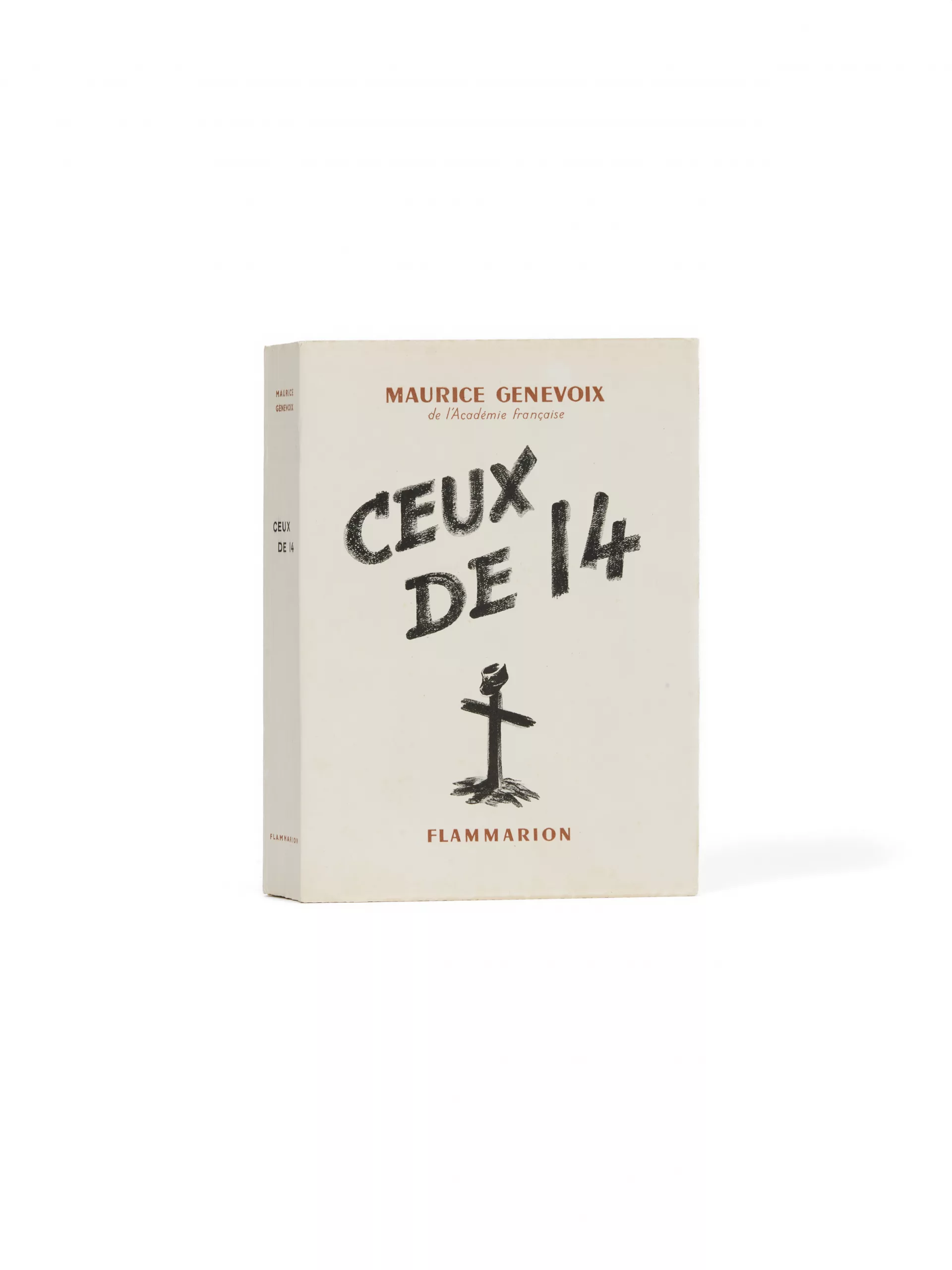
Ceux de 14
One of 220 copies on Alfa paper (no. XVIII) — the only paper issue after the 55 copies on pur fil rag paper.
Ceux de 14 brings together Maurice Genevoix’s war narratives. A young student at the École normale supérieure, Genevoix joined the 106th infantry regiment in September 1914 and fought in the Argonne, notably at the Tranchée de Calonne, where he was severely wounded six months later, on 25 April 1915, by three bullets, two in the arm and one in the chest. After seven months of treatment, he returned to Paris, to the rue d’Ulm, and, encouraged by Paul Dupuy, secretary general of the École, with whom he had corresponded extensively during his ordeal, he agreed to recount his experience of the front and published Sous Verdun in April 1916. This was followed by Nuits de guerre (May 1917), Au seuil des guitounes (September 1918), La Boue (February 1921) and finally Les Éparges (September 1921): a body of work at once historical and literary, ranking among the foremost testimonies of the Great War.
In 1949, Genevoix decided to bring these narratives together, reorganizing them and making some changes to the original text so as to form four narratives instead of five. “Ceux de 14 is an absolute masterpiece, read as a rise toward sacrifice and horror. Its summit is the Battle of Les Éparges, the paroxysm of violence, one of the worst ordeals of 1914–18… The attention given to the living men fighting beside him, more than a hundred of whom are precisely identified, gives this text, whose literary beauty was immediately admired, an incomparable human depth,” writes Michel Bernard, author of Pour Genevoix (La Table ronde, 2011). Eight hundred pages for eight months at the front: unquestionably the most extensive, precise and accurate testimony of the combat experience.
Elected to the Académie française in 1946, Genevoix would from the 1950s on be regarded by veterans of the Great War, and especially by those of Verdun, as their spokesman. General de Gaulle entrusted him with overseeing the creation of the Mémorial de Verdun; at his death in 1980, a national tribute was held at the Invalides. The success of this definitive edition went far beyond the circle of the veterans of 1914, still numerous in 1950: it was a genuine commercial success, with numerous reprintings over the following decades.
The working notebooks and complete manuscript of Ceux de 14 were donated by Maurice Genevoix’s grandchildren to the French State; they entered the collections of the Bibliothèque nationale de France on 4 November 2020.
One week later, on 11 November, Maurice Genevoix entered the Panthéon, symbolically accompanied by “Ceux de 14.” Announced on 6 November 2018 by the President of the Republic during a visit to Les Éparges (Meuse), site of the terrible fighting of 1915 where Genevoix was wounded, this dual panthéonisation had originally been scheduled for 11 November 2019, together with a memorial to be erected in tribute to the poilus. No design having satisfied the President, and the Covid crisis intervening, the ceremony was postponed to coincide with the centenary of the interment of the Unknown Soldier: on 11 November 1920, the tomb of this unidentified soldier, recognized as French, was installed beneath the Arc de Triomphe, before the entry into the Panthéon of Léon Gambetta (1838–1882), founding father of the Third Republic.
In all, seventy-six men and seven women currently occupy the vaults of the republican temple by virtue of their personal merit, whatever its nature. Maurice Genevoix is its seventh writer (with Alexandre Dumas, Victor Hugo, André Malraux, Jean-Jacques Rousseau, Voltaire and Émile Zola) — and the only one of the last century besides André Malraux.
Of Ceux de 14, Maurice Genevoix kept the original manuscript (now at the BnF), two working copies, and several copies of the first edition. The present copy is one of these.
A rare deluxe-paper copy.
From the library of Maurice Genevoix, at “Les Vernelles,” with bookplate.