

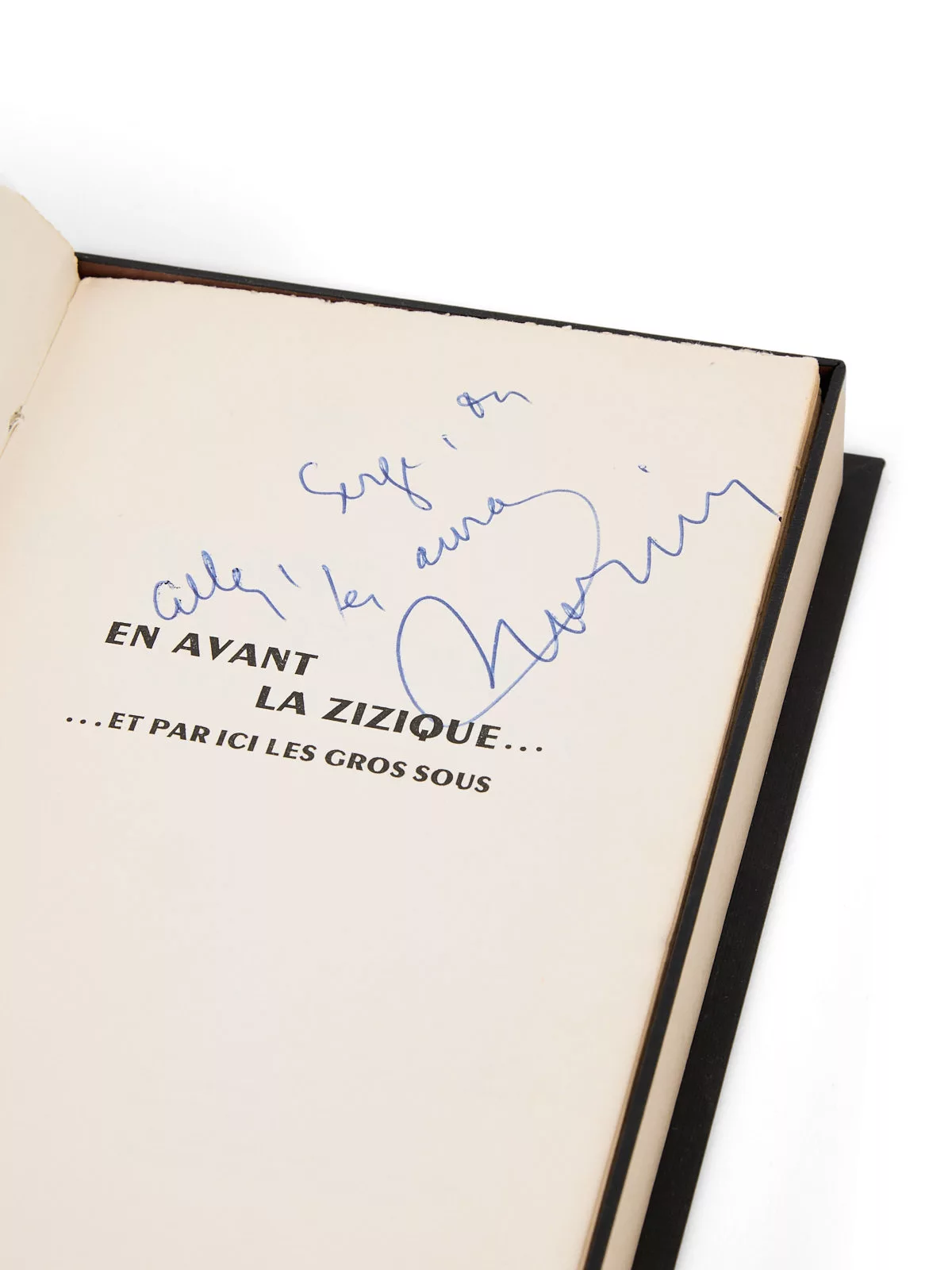
En avant la zizique
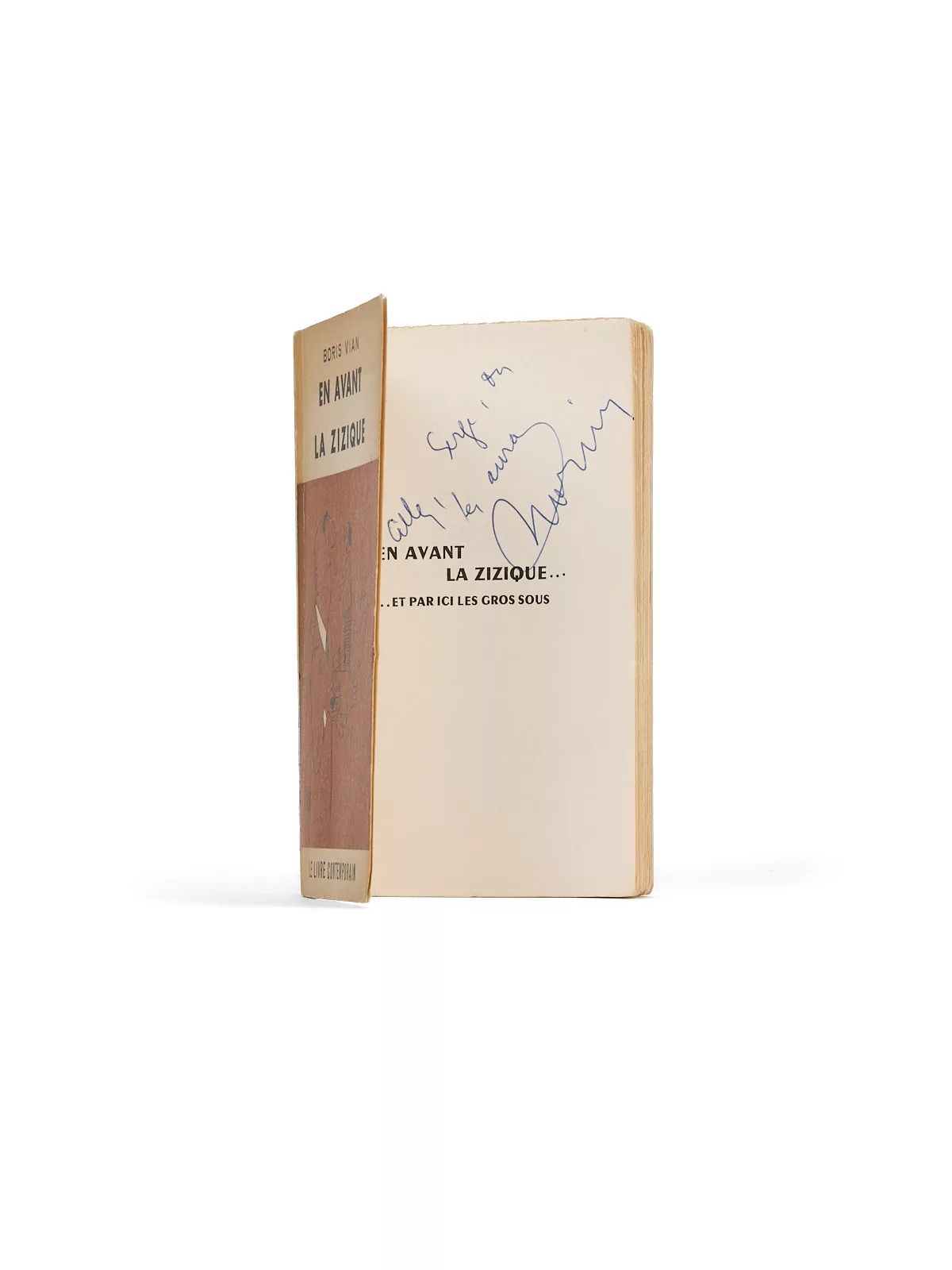
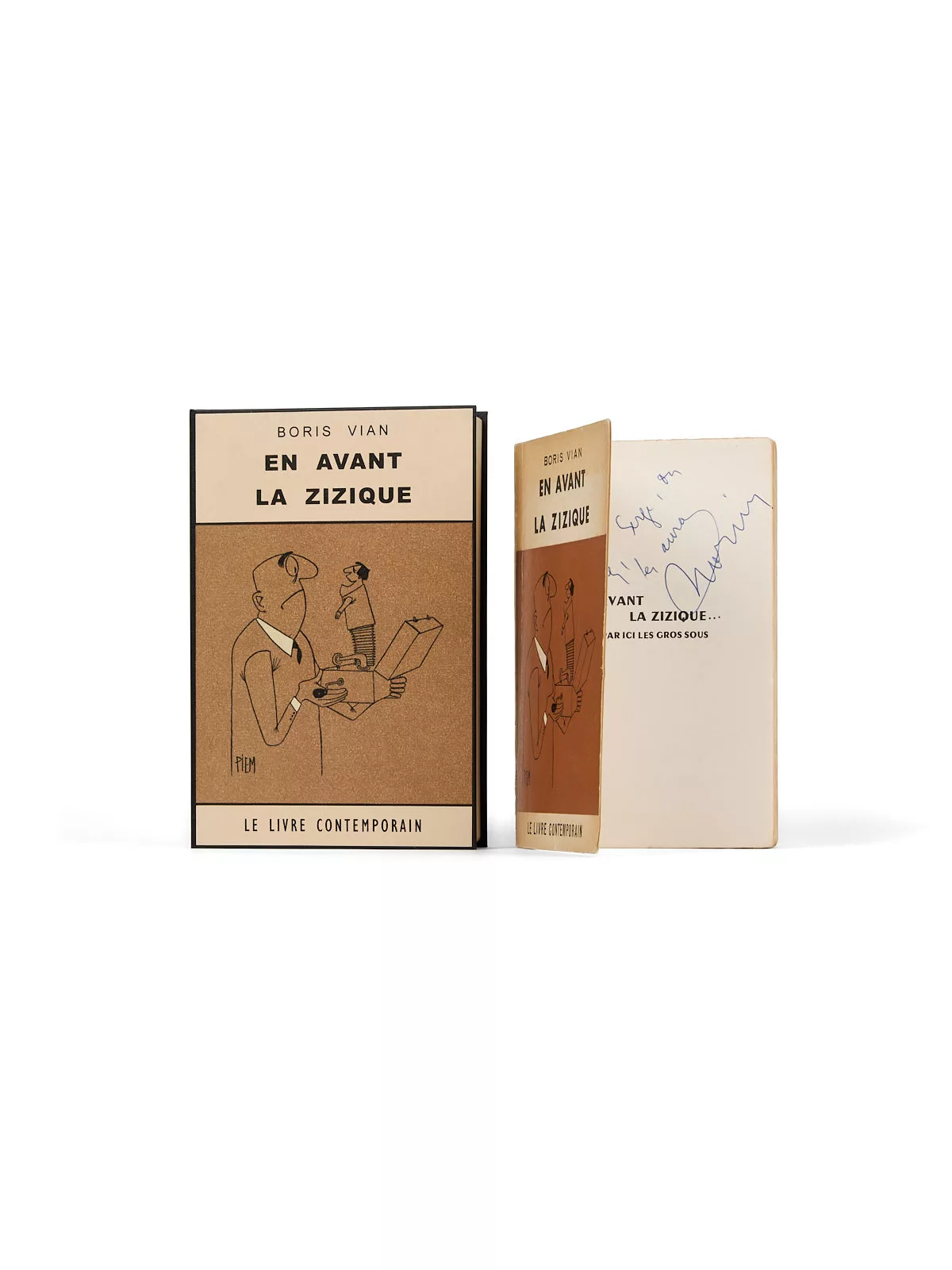
Signed presentation inscription: “Allez, Serge [Gainsbourg], on les aura! Boris Vian.”
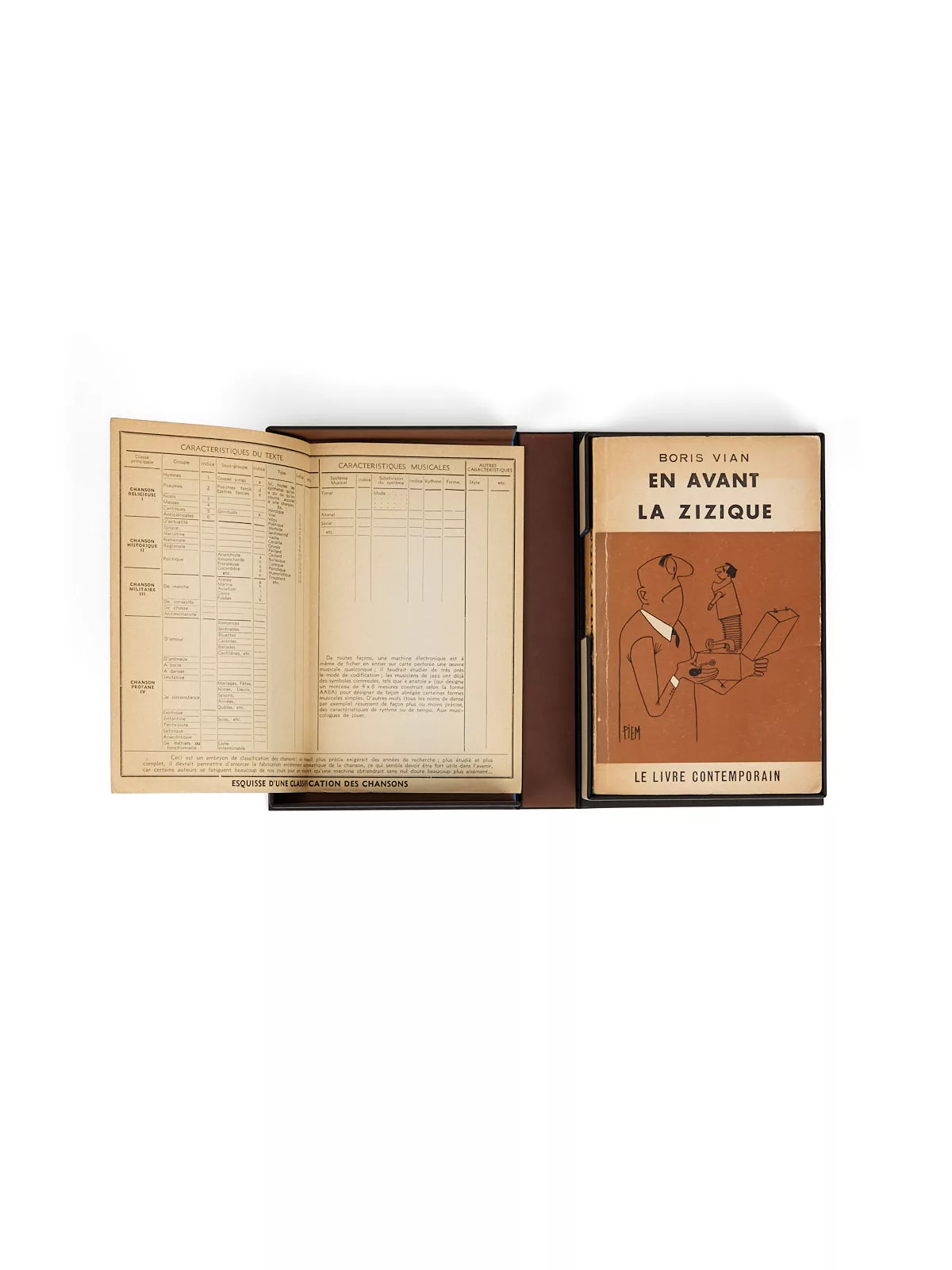
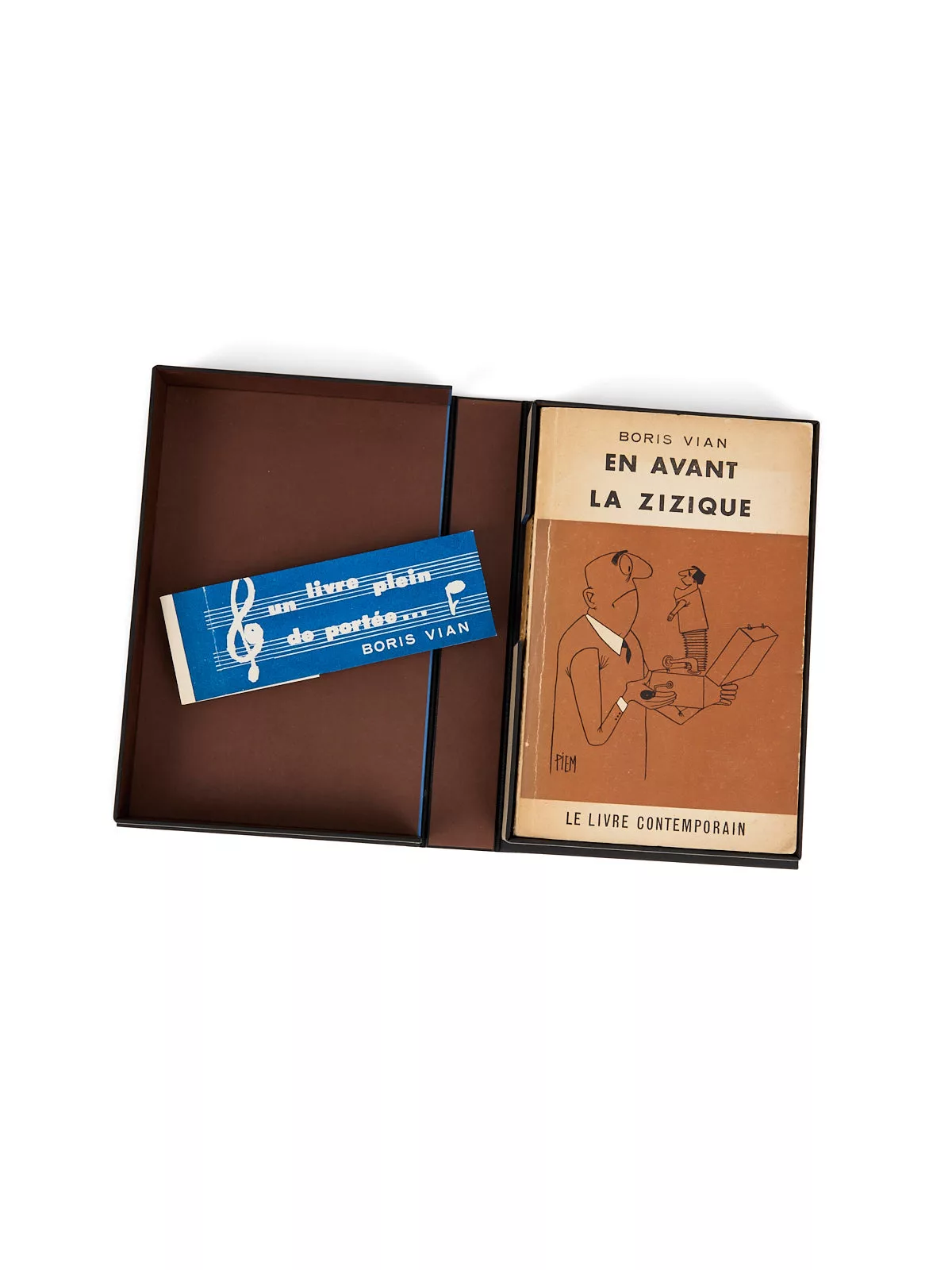
Complete with the folding music plate, publisher's wraparound band preserved.
“Song, let us say at once, is by no means a minor art. The miner does not sing while he works, as Walt Disney well understood, since he had his dwarfs whistle instead. The miner blows while he works, so that coal dust does not enter his mouth. Not being a minor art, song therefore plays, quite naturally, a major role” (En avant la zizique).
A witty line? Certainly, and it was above all in Boris Vian that Gainsbourg found such wit in the late 1950s. Vian had published nothing since L’Arrache-cœur and was preparing En avant la zizique; the man born Lucien Ginzburg had, at the dawn of 1958, made a radical decision of his own: he gave up painting for good, destroyed all his studio work, and chose a new life and a new name — Gainsbourg, in homage to the English painter Gainsborough, combined with the first name Serge, underlining his Russian origins.
His father found him work as a pianist-guitarist at the cabaret Milord l’Arsouille, where he accompanied the singer Michèle Arnaud and met Boris Vian, with whom he shared the same cynical humor and sharp sense of derision. A few months later, Gainsbourg signed with Philips, the label he would never leave.
With Boris Vian’s arranger, Alain Goraguer, Gainsbourg composed his first record, Du chant à la une!, which, despite harsh reviews, won the Grand Prix de l’Académie Charles Cros, a prestigious music award, thanks in particular to the song “Le poinçonneur des Lilas.”
Following the harshness of the attacks against him upon the release of this first record, Boris Vian, a few months before his death, wrote a glowing article in Le Canard Enchaîné (12 November 1958), which deserves to be reproduced here: “Come on, readers or listeners always ready to shout AGAINST, against fake songs and fakes of song, pull two bags out of your pockets and hand them to the record dealer, asking for Philips B 76447 B… unpaid advertisement, I no longer work at Philips, and even if I still did it would make no difference. This is the first 10-inch LP by a curious character named Gainsbourg, Serge, born in Paris on 2 April 1928. As far as I’m concerned, I hope it won’t be the last. As far as you’re concerned, it is up to you to make sure it isn’t. A record is costly to make, a new artist costly to launch, especially when record dealers, swamped with routine stock and paralyzed by VAT increases, no longer even have time to listen to what the record companies send them. What will you hear on this record? First — honor to those who are always forgotten — you will hear, backing Gainsbourg and getting on with him like thieves in Parliament, Alain Goraguer and the nine arrangements he wrote for the songs. Each one, technically speaking, is worth some 17 to 19 out of 20, despite a piano that is sometimes out of tune — but that is not Goraguer’s fault; a piano must be tuned to the vibraphone when there is one at the session. You will hear… three absolute technical successes (structure, style, endings, etc.): ‘Le poinçonneur des Lilas,’ dark, feverish and beautiful… ‘Douze belles dans la peau’ is just as fine… ‘La femme des uns sous le corps des autres’ is a bitter and joyous success… And once you have listened to all that, rascals that you are, you will come and tell me that Gainsbourg does not have a great voice. Fine, it is a little muffled, his nasal sounds are a bit too nasal, but he is not singing opera — if you want opera, buy Depraz. You will also come and tell me that this young man is a skeptic, that he is wrong to see things darkly, that it is not ‘constructive’… (yes, yes, people do say such things). To which I would reply that a skeptic who builds words and music like that should perhaps be looked at twice before being filed among the disenchanted of the new wave… And yet, one thing is missing from this record. A song, perhaps Gainsbourg’s best. It tells of the love between a cannonball and a wooden leg looking for a place to settle. This song is called ‘Friedland.’ Gainsbourg recorded it. But it is not on the record. You must hear it at Milord l’Arsouille, where Serge sings. As for his faults or his qualities, we shall not speak of them. For it is too difficult to pin down the strange character that is Monsieur Gainsbourg. The man has more than one trick up his sleeve to slip away.”
En avant la zizique appeared almost at the same time, during that winter of 1958. It is very likely the only book Vian ever inscribed to Gainsbourg, who, “through his singularity, his cynicism, his bittersweet quality, was the artist most influenced by Vian,” who acted as a catalyst for him: “I take this guy in. Pale under the spotlights, hurling out ultra-aggressive lyrics before a stunned audience. I get hit full in the face and I tell myself: I can do something with this” (quoted by Serge Hureau, Hall de la Chanson, Centre national du patrimoine de la chanson).
Boris Vian was to die a few months later, a little over a year after their decisive meeting: on 25 June 1959, Vian suffered a fatal heart attack during a screening of J’irai cracher sur vos tombes.