

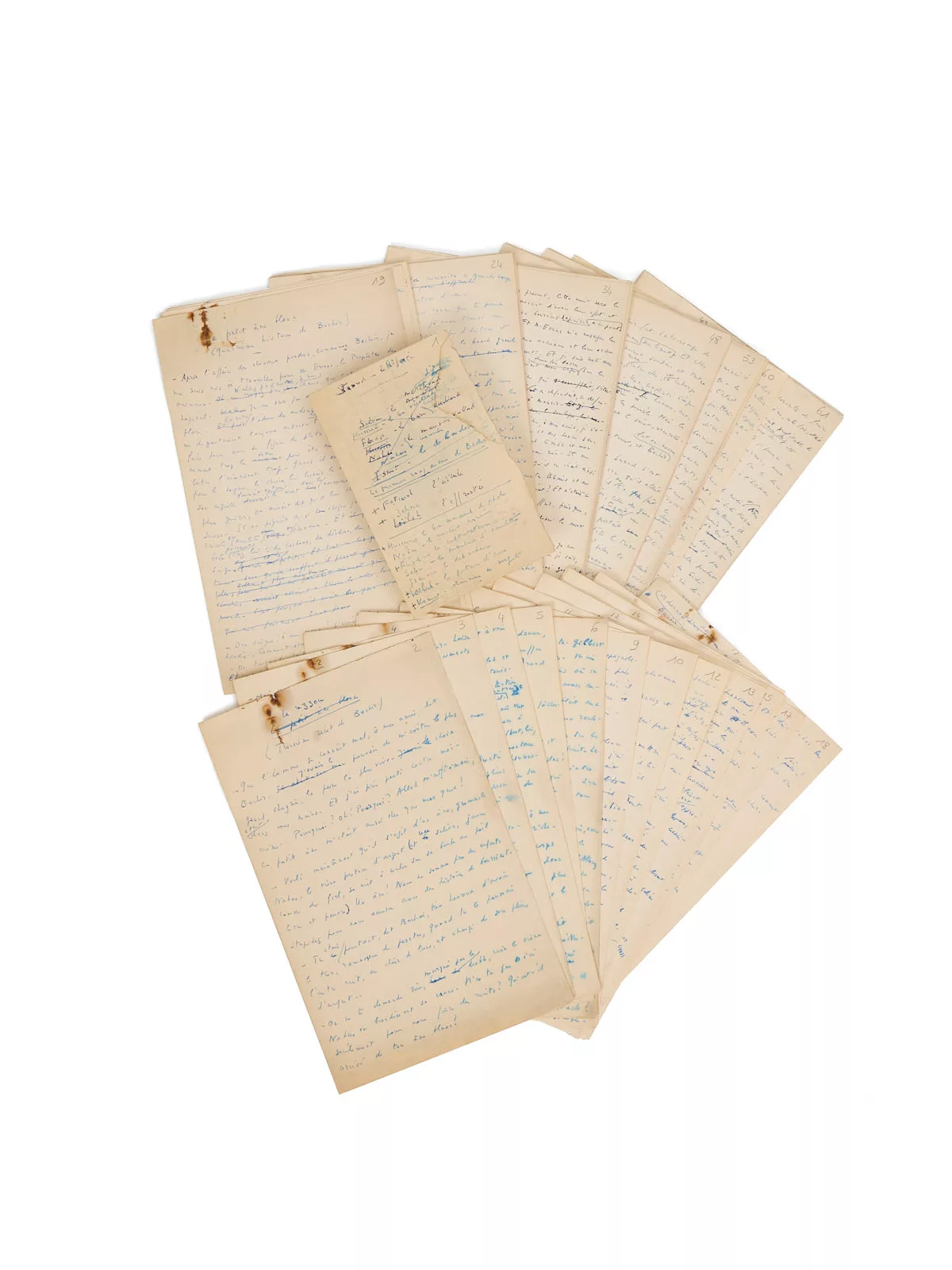
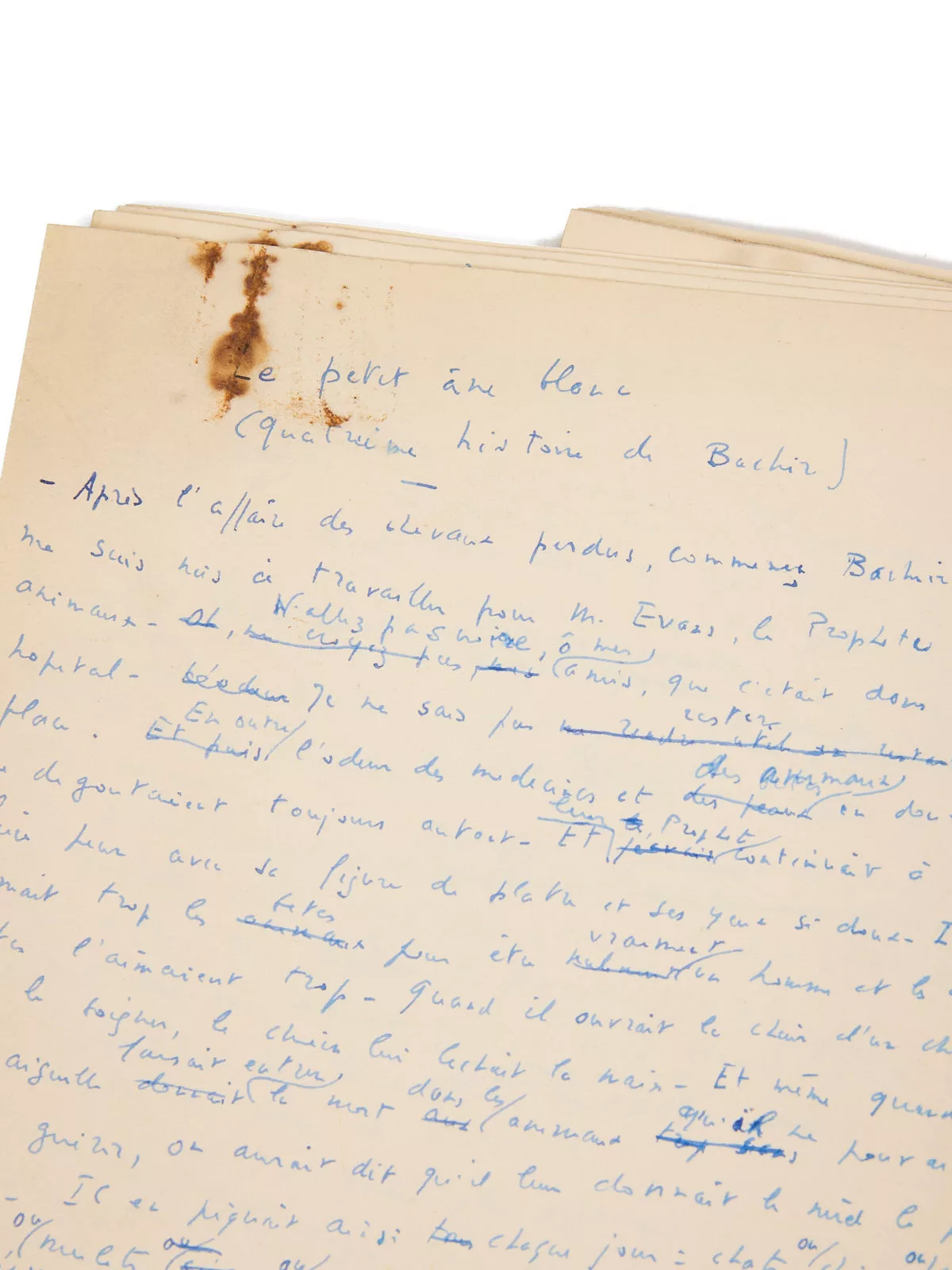
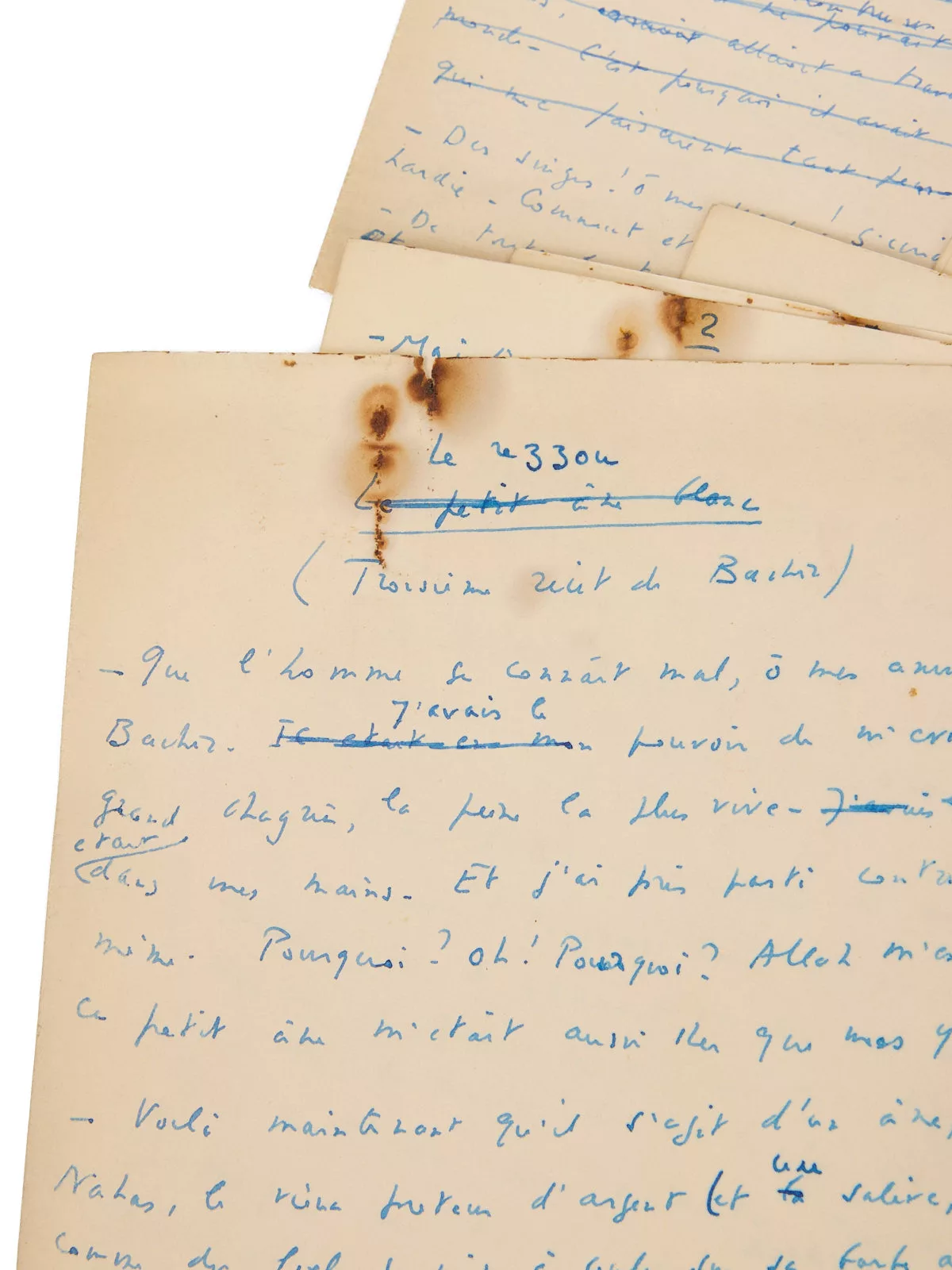
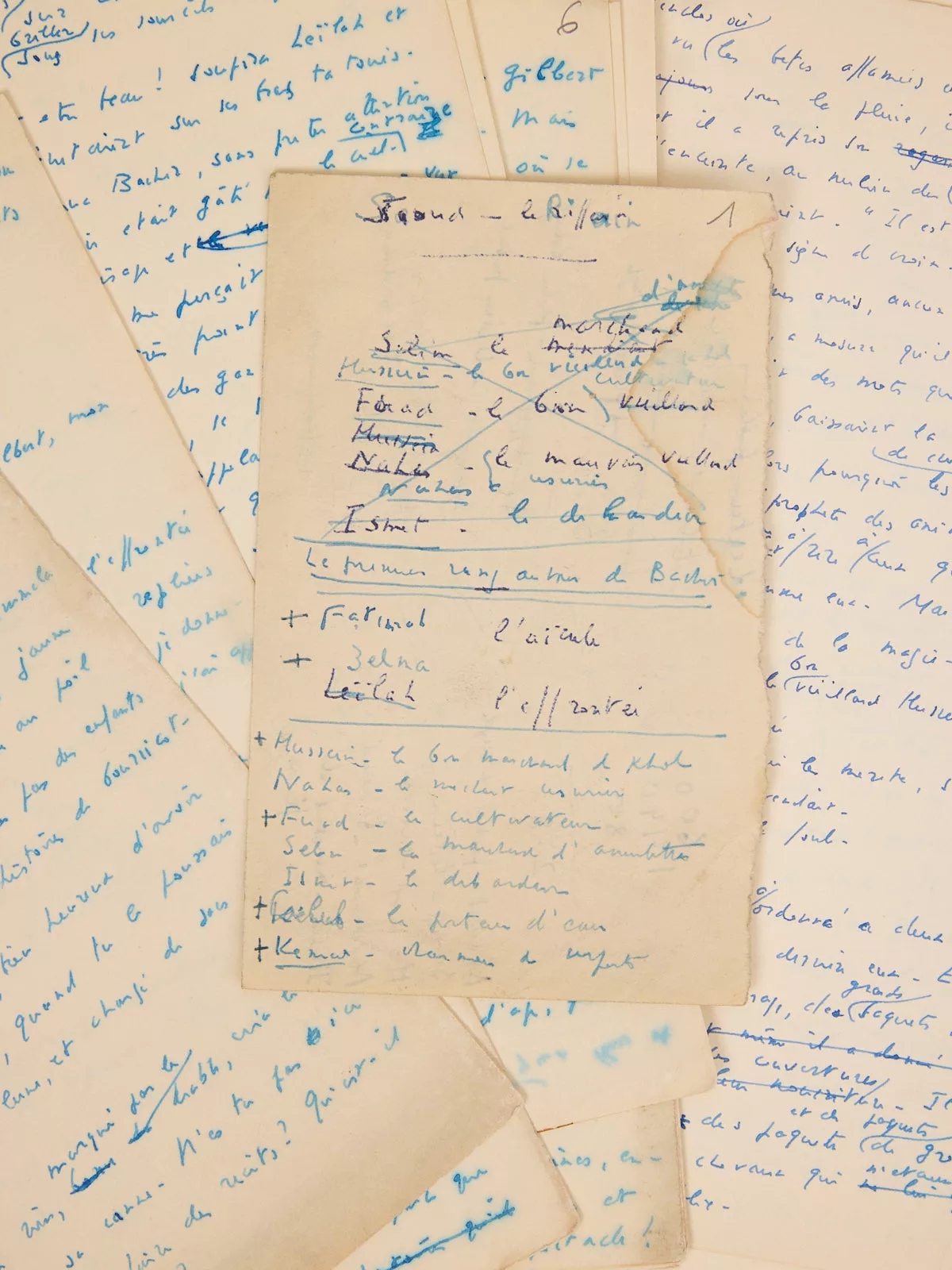
The first 17 leaves bear the title: “Le rezzou – Le petit âne blanc (Troisième récit de Bachir)”; the following 50 leaves: “Le petit âne blanc (quatrième histoire de Bachir).” On the first leaf, a summary note of the characters surrounding the hero — the little hunchback Bachir — offers a rare glimpse into Kessel's workshop of composition.
The 1952 collection brought together seven tales narrated by Bachir, the child-king of the streets of Tangier, on the square of the Grand Socco.
Our two autograph manuscripts document the genesis of the book, originally conceived as a screenplay at the request of Carol Reed in 1950, for which Kessel returned to Tangier — a city he had first discovered, to overwhelming effect, before the war. He haunted its cafés and bars under the guidance of Teddy, a former Legionnaire he had met there in 1939, who then ran a dance hall. Kessel let himself be guided by chance encounters in the streets, his only working method, as he sketched the story requested by the filmmaker he had met in London during the war.
Among the street children, one boy stood out: about twelve years old, hunchbacked, but livelier than the others despite his double deformity. Drawn to the boy’s air of a young gang leader, Kessel gave him a generous sum for a bunch of flowers, and the little hunchback returned with sweets for Michèle O’Brien, Kessel’s wife. The novelist was won over instantly: he had found the hero of his screenplay and set to work. But Reed did not recognize in it the “story” he needed. No matter: Kessel abandoned the film, stayed on two more months at the Minzah, and reworked the material into the tales that would later become Au Grand Socco.
They first appeared as two series of serialized installments in Paris-Presse – L’Intransigeant, from July 1951 to January 1952.
The first series, from 6 to 27 July 1951, presented under the general title “Histoires cruelles et roses de Tanger” five tales: “Le Sergent-major des Irish Guards” (which became “Le Tambour-major” in the book); “Abd-el-Meguid Chakraf, l’Américain”; “C’était écrit”; “Le Figuier” (which became “L’Arbre qui chante”); and “Les Galères de l’Islam” (which became “Nous, pauvres captifs”). The tales of this first series “were considerably reworked by Kessel with a view to book publication, so that it is impossible to determine precisely where each installment begins and ends” (Pléiade, II, p. 1644).
Those of the second series, which concern us here, “Les Contes de Bachir le petit bossu de Tanger,” were published from 22 December 1951 to 4 January 1952: twelve untitled installments, which would be grouped into two chapters in the book: “Le Rezzou” (installments of 22 and 23 December) and “Le Petit Âne blanc,” with no major changes otherwise, in the collection published by Éditions Gallimard on 18 June 1952 in the “Blanche” series, labeled “roman” on the cover.
“Le Rezzou” and “Le Petit Âne blanc” then took their place as the third and fourth stories — as Kessel himself indicates in these manuscripts.
“Le Petit Âne blanc” is a fairy tale, further proof, if any were needed, of Kessel’s storytelling gifts, honed among caravaneers and steeped in the spirit of the Silk Road: little Bachir’s stubborn desire to narrate the world plunges Kessel into the full verve of Oriental legend.
Rare original first-draft manuscripts. These manuscripts are the only surviving autograph material for Au Grand Socco; no other manuscript or typescript relating to the other chapters is known. They were consulted and studied by the Institut des textes et manuscrits modernes (ITEM) in La Rochelle, within the Fonds Kessel made available to a research unit of the Centre National de la Recherche Scientifique and the École normale supérieure. This archive preserves part of the Kessel papers, and it was in light of these rich documents that the new edition of Kessel’s works in the Bibliothèque de la Pléiade was prepared, though without being fully exploited.
These precious manuscripts come from that archive, long inaccessible and whose contents remain unpublished.