

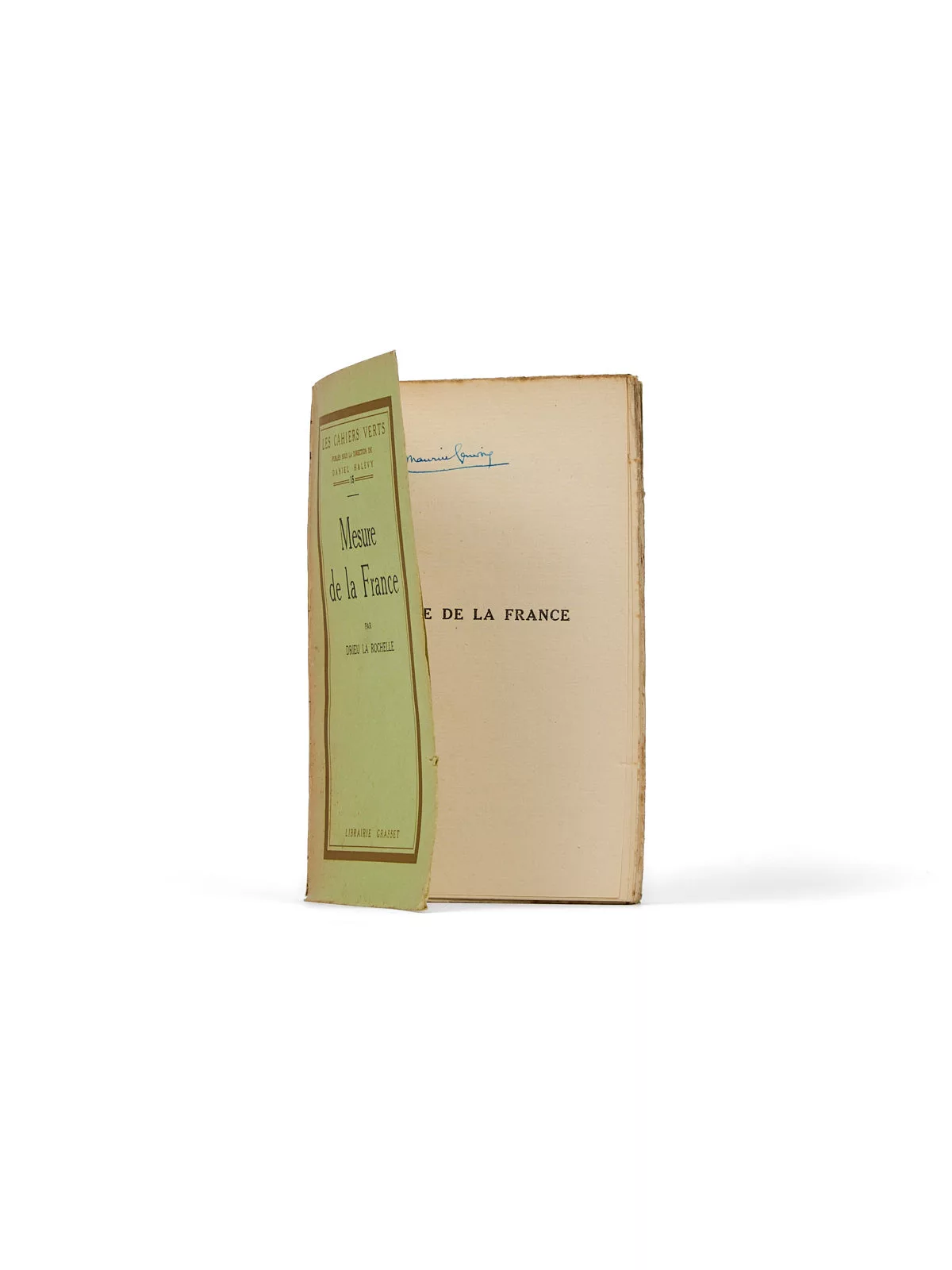
Mesure de la France
One of 5,000 copies on vergé bouffant paper (no. 2893).
Manuscript ownership inscription on the half-title: “Maurice Genevoix.”
An infantry officer wounded three times during the First World War, Pierre Drieu La Rochelle attempts, in this 1922 essay, to make sense of a traumatic moral and national experience. He “measures” victory and its illusions, a gesture that opens his cycle of political essays preceding the novels of his maturity. Drieu’s first significant text, Mesure de la France condenses, in the immediate aftermath of 1914–1918, his uneasy diagnosis of the state of the country and of Europe.
Repeatedly reprinted, the book is read today as a programmatic statement: a topical essay rather than a treatise, revealing the tensions that would preoccupy the writer throughout the interwar period. Critical studies note a text often judged unruly and polemical, but foundational. Asked, in the Enquête mondiale sur les écrivains, both “Which of your works made you best known?” and “Which do you consider a masterpiece?”, Drieu answered Mesure de la France to the first, and to the second: “I have written no masterpiece, and do not intend to.”
A fine copy of fine provenance.
From the library of Maurice Genevoix (manuscript ownership inscription and bookplate).