

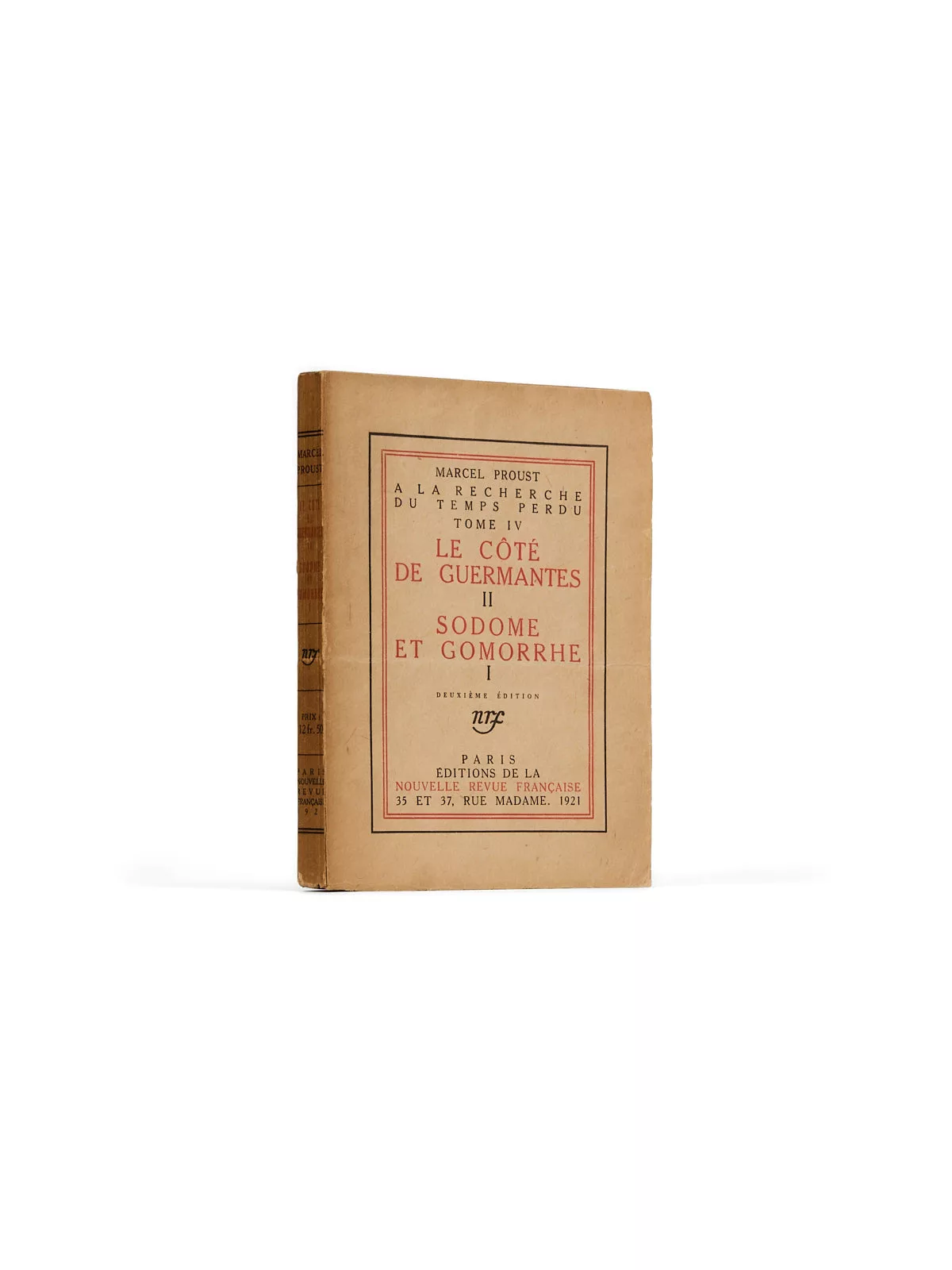
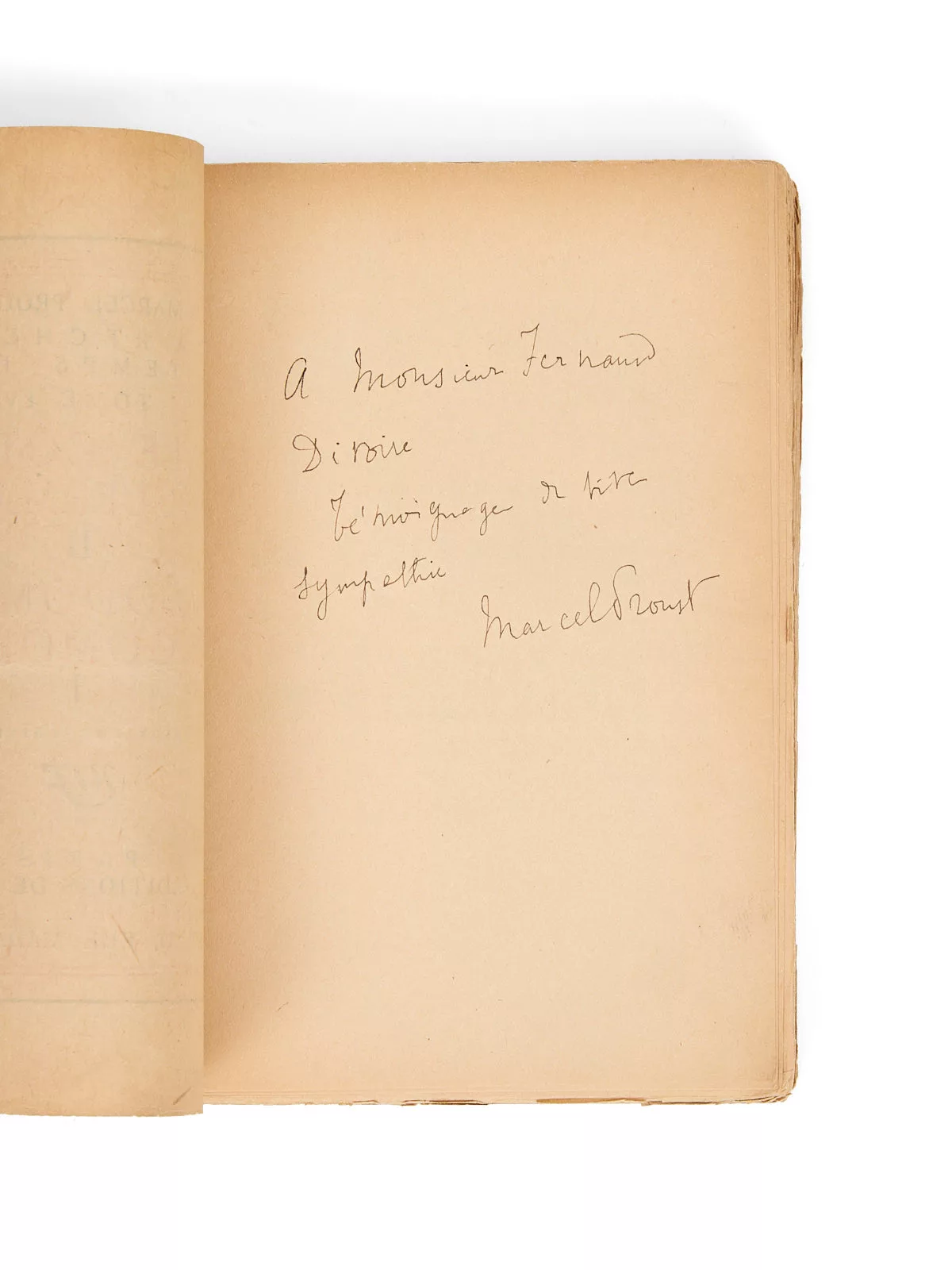
Presentation copy inscribed by Proust to Fernand Divoire: “À Monsieur Fernand Divoire, témoignage de vive sympathie, Marcel Proust.”
This second volume of the Guermantes cycle, published a year after the first, marks a turning point: the fashionable social world begins to crack, giving way to the narrator’s obsessions — grief, desire, the vertigo of time. The aristocratic salons become antechambers of dream, the characters troubled effigies. Albertine and Charlus move to the center of the novel, a prelude to the revelations of Sodome et Gomorrhe, which this volume introduces. The famous dinner scene at the Guermantes’ stands alongside the episode of the red shoes and the first sensual hallucinations concerning Albertine, foreshadowing La Prisonnière.
The volume’s publication was eagerly awaited, and Proust spared no effort in sending copies to those close to him throughout the latter part of 1920, most often on copies bearing later-edition statements, as here — though the Divoire copy does bear the correct date of April 30, which few of them do. The following copies are recorded:
To Jean Ajalbert, Céleste Albaret, Roger Allard, Walter Berry, Antoine Bibesco, Jacques-Émile Blanche, Léon Blum, Mme George Blumenthal, Jacques Boulenger, Marcel Boulenger, Alix Brizon, Louis Brun, Henry Céard, Raymond Clauzel, the Duchesse de Clermont-Tonnerre, Colette, Mme de Chevigné, Léon Daudet, Lucien Descaves, Robert Dreyfus, Gaston Gallimard, André Gide, Armand Duc de Guiche, Duc de Gramont, Bernard Grasset, Reynaldo Hahn, Lionel Hauser, Abel Hermant, Jacques de Lacretelle, Valery Larbaud, Berthe Lemarié, Paul Lombard, Charles Malexis, L. Martin-Chauffier, Clément de Maugny, Francis de Miomandre, John Middleton Murry, Robert de Montesquiou, Paul Morand, Robert Proust, Charles Régismanset, Henri de Régnier, Marie de Régnier [Gérard d’Houville], Jacques Rivière, Louis de Robert, Henri Rochats, Jules Romains, Robert de Rothschild, André Salmon, Sydney and Violet Schiff, Jean Schlumberger, Paul Seippel, Paul Souday, Princesse Soutzo, John C. Squire, Madame Straus, Gustave Tronche, Fernand Vandérem, Jean-Louis Vaudoyer.
Our copy is inscribed to Fernand Divoire, journalist, critic and poet, who took an active part in the literary life of the period (writing for Comoedia, Le Figaro, Le Gaulois and L’Intransigeant) and whose goodwill toward Proust was constant.
A good copy, cited as a previously unpublished inscription in the Bulletin d’informations proustiennes (no. 51, 2021, p. 170).
Third-edition statement, though bearing the correct first-edition publication date.