

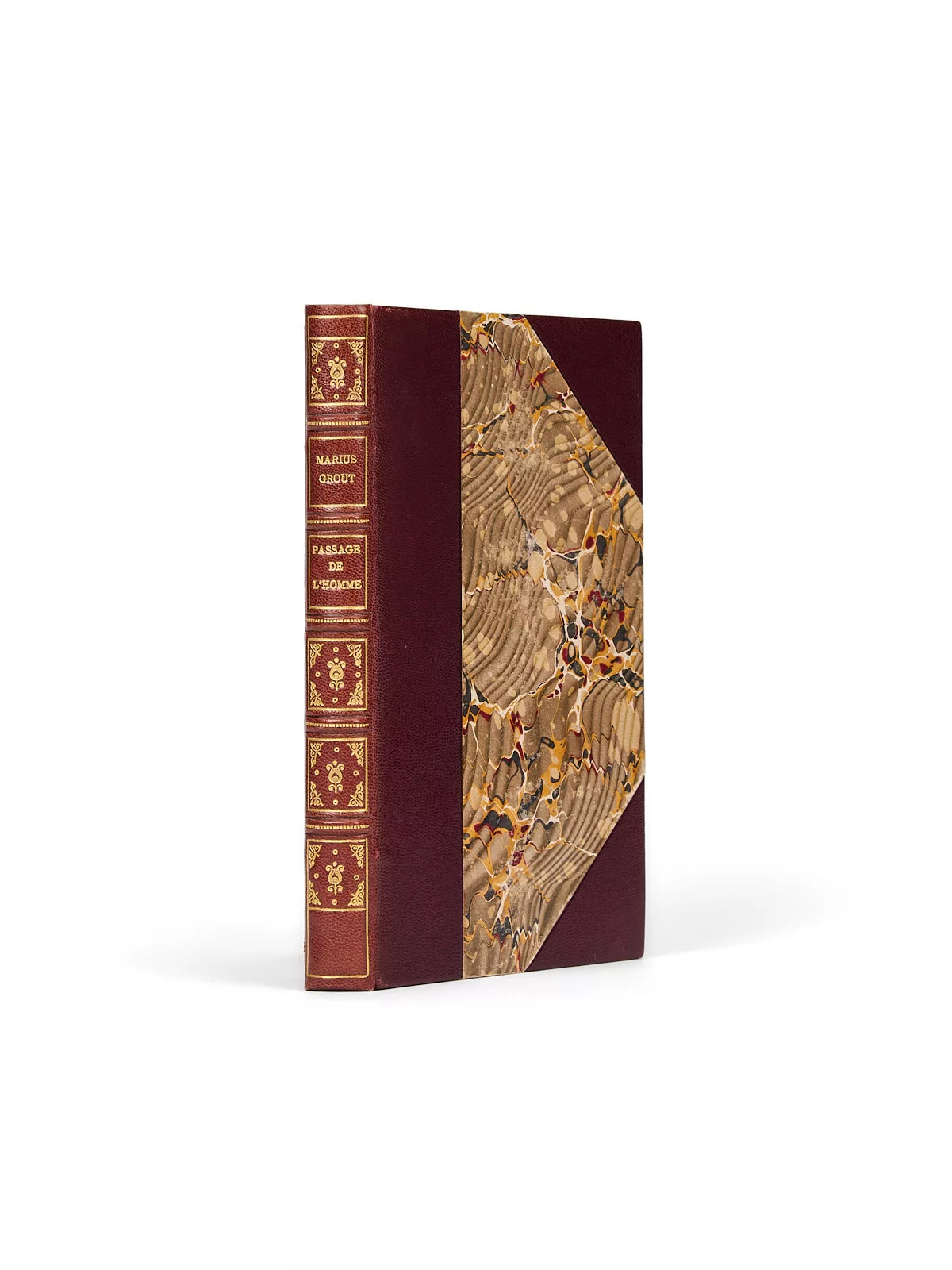

Passage de l’homme
Printed review copy.
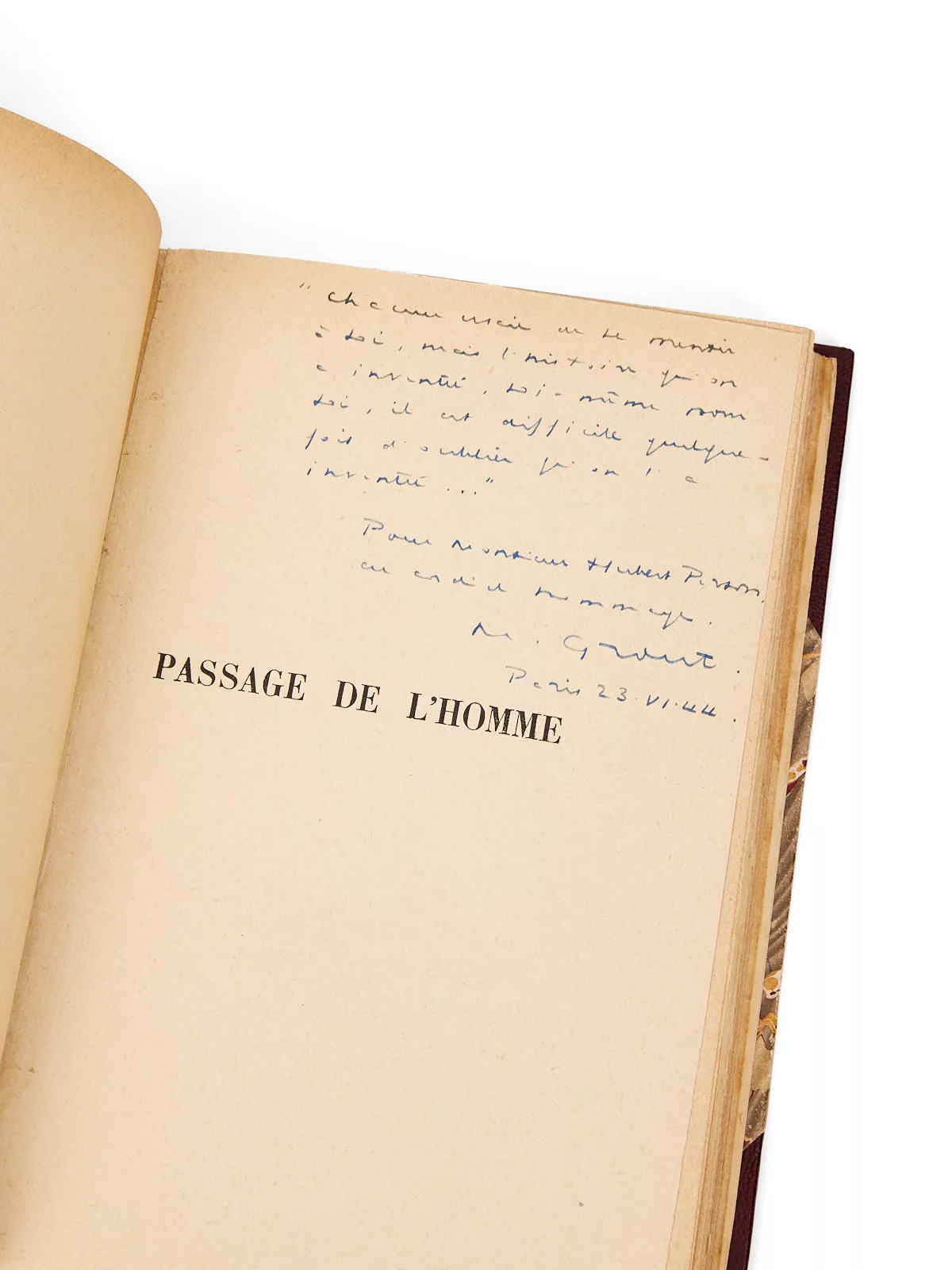
Signed presentation inscription with an added quotation: “Pour Monsieur Hubert Person, en cordial hommage. M. Grout, Paris, 23.VI.44.”
Despite wartime restrictions, the Académie Goncourt continued its deliberations and awarded its prize to Marius Grout (1903–1946), a Norman schoolteacher and spiritual essayist. Passage de l’homme, a novel of great metaphysical density, interrogates the human condition: a deeply pessimistic philosophical tale, written in a language at once sober and demanding: “All I know is that we must live, that we must burn our gods, all the false gods, those taught to us, those born of our dreams, of our own gaze upon ourselves, of our self-indulgence and our fears. (…) All that matters is to be there, seriously there. And not to lie. All that matters is to face things.”
It is easy to see why such a stance of non-engagement might have appealed in 1943, when the prize was awarded on 6 December 1943. But nothing about that year was normal: “the vote was held by correspondence, on 21 March. There was no longer any season. It was said that Simone de Beauvoir stood a good chance with L’Invitée (…) On the great day, she bought herself a new dress and waited nervously for the telephone call at the Café de Flore. Alas!” — for, to general surprise, the prize went to an almost unknown author, who died prematurely three years later, leaving behind a slender but fervent body of work, haunted by the search for the absolute. His early death contributed to making Grout one of the most discreet and forgotten laureates on the prize’s list. “For the third consecutive year since the beginning of the Occupation, Gallimard could rejoice” (Assouline, Du côté de chez Drouant).
Provenance: Hubert Person (with presentation inscription); Aubin; then Gérard Pouguet, with bookplate.