

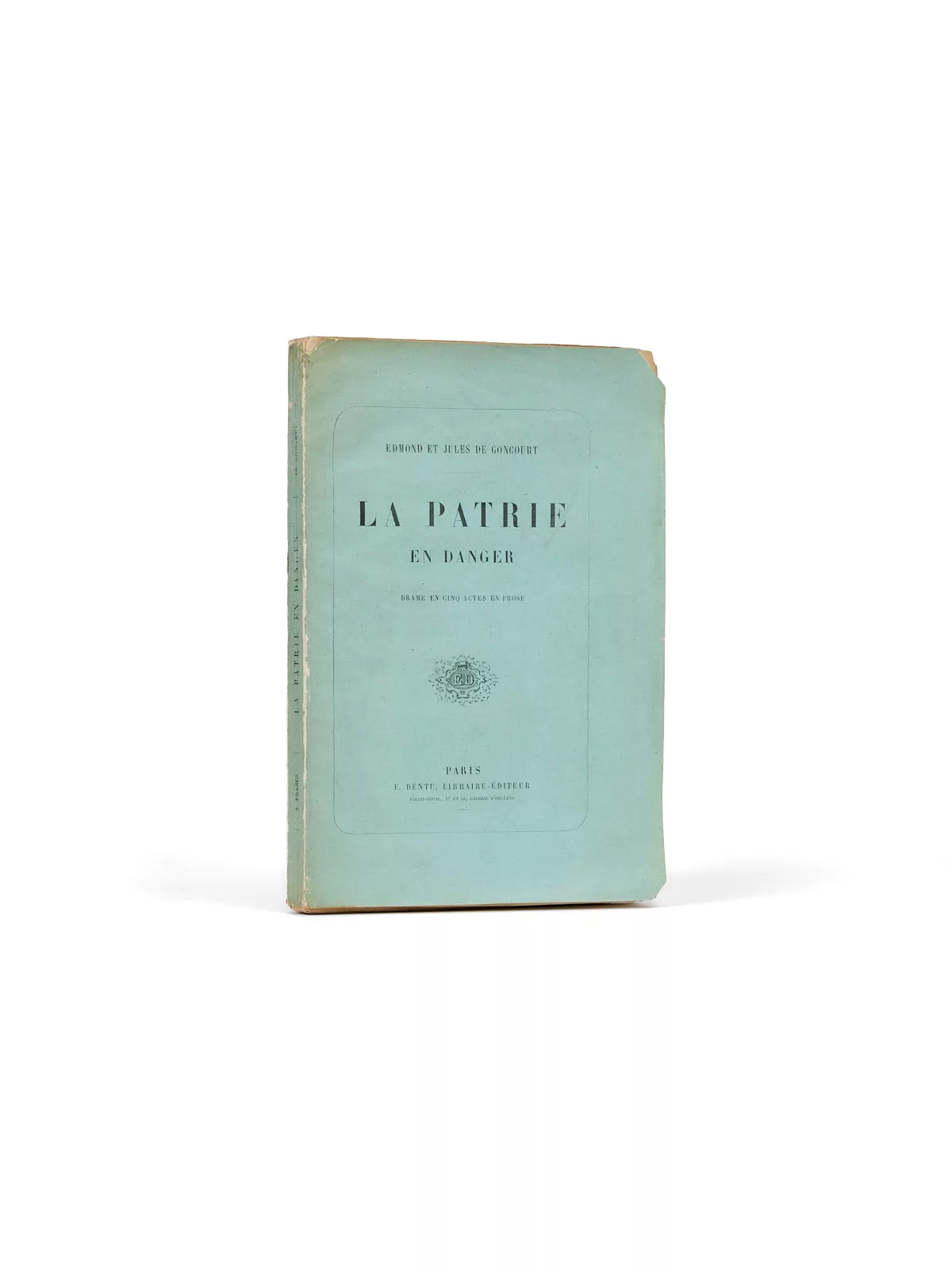
La Patrie en danger
It was on 27 December 1860, as recorded in their Journal, that the Goncourt brothers first mention their forthcoming “play of the Revolution,” originally entitled “Blanche de la Rochedragon.” Rejected by the Théâtre-Français in 1868, it was finally published in 1873 under its definitive title, La Patrie en danger (a “real” marquise de la Rochedragon having objected to the earlier name). Maupassant, who read it in 1879, praised it, saying it gave him “an intense desire to see this work on stage.”
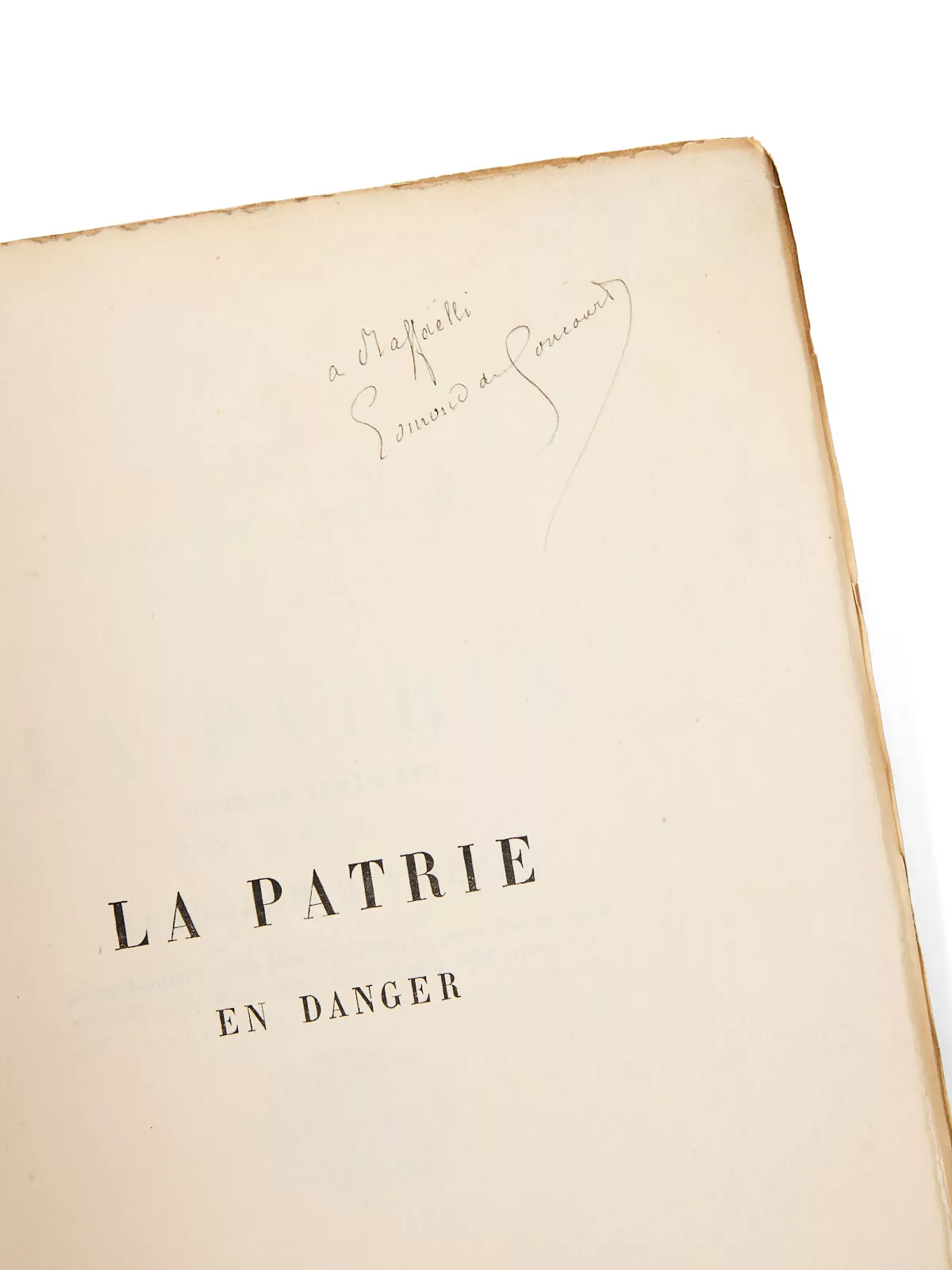
A rare deluxe-issue copy, with an interesting provenance. In Les Goncourt dédicateurs, Christian Galantaris recorded eleven inscribed copies of La Patrie en danger, including the present Raffaëlli copy. Within Galantaris’s census, this is the only inscribed copy printed on Hollande paper, despite other prestigious dedicatees such as George Sand, Charles Asselineau, Victor Hugo, Charles Monselet and Jules Claretie. This detail reveals the esteem in which Goncourt held Raffaëlli.
Since then, other inscribed copies have come to light: those of Alphonse Daudet, Poulet-Malassis and Ernest Renan, and one further Hollande copy, sent to Paul de Saint-Victor.
The Paul de Saint-Victor and Raffaëlli copies are therefore, to date, the only two inscribed copies on Hollande paper known.
Jean-François Raffaëlli was highly regarded by the Naturalists. He illustrated for them an important collection, Les Types de Paris (with texts by Zola, Huysmans, Goncourt and Maupassant), and in 1889, for the Goncourts, Germinie Lacerteux, with ten original etchings, in only three copies: a kind of “illuminated manuscript” avant la lettre, commissioned by the bibliophile Paul Gallimard, whose memory is recorded in the Journal des Goncourt: “Friday 21 June [1889]. — Lunch at Asnières, at Raffaëlli’s, with the Gallimards, to arrange and settle the illustration of the edition of Germinie Lacerteux (…). Raffaëlli’s home, a small bourgeois suburban house, with none of the usual bric-a-brac or china of studios, but where, set on an easel or hung here and there on the walls for viewing, in a prettily gilded frame, is a landscape of Asnières or Jersey, most often painted with Faber oil-based colored pencils, a landscape that looks like a fixed pastel. In this world of bibliophiles, this world of old-book devotees, Gallimard is truly a revolutionary, about to spend 5,000 francs to give himself, like some latter-day tax farmer, a modern deluxe edition all to himself…”
Provenance: Jean-François Raffaëlli (presentation inscription); Pierre Bérès (cat. 17, 1937, no. 130); Daniel Sicklès (sale XII, 1992, no. 4816).
Vicaire, III, 1055; Oberlé, 529; Galantaris, Les Goncourt dédicateurs, no. 343.