

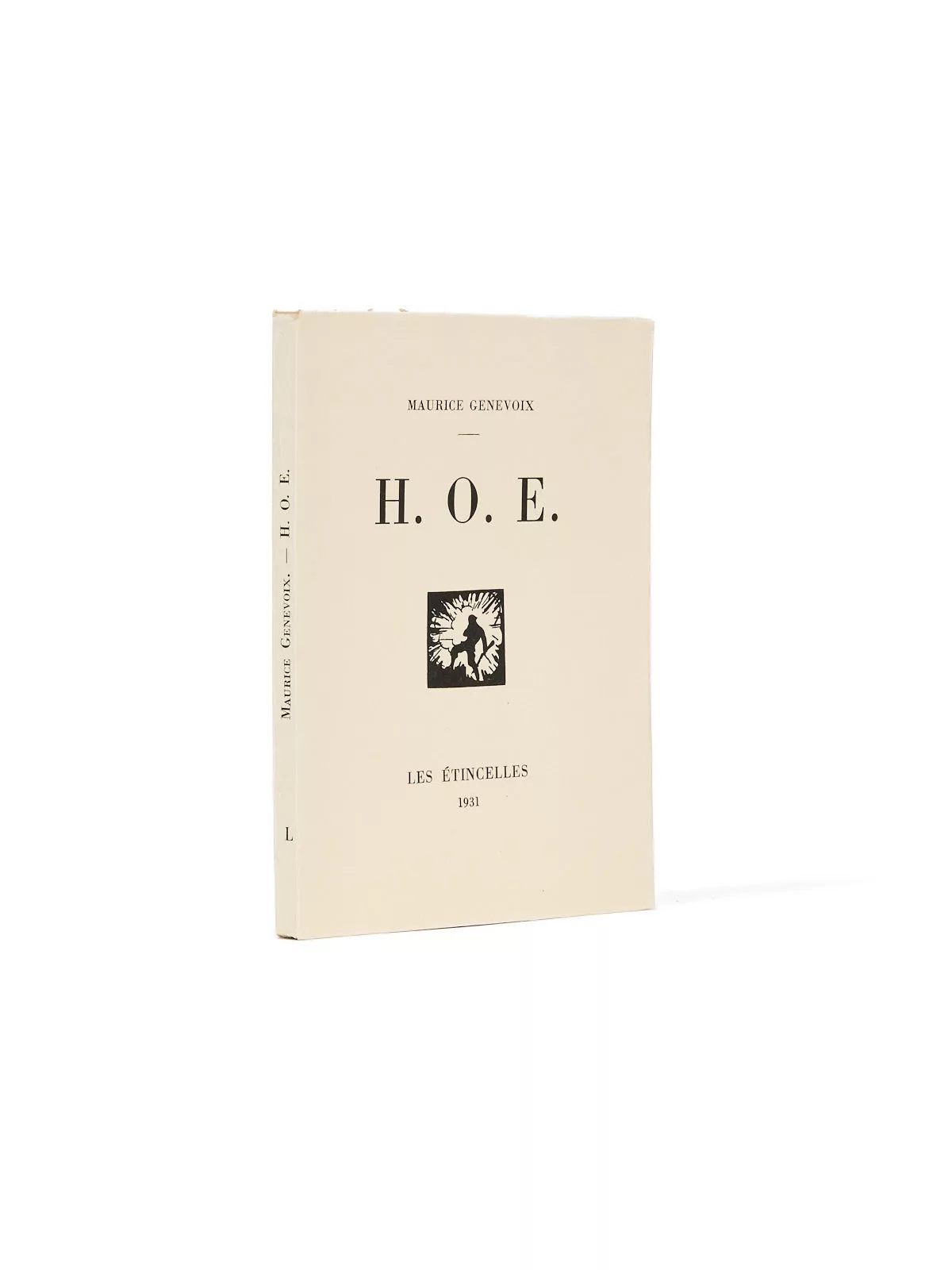
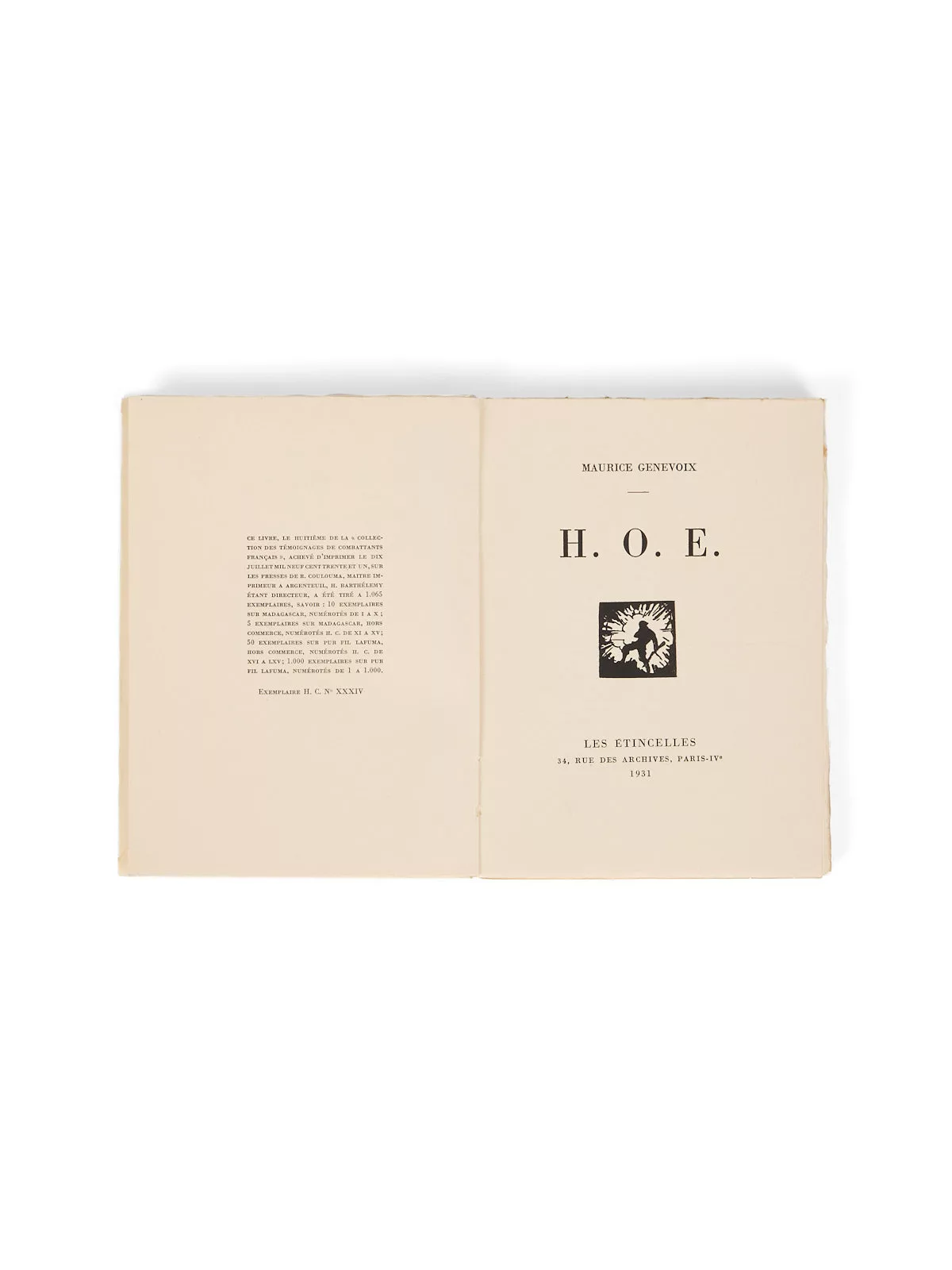
H.O.E.
One of 50 hors commerce copies on pur fil paper, after 15 deluxe copies on Madagascar paper (no. XXXIV).
Genevoix's own copy.
The publishing house Les Étincelles, which had brought out Norton Cru’s Témoins in 1929, immediately launched an ambitious series of “Témoignages de combattants français” [Testimonies of French Combatants]. Each title was entrusted to a different author, the spines of the volumes together spelling out the word “ÉTINCELLES.”
Only eight volumes appeared:
André Thérive, Frères d’armes
Jacques Meyer, La Guerre, mon vieux…
M. Constantin-Weyer, La Salamandre
Louis Thomas, La Gloire
Louis Guichard, La Bouée du Cliff
Jean Galtier-Boissière, Un hiver à Souchez
Gabriel Reuillard, La Prière des captifs
Maurice Genevoix, H.O.E.
This eighth volume was the last to appear; the letter on its spine, like those before it, was one of those meant to spell out “Étincelles.” A ninth volume, announced as Les Étoiles obscures by Henri Malherbe, never materialized.
In his contribution, Genevoix recalls the days following his severe wound of 25 April 1915, during the attack on the Tranchée de Calonne at the Butte des Éparges. The title H.O.E. refers to the Hôpitaux d’Origine d’Étapes, intermediate structures for evacuation and treatment. Genevoix was declared 80 percent disabled.
The text also describes the harsh return to civilian life, the silence of the survivors, and the central role played by veterans’ associations: throughout the interwar period, these associations exercised considerable influence, at times counting up to three million members. Apolitical, republican and without any activist agenda, Maurice Genevoix threw himself wholeheartedly into this movement, driven solely by the wish to bear witness. Survivors of the fighting recognized themselves in his words and rallied behind him.
The second set owned by Genevoix, after one inscribed by his fellow contributors. All the volumes bear the Vernelles bookplate.