


L’Âme du soldat
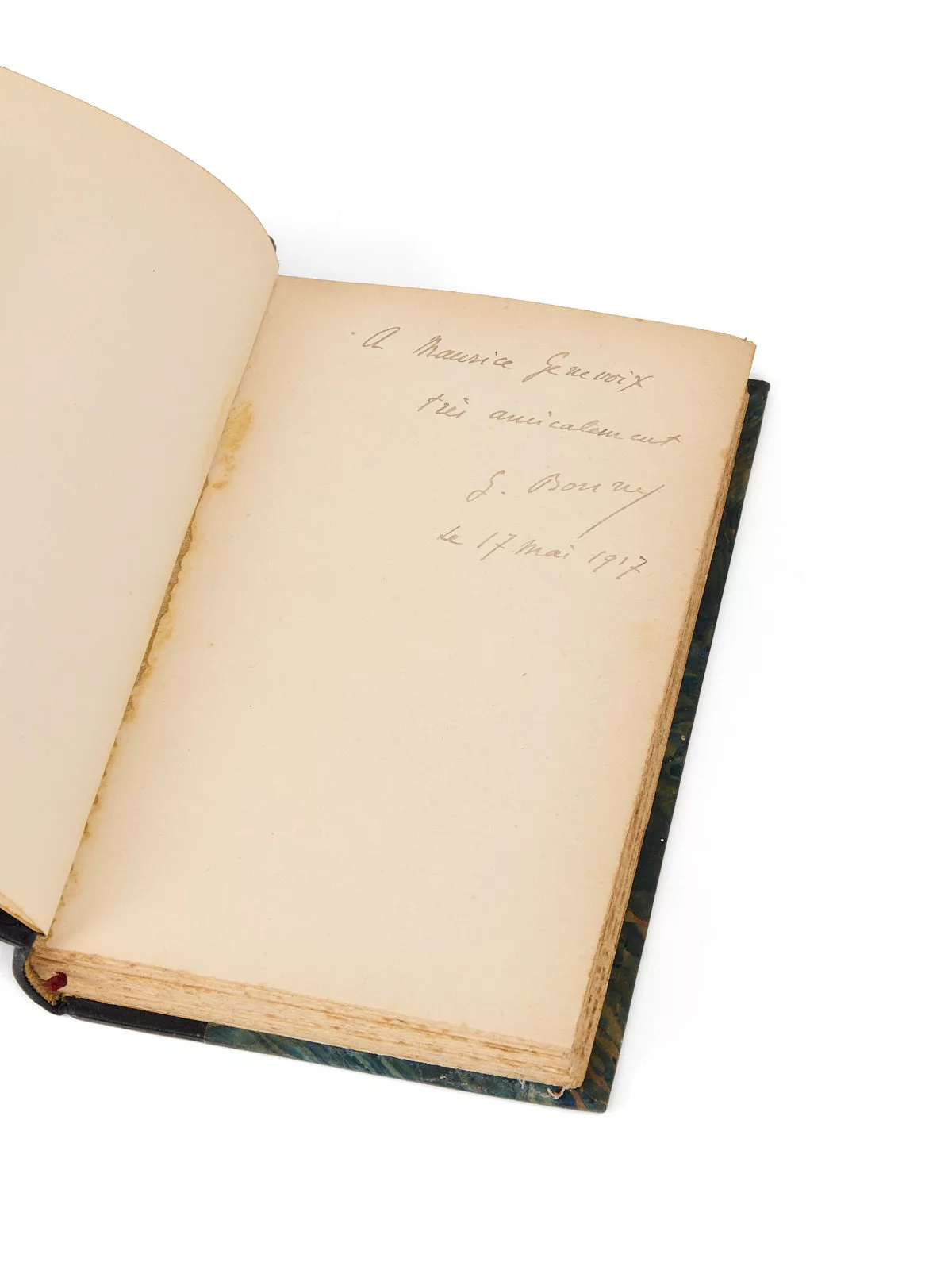
Signed presentation inscription: “À Maurice Genevoix, très amicalement, G. Bonnet. Le 17 mai 1917.”
Published in 1917 by Payot, a publishing house that would play a major role in disseminating war narratives, this account by Georges Bonnet attempts to draw a balanced portrait of the French soldier while rejecting the clichés of propaganda. It offers a more lucid — and for the time, daring — view of the German soldier, running counter to the usual caricatures:
“From the outset, it had been decided that the German was a deplorable soldier. Badly dressed, badly fed, without willpower and without courage, he was doomed to a certain, resounding and swift defeat. […] It has been acknowledged that German soldiers were better organized and better equipped than had been thought. But in the eyes of most people they remained individuals entirely devoid of qualities. […] Such is the ‘classic’ portrait of the ‘Boche.’” (L’Âme du soldat, p. 52).
This more nuanced, less nationalistic outlook earned the book a highly favorable mention in Jean Norton Cru’s Témoins, which regarded it as a testimony of great quality.
Bonnet’s subsequent career is more controversial. Elected a Radical-Socialist deputy in 1924, he held several ministerial posts during the 1930s: Minister of Finance in 1937, and above all Minister of Foreign Affairs between 1938 and 1939. He was one of the architects of a policy of appeasement toward Nazi Germany, signing a non-aggression declaration with Ribbentrop in Paris on December 6, 1938. An avowed supporter of Pétain, he voted full powers to the Marshal on July 10, 1940, and sat on the Conseil National of Vichy. On this account, Churchill reserved for him an uncompromising judgment in The Gathering Storm:
“Even outside the circles of government, many of us felt that Bonnet was the perfect embodiment of defeatism, and that all his skillful verbal maneuvers carried the sound of ‘peace at any price.’”
Exiled in Switzerland at the Liberation, he returned quietly to France in the 1950s and made an unsuccessful attempt at a political comeback in the 1967 legislative elections.
This 1917 volume nonetheless remains a testimony of considerable interest, notwithstanding the author’s later career, radically removed from Genevoix’s moral stance.