

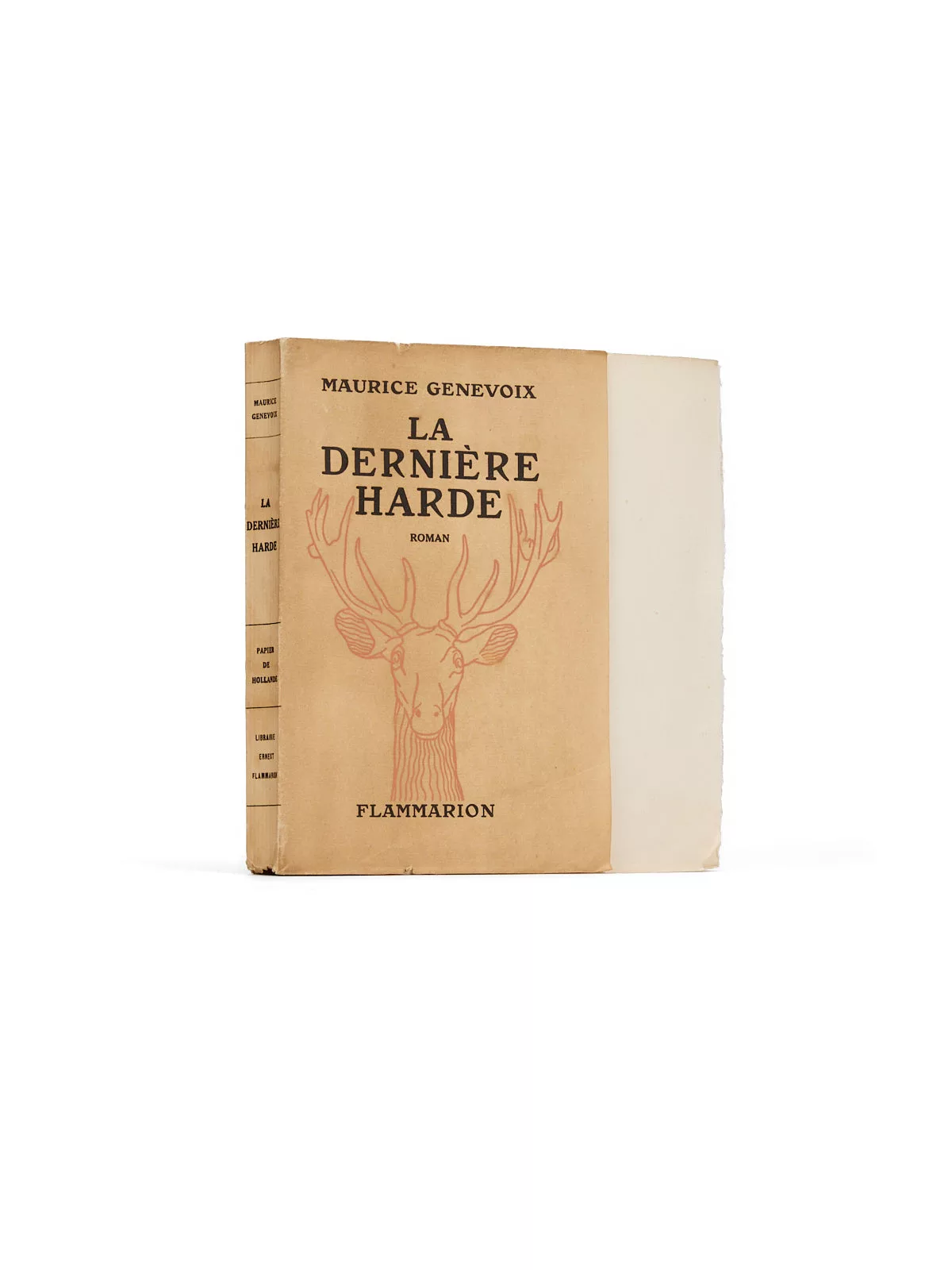

La Dernière Harde
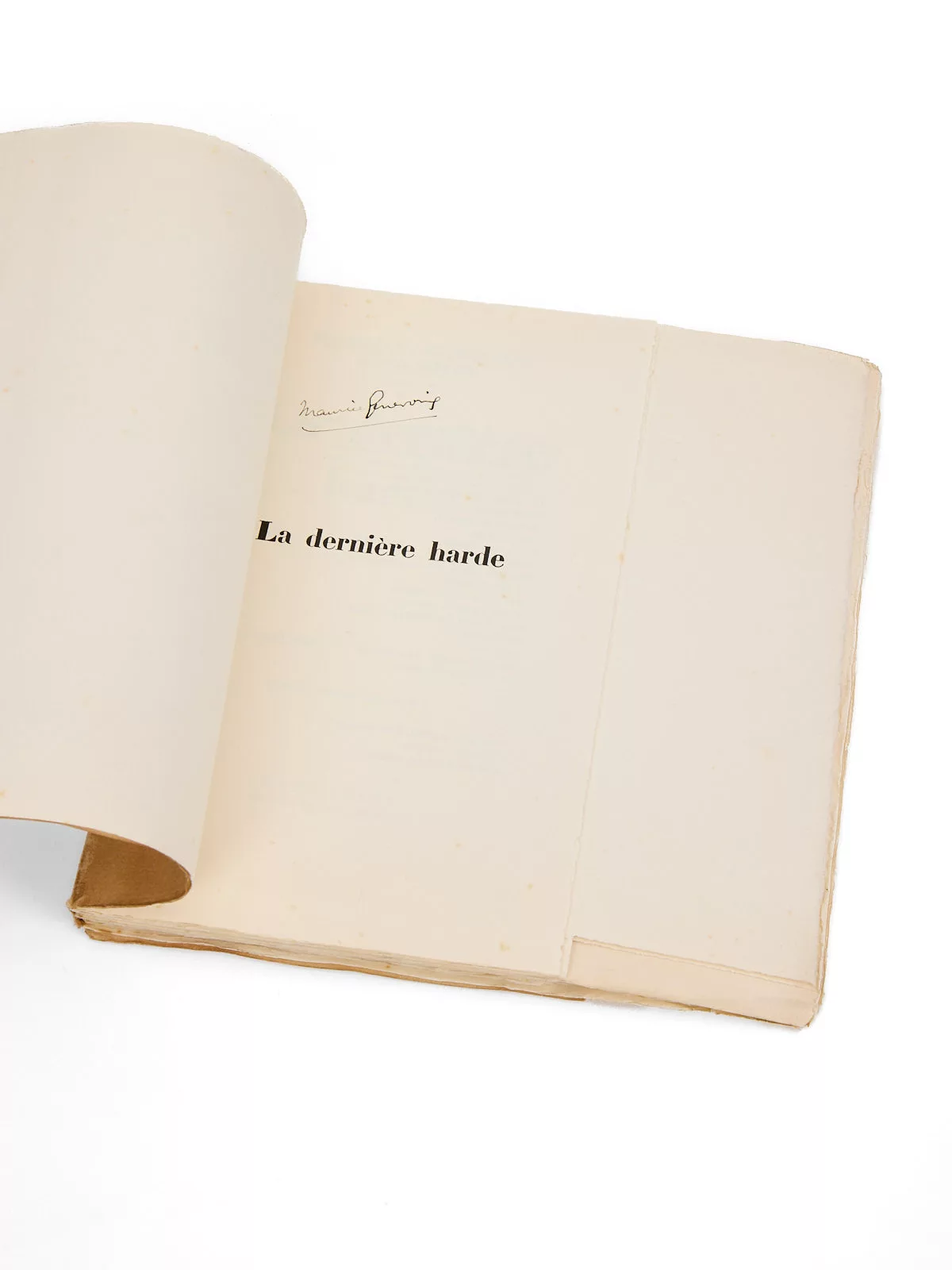
One of 10 copies on Hollande paper (no. 2).
The author's own copy, with his manuscript ownership inscription.
Published in 1938, La Dernière harde continues the vein of Raboliot (1925) and Forêt voisine (1933), works in which Genevoix celebrates the Sologne region and its inhabitants — men and animals alike. As Mireille Sacotte has shown (La Dernière harde, Garnier-Flammarion edition), “despite the hymn to life at the center of the work, it is death that ultimately triumphs.” For a man who had witnessed the slaughter of 1914–18, the novel reads as a warning of the inevitable return of killing — a grim premonition borne out by the Second World War, which broke out less than a year after the novel’s publication. In this sense it can be compared to Ernst Jünger’s On the Marble Cliffs, another prophetic novel-poem sensing the shadow of coming evil.
On publication, the book was praised by critics for the power of its descriptions and the density of its prose. The press hailed it as one of the high points of Genevoix’s naturalistic and poetic vein, with Le Mercure de France praising “a book of poignant intensity, in which the author of Raboliot gives the forest a voice worthy of ancient tragedy.”
Maurice Genevoix finished writing the novel on 16 February 1938. A few months later, on 9 November, he was struck by the premature death of his wife, Yvonne Montrosier, whom he had married in 1937. She was only thirty. To combat the solitude that overwhelmed him, Genevoix set out on a lecture tour across Canada, leaving France on 25 March 1939. After two months in eastern Canada, he made a long railway journey to the opposite coast and Vancouver, punctuated by stops in major cities where he addressed audiences gathered by the Alliance Française.
From this long stay he drew five short stories, a novel and a travel journal, published respectively in 1942, 1944 and 1945 under the titles Laframboise et Bellehumeur, Eva Charlebois and Canada. They were gathered in a collected edition in 1980 under the charming title Je verrai, si tu le veux, les pays de la neige.
From the library of Maurice Genevoix, with bookplate.