

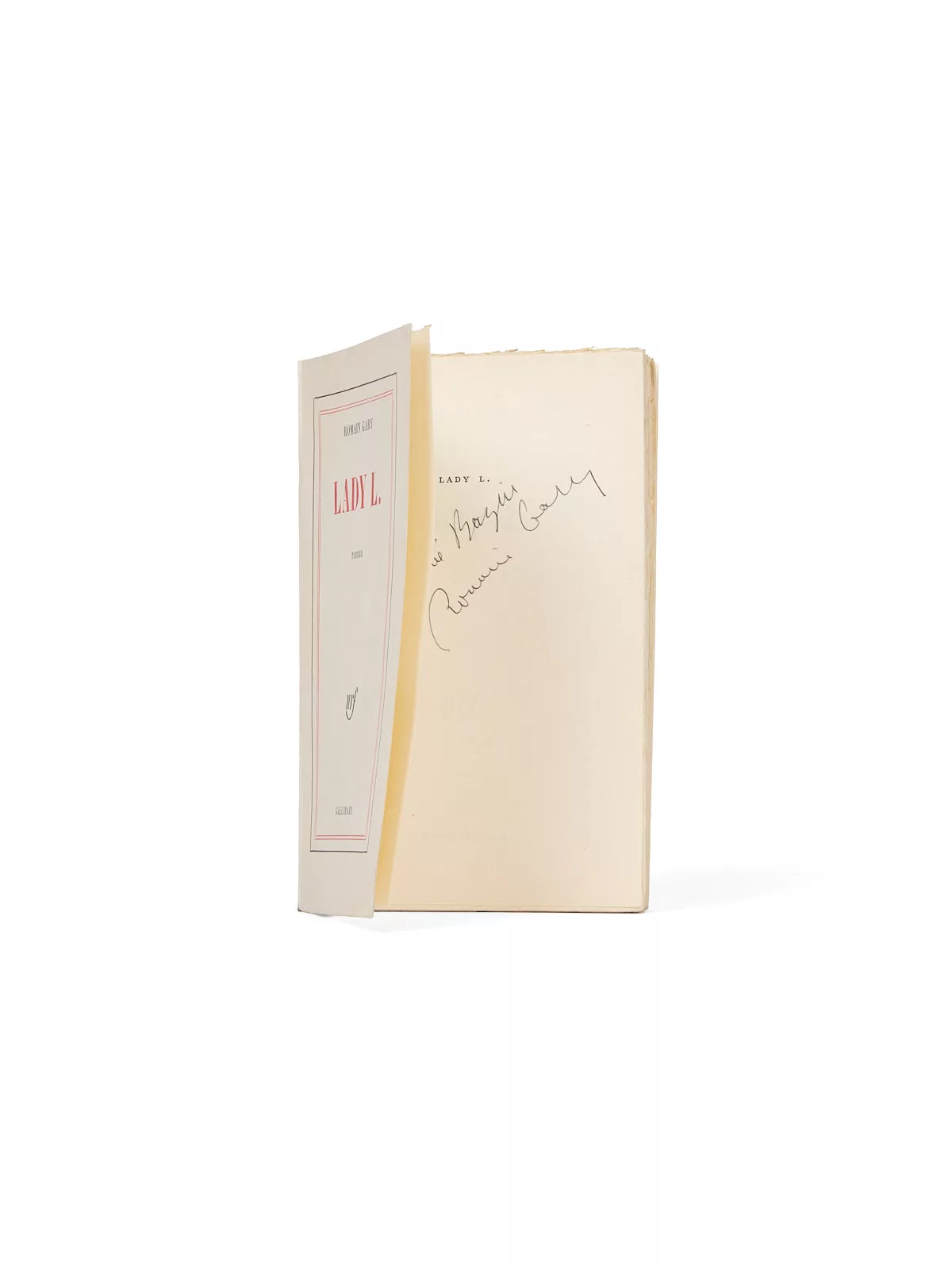
Lady L.
Signed presentation inscription: “À Hervé Bazin - Romain Gary.”
Lady L. was the first novel Gary wrote directly in English, and thus the first in any language other than French.
When Lesley Blanch met Romain Gary in 1944, she had just turned forty, on the day of the Normandy landings. An editor at Vogue, where she had overseen features since 1937, this elegant and witty London writer, of undeniable literary talent, was highly regarded in fashion circles. They married on April 4, 1945. A few months later, a diplomatic career opened up for Gary. A devoted wife, she accompanied him from posting to posting — Sofia, Bern, Paris, New York and Los Angeles — and taught him her language to perfection. “His much-admired English accent,” she noted, “gained an extra charm from the Russian rolled r’s that Romain added to it. He had acquired a perfect pronunciation; only the timbre of his voice, that deep, husky timbre, kept something Slavic about it.” Gary quickly gained fluency, to the point of writing four novels directly in English: Lady L. was the first, in 1958 (translated in 1963), followed by The Talent Scout (1961), The Ski Bum (1964) and The Gasp (1973). Gary also translated La Promesse de l’aube, La Tête coupable and White Dog entirely himself, and was closely involved in the translations of Colors of the Day, The Roots of Heaven, A European Education, The Dance of Genghis Cohn and Europa — and, indirectly, through Ajar/Pavlowitch, in that of Momo.
A fine copy of distinguished provenance: it is inscribed to Hervé Bazin, who since 1960 had been a member of the Académie Goncourt, elected to the seat of Francis Carco, who had himself voted four years earlier for Romain Gary and Les Racines du ciel. Bazin would become president of the Académie in 1973 and, unknowingly, crown Gary a second time in 1975 with La Vie devant soi.